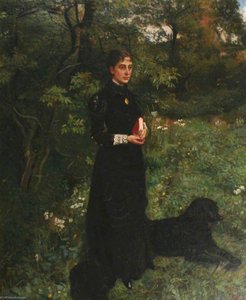
William Edward Milner: A Victorian Observer of Rural England
The late Victorian era, a period of rapid industrialization and social change in Britain, witnessed a fascinating shift within the art world. While grand historical paintings and opulent portraits continued to hold their place, a burgeoning interest emerged in depicting everyday life – the lives of ordinary people amidst the landscapes they inhabited. Within this movement stood William Edward Milner (1849-1895), a Lincolnshire artist whose evocative scenes of rural England offer a poignant glimpse into a vanishing world. Born in Gainsborough, a town steeped in agricultural tradition, Milner’s artistic journey was inextricably linked to his birthplace and the rhythms of its countryside.
Milner's early life provided him with an intimate understanding of the region’s visual landscape. His father, also named William Millner, was a respected teacher and artist himself, instilling in young William not only technical skills but also a deep appreciation for the natural world. This familial legacy proved crucial; it wasn’t merely that Milner inherited artistic talent, but rather a profound connection to the land and its people – a connection that would profoundly shape his work. Initially pursuing a career as a draper, he transitioned into painting around 1845, driven by a desire to capture the essence of his surroundings with greater fidelity than mere commercial depictions could offer.
The Palette of Rural Life
Milner’s artistic style is often described as realist, yet it transcends simple documentation. He possessed a remarkable ability to imbue his scenes with atmosphere and emotion, capturing not just the outward appearance of a landscape or a rural activity but also the underlying mood – a sense of quiet contemplation, melancholy, or even a subtle hint of foreboding. His compositions frequently feature figures engaged in commonplace tasks: farmers tending their fields, children playing in streams, laborers loading produce for market. These aren’t heroic narratives; they are snapshots of ordinary lives, rendered with meticulous detail and a sensitivity to light and color.
His use of color is particularly noteworthy. Milner favored muted earth tones – browns, greens, ochres – reflecting the palette of the Lincolnshire countryside. He skillfully employed atmospheric perspective, creating a sense of depth and distance through subtle variations in tone and hue. Light plays a crucial role in his paintings, often casting long shadows and illuminating details with a soft, diffused glow, evoking the golden light of early mornings or late afternoons. His work is reminiscent of artists like George Chinnery, who also captured the essence of rural life with remarkable realism and sensitivity.
Notable Works and Recognition
Among Milner’s most celebrated works are “Spot & His Friend” (1895), a tender depiction of a boy and his dog in a pastoral setting; "Preparing for Market, a Man and a Boy Loading Rhubarb" (1890), which captures the laborious routine of rural life with poignant detail; and “Will he come,” a haunting image of a solitary figure contemplating a distant landscape. These paintings, along with several others, were exhibited at the Royal Academy in London and garnered considerable critical acclaim during his lifetime. His work was also featured in the Birmingham exhibition of modern artists in 1844, where he was lauded for his “promise” as an artist.
In 1847, Milner’s paintings were showcased at the Gainsborough Art Union Draw, a significant event that further cemented his reputation within the local art community. The sale of these works demonstrated a strong public interest in his work and highlighted the growing appreciation for genre painting as a legitimate form of artistic expression.
Legacy and Historical Significance
William Edward Milner’s contribution to Victorian art lies not in grand historical narratives or revolutionary stylistic innovations, but rather in his quiet, observant portrayal of rural England. He captured a fleeting moment in time – a world on the cusp of profound change – with remarkable sensitivity and skill. His paintings offer a valuable window into the lives of ordinary people during a pivotal era in British history, reminding us of the enduring beauty and significance of the countryside.
Today, Milner’s works are housed in public collections, including Gainsborough Old Hall Museum, ensuring that his evocative scenes continue to resonate with audiences. His legacy as a skilled realist painter and a keen observer of human nature endures, solidifying his place as an important figure in the history of British art.


 Peržiūrėti realaus dydžio版
 Pasidalinti
 Dalintis
 Išsamiau
 Vadovas

 Atsisiųsti
 Panašūs eksponatai
 Rentgeno spindulių nuotrauka
 Automatinė diorama
 Q&A
Q&A Statistika

 Skaityti daugiau
 Perjungti į spausdinamus版作品





































 Stiklo variantas prieinamas tik pasirinkus dydį iki 110 cm