Rankiniu būdu tapytas aliejus ant droblio jūsų pageidaujamame dydį ir rėmuose – mūsų menininkų darbas pagal užsakymą. ( Pirkti spaudinį Pirkti vaizdą)





























Pasirinkite iš mūsų nustatytų dydžių, atitinkančių originalaus meno kūrinio proporcijas.

Galite įvesti savo matmenis, kad jie atitiktų konkretų rėmą ar erdvę. Jei pasirinktas dydis neatitinka originalaus paveikslėlio proporcijų, mes arba apkropsime meno kūrinį, arba papildysime tapybą rankomis dažytい elementais. Prieš pradėdami gamybą, jūsų patvirtinimui atsiųsime skaitmeninį maketą.
Atkreipkite dėmesį, kad ekrane rodomas vaizdas neatspindi tikrojo apkarpymo ar papildymo. Tik maketas tiksliai parodys galutinę kompoziciją.
Nors galima rinktis ir individualius dydžius, rekomenduojame pasirinkti matmenis iš nustatytos sąrašo, kad būtų išlaikytos originalios proporcijos.
Pristatymas visame pasaulyje () per 3–4 savaites, o ne įprastai – per 5 savaites. (6 rugsėjis). Kokybė lieka nepakeičiama.


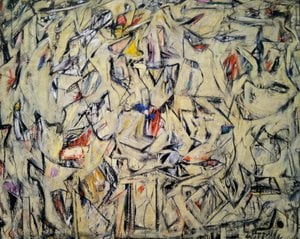
Whose Name Was Writ in Water
Reprodukcijos matmenys
Willem de Kooning's "Whose Name Was Writ in Water," painted in 1975, is a powerfully evocative work that encapsulates the core tenets of Abstract Expressionism – a movement he helped define. This close-up view reveals not just paint on canvas, but a visceral outpouring of emotion and a deliberate disruption of traditional artistic representation. The painting’s dynamism stems from de Kooning's masterful manipulation of color and texture, creating a surface that seems to writhe with energy. Dominating the composition are bold strokes of red and blue, interwoven with strategic accents of green, yellow, and white – colors he frequently employed to convey intense psychological states. The title itself, “Whose Name Was Writ in Water,” adds another layer of complexity, hinting at themes of memory, loss, and perhaps even the elusive nature of identity.
De Kooning's technique is immediately apparent in this piece. The application of paint is anything but smooth; it’s deliberately rough, fragmented, and layered. Thick impasto – built-up areas of heavy paint – creates a tactile surface that demands attention. He employed a vigorous, almost violent brushstroke, often applying the paint with a palette knife as much as with his brushes. This technique wasn't simply about creating an image; it was about imbuing the canvas with feeling. The visible brushstrokes aren’t accidental; they are deliberate marks of energy and struggle, reflecting de Kooning’s own turbulent emotional landscape. The close-up view allows us to appreciate the sheer physicality of his process – a testament to his commitment to expressive abstraction.
"Whose Name Was Writ in Water" was created during a pivotal moment in art history, roughly halfway through de Kooning’s career. Following his early figurative work, particularly his iconic "Woman" series, he increasingly embraced abstraction, though always retaining a raw, almost confrontational quality. This painting reflects the broader trends of Abstract Expressionism – a movement born out of the anxieties and uncertainties of post-World War II America. Artists like de Kooning sought to express fundamental human emotions through non-representational forms, rejecting traditional notions of beauty and harmony. De Kooning’s work stands as a crucial bridge between his earlier explorations of figuration and his later, more purely abstract endeavors, showcasing the evolution of one of art's most influential figures.
The title itself is laden with potential symbolism. "Writ in Water" suggests something fleeting, ephemeral – perhaps a memory fading away or an attempt to capture a moment that’s inherently unstable. The dominant colors—red for passion and violence, blue for melancholy and introspection—contribute to the painting's overall mood of unease and intensity. Ultimately, “Whose Name Was Writ in Water” is not about literal representation; it’s about conveying an emotional state – a feeling of disorientation, struggle, and perhaps even a desperate search for meaning. It invites viewers to confront their own anxieties and grapple with the complexities of human experience.


1904 - 1997 , Nyderlandai

Atraskite 10 legendinių abstraktus ekspresionizmo kūrinių! Pažinkite Pollocko, Rothko ir kitų genijų istorijas bei jų spalvingas meno interpretacijas. Puikios meninės reprodukcijos jūsų namams – WahooArt.com

Journey through Wassily Kandinsky's 25 most iconic abstract paintings. Explore his revolutionary use of color, form & spiritual expressionism. Find museum-quality Kandinsky reproductions and elevate your home decor with WahooArt.com. Discover all masterpieces on WahooArt.com!

Atraskite 25 įspūdingiausius Francisco Goya šedevrus! Ispanų romantizmo meistro paveikslai, portretai ir juodoji tapyba. Įkvėpkite interjerui su aukštos kokybės Goya reprodukcijomis | WahooArt.com

Immerse yourself in the captivating world of slate blue! Explore 10 iconic paintings by Monet, Van Gogh & Renoir. Discover their stories, techniques & find museum-quality art reproductions for your home at .

Explore the evolution of Willem de Kooning's iconic Abstract Expressionist paintings. Discover his signature style, key themes & investment potential with expert insights for discerning art collectors.

 Peržiūrėti realybėje
 Pasidalinti
 Dalintis
 Išsamiau

 Atsisiųsti
 Panašūs eksponatai
 Rentgeno nuotrauka
 Automatinė diorama

 Skaityti daugiau







 Stiklo variantas prieinamas tik pasirinkus dydį iki 110 cm