A Quiet Resonance in the Heath
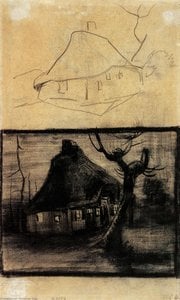
In the vast, often turbulent biography of Vincent van Gogh, there exist rare, quiet moments of profound stillness that offer a window into his developing soul. “Tabernacle in the Heath,” created in 1886, is one such masterpiece of restraint. During his formative years in Paris, while the art world was beginning to vibrate with the frenetic energy of Impressionism, Van Gogh found himself deeply anchored in the traditions of Realism. This delicate pencil and wash drawing captures a modest, thatched-roof house nestled within a tranquil landscape, serving as a poignant testament to his unwavering dedication to capturing the essence of rural life. The scene is not one of grand drama, but of an understated, earthy dignity that speaks to the very heart of the Dutch vernacular tradition.
The composition invites the viewer into a world of solitude and peace, far removed from the psychological storms that would later define his most famous oil paintings. Through meticulous attention to detail, Van Gogh renders the textures of the thatched roof and the surrounding grasses with an honesty that feels almost tactile. There is a rhythmic quality to his lines—a subtle precursor to the expressive, swirling energy of his later works—that breathes life into the inanimate structures of the heath. The presence of two small figures, positioned quietly within the landscape, adds a layer of human connection to the scene, suggesting a harmonious coexistence between man and the natural world.
The Mastery of Line and Earthly Tones
Technically, this work showcases Van Gogh’s incredible command over monochromatic media. Utilizing pencil, ink, and wash on paper, he achieves a depth of field that belies the simplicity of his tools. The artist employs bold, deliberate lines to delineate forms, creating a sense of structural permanence for the house, while softer washes allow the landscape to recede into a misty, atmospheric distance. This interplay between sharp definition and soft diffusion creates a sense of movement within the stillness, mirroring the subtle shifts of light across a windswept plain.
For the discerning collector or interior designer, this piece offers a sophisticated palette of earthy tones and structural elegance. It possesses a timeless quality that allows it to integrate seamlessly into diverse decor styles, from rustic farmhouse aesthetics to modern minimalist galleries. The artwork does not demand attention through garish color, but rather earns it through its profound emotional depth and technical precision. To possess a high-quality reproduction of this work is to bring a sense of historical gravity and serene contemplation into a living space, providing a focal point that encourages reflection and quietude.
A Legacy of Sincerity
Beyond its aesthetic merits, “Tabernacle in the Heath” serves as a vital historical document. It captures a pivotal moment in art history when the gritty, unvarnished truth of Realism began to merge with the emotional intensity of Post-Impressionism. In this drawing, we see the seeds of the genius that would eventually transform the way humanity perceives color and emotion. The simplicity of the subject matter—a mere house in a field—is elevated by Van Gogh’s ability to imbue the mundane with a sense of the sacred.
For those who find beauty in the authentic and the unadorned, this artwork stands as an enduring symbol of sincerity. It reminds us that even in the most modest settings, there is a profound beauty waiting to be discovered by those with the eyes to see it. Whether viewed as a study of light and texture or as a window into the early mind of a master, this piece remains an essential cornerstone for any serious appreciation of Van Gogh’s transformative journey through the landscape of human experience.



 Peržiūrėti realaus dydžio版
 Perjungti į spausdinimą
 Siųsti
 Dalintis
 Išsamiau
 Gidas
Gidas

 Atsisiųsti
 Panašūs eksponatai
 Rentgeno spindulių nuotrauka
 Diaporama
 Statistika

 Rodyti daugiau






































 Stiklo variantas prieinamas tik pasirinkus dydį iki 110 cm