Gaukite spausdinimui paruoštą failą, kurio kokybė gerokai viršija internetinę peržiūrą. Kiekvienas mūsų parduodamas skaitmeninis vaizdas yra ištrauktas iš aukštos raiškos pagrindinio failo mūsų duomenų bazėje — paprastai jis siekia nuo 5 000 iki 15 000 pikselių plotio — todėl galite drąsiai spausdinti didelius formatus, apkirpti vaizdą ar reprodukcija užtikrins visas smulkias detales.
Mūsų studijoje nė viena kopija nelieka neapdorota. Skaitmeninio vaizdo ekspertas, lygiu su originaliu paveikslu, patikrina spalvas ir, jei reikia, jas koreguoja, o tada profesionaliais retušavimo įrankiais padidina aiškumą bei detales — visada išlaikydamas ištikimybę autoriaus teptuko traukoms ir stiliui. Rezultatas – vaizdas, kuris atrodo kaip tikras paveikslas, o ne kaip su filtrais apdorotas skenavimas.
Patvirtinate prieš užsakymo pabaigą: mūsų ekspertas per 72 valandas el. laišku atsiųsta vaizdą jūsų peržiūrai. Nepasitenkinate rezultatu? Paprašykite patobulinimų ar pataisymų arba prašykite pinigų grąžinimo, jei kokybė neatitinka jūsų lūkesčių.
Ši kokybė yra patikima leidybos įstaigoms, dizaino studijoms, galerijoms ir spaudos įmonėms.
Atsisiųskite didelės raiškos failą asmeniniam naudojimui, spausdinimui ir kūrybiniams projektams. ( Perjungti į spausdinamus版作品 Pirkti rankų darbo tapybą)
Pasirinkę WahooArt.com, jūs ne tik gaunate paveikslėlį – jūs gaunate profesionaliai patobudintą skaitmeninį kūrinį, sukurtą itin tikniai ir užtikrinantį pasitenkinimą. Štai viską, kas automatiškai pritékia jūsų užsakymui:
Jūsų aukštos raiškos skaitmeninis vaizdo failas bus išsiųstas el. paštu per 72 valandas nuo užsakymo – jis bus paruoštas naudoti be jokių papildomų veiksmų.
Jūsų meno kūrinys profesionaliai optimizuojamas naudojant pažangius dirbtinio intelekto įrankius ir rankinį redagavimą, užtikrinant maksimalią detalę, aiškumą ir spalvų tikslumą.
Atsitiktinai ištrytikote ar praradote savo failą? Nebijokite – bet kuriuo metu atsiųsime jį jums vėl nemokamai.
Mėgaukitės savo meno kūrynu be jokių muitinės mokesčių, įkainų ar pristatymo išlaidų – skaitiniai failai visada yra neapmokestinami.
Naudodami profesionalią įrangą ir spalvų valdymo sistemas, užtikriname, kad jūsų skaitmeninis vaizdas kuo tiksliau atspindėtų originalias spalvas.
Jei nebuvosite patenkinti įsigyto skaitmeninio vaizdo, mes jį tališkai koreguosime arba grąžinsime 100% sumą per 100 dienų – be jokių klausimų.
Nesitenkinate? Gaukite visą sumokėtą sumą per 100 dienų nuo skaitmeninio failo gavimo – be jokių papildomų klausimų.
Pirkti 3 nuotraukas – 10% nuolaida – Pirkti 5 – 15% nuolaida – Pirkti 10 ir daugiau – 20% nuolaida. Puikiai tinka kūrybiniams projektams, galerijoms bei agentūroms.
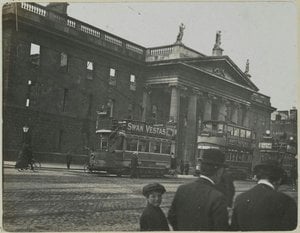
Thomas Johnson Westropp’s “Eden Quay” isn't merely a photograph; it’s a frozen moment in time—a visceral testament to the devastation wrought by the Easter Rising of 1916. Captured on May 17th, just weeks after Dublin endured the brutal bombardment of British forces during the rebellion, this monochrome image transcends documentation and becomes an emblem of loss interwoven with an undeniable spirit of defiance.
The composition is strikingly simple yet profoundly effective. A long, straight street dominates the frame, receding into a hazy distance—a deliberate choice that amplifies the sense of scale and underscores the immensity of the destruction surrounding it. Buildings loom large in the background, their facades scarred by explosions and fires, forming a jagged skyline that speaks volumes about the conflict’s destructive force. At the forefront stands a horse-drawn carriage, providing a grounding element against which the grandeur of ruin is contrasted.
Westropp's masterful use of light contributes significantly to the photograph’s mood. Diffused illumination softens shadows and minimizes harsh contrasts, fostering an atmosphere of solemn contemplation rather than dramatic spectacle. This understated lighting emphasizes textures—the rough cobblestones beneathfoot, the crumbling brickwork of the buildings—drawing the viewer into a detailed sensory experience.
Beyond its technical merits, “Eden Quay” resonates with powerful symbolic significance. The ruined buildings serve as poignant reminders of human vulnerability in the face of overwhelming power – a visual representation of fragility against the backdrop of historical upheaval. Yet, amidst the devastation, figures populate the sidewalk, symbolizing enduring life and resilience—a subtle but crucial element that elevates the photograph beyond mere depiction to profound contemplation.
Ultimately, “Eden Quay” compels us to confront not only the horrors of war but also the capacity for beauty to emerge from ruin. It’s a hauntingly evocative piece that invites viewers to consider themes of loss, memory, and the enduring spirit of humanity—a timeless image destined to inspire admiration and contemplation for generations to come.
Originalus kūrinys „Eden Quay“ saugomas Trinities koledžo Dublino biblioteka, o jo autorinė teisė yra yra viešosios erdvės dalis – jo autorinė teisė pasibaigusi.
Perceptinio ryškumo prasme, „Eden Quay“ – Thomas Johnson Westropp yra brilliant.
„Eden Quay“ – Thomas Johnson Westropp technika – Giclée Print, kūrybinė data – 1916.

Thomas Johnson Westropp was born on August 16, 1860, at Attyflin Park, Patrickswell, County Limerick, Ireland. His ancestors were landowners of English origin who had resided in the area since the mid-16th century. From a young age, Westropp displayed a keen interest in antiquities, meticulously documenting topography, ancient buildings, and folk life during family trips throughout neighboring counties.
He pursued higher education at Trinity College Dublin, earning an MA in 1882. He furthered his studies with a degree in civil engineering in 1885, subsequently apprenticing under Bindon Blood Stoney, who was overseeing the expansion and dredging of the Dublin port entrance.
Despite his initial training as an engineer, Westropp soon abandoned professional practice to dedicate himself fully to archaeological research. He became assistant surveyor for County Meath briefly but quickly prioritized his passion for uncovering Ireland’s past. For the remainder of his life, he focused on researching antiquities along the western seaboard of Ireland.
Westropp is renowned for his incredibly detailed sketches of buildings, grave slabs, and other archaeological remains found throughout Ireland. These drawings are not merely artistic representations; they serve as invaluable historical records. Many of these sketches are now preserved by the Royal Irish Academy.
His work extended beyond visual documentation to include the collection of folklore and local traditions, providing a rich tapestry of cultural insights into 19th and early 20th-century Ireland.
Westropp’s initial engineering training likely influenced his meticulous approach to documentation and precise rendering of architectural details. His mentor, Bindon Blood Stoney, a prominent engineer involved in significant infrastructural projects, instilled a sense of technical precision. However, it was his innate curiosity and passion for Irish history that truly shaped his artistic development.
His work can be seen as part of a broader movement of antiquarianism prevalent during the Victorian era, where there was growing interest in preserving and understanding historical artifacts and traditions.
Thomas Johnson Westropp died in 1922, leaving behind a substantial body of work that continues to be studied by historians, archaeologists, and folklorists today. His detailed sketches and meticulous notes remain essential resources for understanding Ireland’s rich past. He is remembered as a dedicated scholar who played a crucial role in preserving Irish cultural heritage.
His publications are widely accessible in libraries throughout the west of Ireland, ensuring his contributions continue to inspire future generations.

1860 - 1922 , Ireland
 Pasidalinti
 Dalintis
 Išsamiau
 Vadovas

 Atsisiųsti
 Panašūs eksponatai
 Automatinė diorama
 问答
问答
 Statistika


 Skaityti daugiau