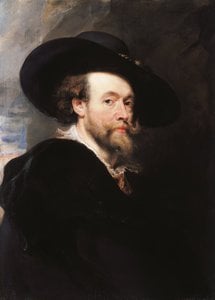
A Gathering of Minds: Peter Paul Rubens’ “The Four Philosophers”
Peter Paul Rubens' "The Four Philosophers," painted in 1602, isn’t merely a portrait; it’s a vibrant tableau vivant – a snapshot of intellectual fervor captured with breathtaking dynamism. This oil-on-canvas masterpiece, measuring 167 x 148 cm, transports us to a richly appointed chamber where the weighty matters of philosophy and learning are passionately debated. Rubens, a master of Baroque intensity, doesn’t offer a static representation but instead conjures an atmosphere brimming with animated discussion, inviting the viewer into this intimate circle of thinkers. The painting immediately draws the eye with its rich palette – deep reds, blues, and golds dominate, creating a sense of opulent warmth that contrasts beautifully with the cool light illuminating the scene.
The composition itself is a marvel of controlled chaos. Four men, identified as Peter Paul Rubens himself, his brother Philip Rubens, Justus Lipsius, and Joannes Woverius, are clustered around a substantial dining table, its surface scattered with books and partially consumed food – a deliberate detail suggesting the pursuit of knowledge often intertwines with sustenance and convivial exchange. Each figure is rendered with meticulous attention to detail; their gestures, expressions, and clothing speak volumes about their personalities and intellectual pursuits. Notice, for instance, Lipsius’s commanding presence, his hand raised in gesture as if mid-sentence, or the contemplative gaze of Woverius. The background, featuring a bust of Seneca – a key figure in Stoic philosophy – subtly reinforces the painting's central theme.
The Seeds of Neostoicism and Renaissance Influence
“The Four Philosophers” emerged during a pivotal moment in European intellectual history: the rise of Neostoicism. Founded by Justus Lipsius, this philosophical movement sought to revive the principles of Stoicism – emphasizing reason, virtue, and acceptance of fate – amidst the turmoil of religious and political upheaval. Rubens, deeply immersed in classical learning, skillfully incorporates these ideas into his depiction. The painting isn’t simply a record of a specific gathering; it's an embodiment of the Neostoic ideal of intellectual discourse as a path to wisdom and self-improvement. Rubens himself was a fervent admirer of classical antiquity, and this influence is evident throughout his oeuvre – from the careful study of anatomy to the dramatic use of light and shadow reminiscent of Caravaggio’s *tenebrism*.
Furthermore, the setting itself offers clues to the painting's context. The room’s abundance of books and paintings echoes the intellectual atmosphere of the burgeoning libraries and academies that were becoming increasingly prevalent in Renaissance Europe. Interestingly, there’s a subtle parallel with the Duluth Public Library, a modern institution designed to seamlessly blend library services with an art museum – a space dedicated to both knowledge and aesthetic appreciation. This deliberate juxtaposition highlights the interconnectedness of learning and beauty, a central tenet of Rubens' artistic philosophy.
Technique and the Baroque Master
Rubens’ mastery of oil paint is immediately apparent in the painting’s rich textures and luminous colors. He employed a technique known as *alla prima*, working directly onto the canvas without extensive underpainting, resulting in a remarkably fluid and vibrant surface. The use of loose brushstrokes creates a sense of movement and energy, capturing the dynamism of the conversation unfolding before us. The artist's ability to render human form with such anatomical accuracy – a skill honed during his early training – is equally impressive. Consider, for example, the way Rubens captures the folds of fabric, the subtle nuances of facial expression, and the weight of each figure’s body.
Rubens’ approach also bears resemblance to Johannes Vermeer's work, particularly in his use of light to create a sense of depth and realism. However, while Vermeer often favored a more subdued palette and intimate settings, Rubens embraces a grander scale and a more theatrical presentation. “The Four Philosophers” is a testament to Rubens’ versatility as an artist – a masterful blend of classical learning, Renaissance influences, and Baroque dynamism.
A Timeless Dialogue: Acquiring a Reproduction
For those captivated by the intellectual intensity and artistic brilliance of “The Four Philosophers,” Peter Paul Rubens: The Four Philosophers is now available as a meticulously crafted, handmade oil painting reproduction on WahooArt. This platform ensures that you receive a faithful representation of the original masterpiece, capturing its vibrant colors, dynamic composition, and profound sense of intellectual engagement. Whether displayed in your study, living room, or art gallery, this reproduction will serve as a constant reminder of the enduring power of human intellect and artistic expression.



 Peržiūrėti realaus dydžio版
 Perjungti į spausdinimą
 Siųsti
 Dalintis
 Išsamiau
 Vadovas

 Atsisiųsti
 Panašūs eksponatai
 Rentgeno spindulių nuotrauka
 Diaporama
 Statistika


 Rodyti daugiau