Muziejų lygio „giclée“ arba drobos spausdinimas: greita gamyba ir lankstios apdailos parinktys. ( Pirkti rankų darbo tapybą Perejti prie skaitmeninių vaizdų)





























Pasirinkite iš mūsų nustatytų dydžių, atitinkančių originalaus meno kūrinio proporcijas.

Įveskite jums reikiamą plotį ir aukštį, kad atvaizdas derėtų prie jūsų rėmo ar sienos. Spausdiną galima tik sumažinti, bet nepadidinti virš originalaus paveikslėlio dydžio, todėl keičiant proporcijas, dalis vaizdo prarandama. Prieš spausdinimą atsiųsime jums skaitmeninį maketą patvirtinimui. Šioje puslapio nuotraukoje matomas pjūvis nėra tikslus – jį rodo tik maketas.
Pristatymas visame pasaulyje () per 2 weeks, o ne įprastas 4/5 savaičių laikotarpis. (1 lapkritis)
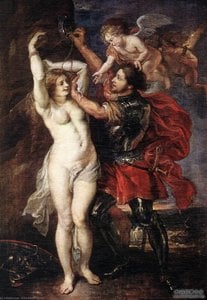
Andromeda
Reprodukcijos matmenys
In the grand theater of the seventeenth century, few moments capture the raw intensity of heroism and divine grace as exquisitely as Peter Paul Rubens’ Andromeda. Painted around 1638, this masterpiece serves as a breathtaking window into a world where myth and emotion collide with unparalleled vigor. The canvas transports the viewer to a perilous seascape, capturing the precise heartbeat of a rescue. We witness the legendary Andromeda, chained to jagged rocks as a consequence of her mother's pride, awaiting the arrival of Perseus. Rubens does not merely depict a scene from Virgil’s Aeneid; he engineers a spectacle where the turbulent ocean and the vulnerability of the human form create a palpable sense of drama that continues to captivate the modern eye.
The painting is a triumph of the Baroque style, characterized by its swirling energy and the masterful use of chiaroscuro. Rubens employs the interplay of light and shadow to heighten the emotional stakes, casting a luminous glow upon Andromeda’s skin while plunging the encroaching sea monster, Cetus, into much darker, more menacing tones. This technique creates a three-dimensional depth that makes the crashing waves feel almost audible. The composition is a dynamic vortex of movement; the muscular realism of the figures conveys both physical strength and psychological fragility, making the piece an essential study in the human condition under duress.
To behold this work is to witness the pinnacle of Flemish oil painting. Rubens’ technique involved a sophisticated process of layering thin, translucent glazes over a meticulous underpainting. This method allowed for an incredible luminosity, capturing the way light dances across Andromeda's drapery and reflects off the spray of the salt-heavy air. Every element, from the textured, weathered rocks to the powerful, feathered wings of Pegasus, is rendered with an anatomical precision that reflects the humanist ideals of his era. For the discerning collector or interior designer, such detail ensures that a high-quality reproduction retains the "inner warmth" and glowing skin tones that are the hallmarks of Rubens’ hand.
Beyond its visual splendor, the artwork is steeped in profound symbolism. Andromeda herself stands as a symbol of chastity and piety, her very presence a testament to endurance. In contrast, the approaching Perseus embodies the arrival of heroism and divine intervention, while the monstrous Cetus represents the chaotic forces of destruction. This duality between the sacred and the profane provides a narrative depth that elevates the painting from a mere mythological illustration to a complex philosophical statement.
Commissioned originally for the Spanish court by Philip IV, this work carries an inherent sense of prestige and historical grandeur. It is a piece that speaks of diplomacy, ambition, and the revival of classical glory. For those looking to curate a space with character, Andromeda offers more than just decoration; it offers a conversation piece. Whether placed in a grand library or as a focal point in a contemporary living space, the painting’s opulent color palette and dramatic movement provide an anchor of classical elegance.
Integrating a reproduction of such a monumental work allows an interior to breathe with the spirit of the Golden Age. It invites viewers to contemplate the eternal struggle between light and dark, heroism and vulnerability. For art lovers and decorators alike, Rubens’ Andromeda remains an inexhaustible source of inspiration, promising to transform any environment into a sanctuary of mythic beauty and historical depth.
„Andromeda“ Peržiūra interjere puslapio funkcija leidžia peržiūrėti kūrinį prieš užsakant.
Kūrinį „Andromeda“ sukūrė Pirė Petras Paulius Rubenas. Darbas katalogizuojamas Pirė Petras Paulius Rubenas vardu.
Įtvirtinta „Andromeda“ – Pirė Petras Paulius Rubenas nuotaika yra Romantic, o emocinis tonas – Romantic.


1577 - 1640 , Vokietija

Explore the breathtaking drama of the Baroque era. From the mastery of chiaroscuro to epic mythological narratives, discover a definitive guide to art's most powerful period of light, shadow, and emotion for the true classical art enthusiast.

Explore the breathtaking power of Baroque art. Delve into the dramatic interplay of light, shadow, and motion through the works of masters like Caravaggio. Discover how the era's intense emotional realism continues to inspire collectors and connoisseurs of classical grandeur.
 Peržiūrėti realaus dydžio版
 Pasidalinti
 Dalintis
 Išsamiau
 Vadovas

 Atsisiųsti
 Panašūs eksponatai
 Rentgeno spindulių nuotrauka
 Automatinė diorama
 Q&A
Q&A Statistika

 Skaityti daugiau









 Stiklo variantas prieinamas tik pasirinkus dydį iki 110 cm