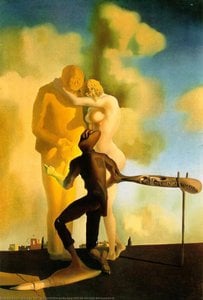
Harlequin, 1927
Salvador Dalí's Harlequin, painted in 1927, is a captivating work of art that showcases the artist’s early exploration into Surrealism. This iconic piece exemplifies Dali’s unique style and his ability to create dreamlike scenes with vivid imagery.
Background on Salvador Dalí
Salvador Domingo Felipe Jacinto Dalí i Domènech, Marquis of Dalí de Púbol, known globally as Salvador Dalí, was a Spanish painter, sculptor, and filmmaker who is best known for his contributions to the Surrealist movement. Born in Figueres, Spain, he began studying art at a young age and went on to attend the Royal Academy of Fine Arts in Madrid. It was during this time that Dali developed an interest in Cubism and Futurism, which would later influence his work as a Surrealist artist.
The Harlequin Figure
In Harlequin, Dali depicts the iconic figure of Pierrot, also known as Harlequin, from Italian commedia dell’arte. This character is often portrayed as a sad clown who pines for love but is ultimately rejected by his beloved Columbine. The use of this archetypal figure allows Dali to explore themes such as unrequited love and the human condition through a fantastical lens.
Style and Technique
Dalí's signature style can be seen in Harlequin, with its dreamlike imagery, distorted perspectives, and meticulous attention to detail. The painting features a central figure of Harlequin standing against a stark background, surrounded by various objects that seem to defy gravity or logic. This juxtaposition between reality and fantasy creates an otherworldly atmosphere that is characteristic of Dali’s work during this period.
- Visit WahooArt.com to explore more artworks by Salvador Dali and other renowned artists.
- Learn more about the Museo Nacional Centro de Arte Reina Sofía in Madrid, Spain, which houses an extensive collection of modern and contemporary art, including works by Salvador Dali.
Surrealism is a cultural movement that aims to revolutionize the human experience by exploring the subconscious mind.
Additional Research:
Harlequin (1927) - Salvador Dali - WikiArt.org
WikiArt describes “Harlequin” as a Surrealist painting created in 1927 by Salvador Dalí. It’s notable for its depiction of Pierrot, the melancholic clown from Commedia dell'arte, and its exploration of themes like desire and rejection within a fantastical setting.
Photo Description:
The image is a painting of a surrealistic scene featuring a man with a head that has been cut off. The man’s face appears to be made up of various body parts, including a hand and an eye. The painting also includes a chair in the background, which adds to the overall composition of the artwork.
The colors used in the painting are predominantly red and blue, creating a striking contrast between the two hues.
Overall, the image is a thought-provoking piece that challenges the viewer’s perception of reality.
Salvador Dalí: A Life in Surrealism
Salvador Domingo Felipe Jacinto Dalí i Domènech, Marquis of Dalí de Púbol, known globally as Salvador Dalí, was a Spanish surrealist painter born on May 11, 1904, in Figueres, Spain. He died on January 23, 1989, leaving behind a legacy that continues to captivate and challenge audiences worldwide.
Early Life and Education
Dalí’s early life was marked by a complex relationship with his father, which profoundly influenced his artistic themes and persona. He demonstrated artistic talent from a young age, receiving formal training at the San Fernando Academy of Fine Arts in Madrid. A pivotal moment occurred at 16 when he discovered modern painting, sparking an intense interest that led to his first public exhibition in 1919.
Artistic Development and Influences
Dalí’s artistic journey was a dynamic evolution shaped by several key influences:
- Cubism: Provided a foundation for deconstructing forms and perspectives.
- Futurism: Inspired Dalí's fascination with speed, dynamism, and technological advancements.



 Peržiūrėti realybėje
 Pirkti rankomis tapytą paveikslą
 Pasidalinti
 Dalintis
 Išsamiau

 Atsisiųsti
 Panašūs eksponatai
 Rentgeno nuotrauka
 Automatinė diorama
 Statistika

 Skaityti daugiau






































 Stiklo variantas prieinamas tik pasirinkus dydį iki 110 cm