Celestial Ride: A Surreal Descent into the Subconscious
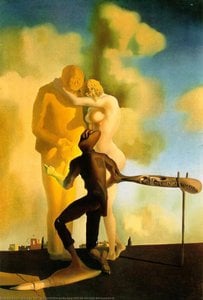
Salvador Dalí’s “Celestial Ride,” painted in 1957, isn't merely a landscape; it’s an immersive journey into the artist’s meticulously constructed dreamscape. This arresting work, rendered in oil on canvas, embodies the core tenets of Surrealism – a deliberate exploration of the subconscious mind, unbound by logic or reason. The scene unfolds with a captivating paradox: a colossal, vaguely bovine creature, reminiscent of both an ox and a bull, dominates the composition, its impossibly elongated legs reaching towards a swirling, ethereal sky. Suspended within this bizarre beast is a cubic structure, adorned with diminutive human figures – a visual representation of Dalí’s fascination with atomic theory and the scale of existence. Below, a crumbling classical building lies partially submerged in the earth, hinting at the collapse of established order and the unsettling juxtaposition of past and future.
The painting's color palette is deliberately muted, dominated by earthy tones – ochres, browns, and deep blues – that contrast sharply with the vibrant turquoise and yellow hues of the sky. This creates a sense of otherworldly depth and reinforces the dreamlike quality of the scene. Dalí’s signature meticulous technique is evident in every detail: the precise rendering of textures, the subtle gradations of light and shadow, and the almost photographic realism applied to such fantastical subjects. He employed a layering technique, building up color gradually to achieve the luminous effect characteristic of his mature work.
The Symbolism of Myth and Mortality
“Celestial Ride” is rich in symbolic meaning, deeply rooted in Dalí’s personal mythology and anxieties. The central creature, often interpreted as a self-portrait, embodies both strength and vulnerability – a representation of the artist himself grappling with his own identity and mortality. The dead brother, Salvador, looms large within this image, not explicitly depicted but subtly integrated into the structure within the beast's body, symbolizing the enduring presence of loss and the constant negotiation between memory and reality. The diminutive figures scattered below represent humanity in miniature, dwarfed by the immensity of the cosmos and the overwhelming power of nature.
The crumbling classical building is a potent symbol of decaying empires and the inevitable passage of time. It echoes the ruins found in Renaissance paintings, suggesting a critique of traditional values and a yearning for something new. Dalí frequently used architectural elements to represent the subconscious, and this structure here serves as a portal into the depths of his own psyche.
Dalí’s Surrealist Vision: Freud and Beyond
“Celestial Ride” is inextricably linked to Salvador Dalí's deep engagement with Sigmund Freud’s theories on psychoanalysis. Like many Surrealists, Dalí sought to unlock the hidden meanings within dreams and the unconscious mind. This painting exemplifies this approach, presenting a world where logic is suspended and symbolic imagery reigns supreme. The juxtaposition of familiar forms – the bull, the building, the human figures – with utterly bizarre elements creates a sense of disorientation and invites viewers to interpret the scene through their own subjective experiences.
Dalí’s interest in science, particularly atomic theory, also played a significant role in his artistic vision. The cubic structure within the creature can be seen as a representation of the atom, suggesting a connection between the inner workings of the mind and the fundamental building blocks of reality. This reflects Dalí's fascination with the modern world and its technological advancements.
A Timeless Exploration of the Human Psyche
“Celestial Ride” remains one of Salvador Dalí’s most compelling works, a testament to his extraordinary talent and his unwavering commitment to exploring the depths of the human psyche. Its dreamlike imagery, rich symbolism, and meticulous technique continue to captivate viewers today. More than just a beautiful painting, it's an invitation to contemplate our own subconscious desires, fears, and aspirations – a journey into the boundless realms of imagination.



 Peržiūrėti realaus dydžio版
 Pirkti rankomis tapytą reprodukciją
 Siųsti
 Dalintis
 Išsamiau
 Vadovas

 Atsisiųsti
 Panašūs eksponatai
 Rentgeno spindulių nuotrauka
 Diaporama
 Statistika

 Rodyti daugiau






































 Stiklo variantas prieinamas tik pasirinkus dydį iki 110 cm