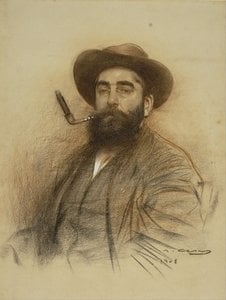
Before the Bath, autoriaus Ramon Casas Carbó, meistro rankomis sumalatyta aliejų technika reprodukcija
Peržiūrėti realaus dydžio版 Peržiūrėti AR realybėje Perjungti į spausdinamus版作品 Perejti prie skaitmeninių vaizdų Pasidalinti
Išsamiau Vadovas Pridėti į mėgstamiausius Atsisiųsti Panašūs eksponatai Rentgeno spindulių nuotrauka Automatinė diorama 问答 Prezentacija Statistika

Before the Bath Rankiniu būdu dažyta aliejaus reprodukcija

Ramon Casas (1866-1932) was a leading Catalan Modernisme artist known for his striking portraits of Barcelona's elite and evocative genre scenes like 'El garrot.' His work captures the spirit of a turbulent era with Impressionistic brushstrokes and graphic design influence.

Šiame puslapyje rodomas meno kūrinys yra saugomas autorių teisių įstatymais, todėl neturime teisės legaliai kurti ar parduoti jo identiškos reprodukcijos. Ši apsauga užtikrinama remiantis tokiais tarptautiniais susitarimais kaip Bernės konvencija ir pagal nacionalines įstatymų nuostatas, įskaitant tas, kurias nurodo JAV autoriškos teisės įstatymas – 17-asis skyrius.

Kaip pagarbią ir teisėtą alternatyvą, mes siūlome pagal užsakymą rankomis dažytus paveikslus, įkvėptus originalo. Mūsų įgudę ir profesionalūs menininkai kruopščiai tiria originalo stilių, nuotaiką ir meninę esmę, kad sukurtų naują, unikalią kūrinį, kuris sukelia tą paties jausmą – išlikdamas tuo tarciau originaliu, savarankišku kūrybiniu darbu.

Šis metodas visiškai atitinka autorių teises, nes jame nėra saugomo kūrinio kopijavimo ar dubliavimo. Tai yra kūrybinė reinterpretacija – naujas paveikslas, kurį įkvėpė originalas, tačiau kuris nėra jo identiškas.

Rankų darbo aliejinės reprodukcijos

Rankiniu būdu tapytas aliejus ant droblio jūsų pageidaujamame dydį ir rėmuose – tai mūsų menininkų pagal užsakymą sukurtas darbas. ( Perjungti į spausdinamus版作品 Perejti prie skaitmeninių vaizdų)

Standartinis dydis
pagal užsakymą
CM
INCH

Pasirinkite iš mūsų nustatytų dydžių, atitinkančių originalaus meno kūrinio proporcijas.

plotis
aukštis

Įveskite jums reikiamą plotį ir aukštį, kad paveikslas atitiktų jūsų rėmą ar sieną. Kadangi šis darbas yra rankinio darbo, siekiant išgauti kitokios formos dydį, paveikslas gali būti šiek tiek didesnis (nuo kraštų bus palikta daugiau erdvės) arba mažesnis – pasirinkite jums patogiausią variantą. Prieš pradedant tapyti, atsiųsime jums skaitmeninį maketą patvirtinimui. Šioje puslapio nuotraukoje matomas vaizdas nėra galutinis rezultatas – jį parodys tik sukurtas maketas.

Ką galima pakeisti (pavyzdžiai): Pakeisti veidą į kliento nuotrauką; Pridėti augintinį (pvz., pakeisti katę šunimi); Įtraukti paslėptą žinutę fone; Pakeisti fono kraštovaizdį ar elementus.
Gavus užsakymą, WahooArt.com komanda susisieks su klientu el. paštu dėl instrukcijų ir pateiks maketo pavyzdį

Pristatymas visame pasaulyje () per 3–4 savaites, o ne įprastai – per 5 savaites. (11 lapkritis). Kokybė lieka nepakeičiama.

Nemokamas greitasis pristatymas visame pasaulyje
Aukštos kokybės lininis drobė
Pilnas siuntimo draudimas
Muitinės mokesčių grąžinimo garantija
Tikro spalvų atitikimo garantija
100 dienų grąžinimo politika (tik esant įtaigoms)
100% pinigų grąžinimo garantija
Nuolaida dideliems užsakymams

Visos kainos suma

€ 243

Before the Bath

Reprodukcijos technika

Reprodukcijos matmenys

-

Bendroji kaina

€ 243


Autoriaus biografija

A Chronicler of Catalan Modernisme: The Life and Art of Ramon Casas

Ramon Casas i Carbó, born in Barcelona on January 4th, 1866, was more than just a painter; he was a visual poet of his time, an artist who captured the spirit of a Catalonia undergoing profound transformation. Living through a period marked by both burgeoning artistic freedom and intense political and social upheaval, Casas became synonymous with Catalan Modernisme, a movement that sought to forge a unique cultural identity for the region. His life story is inextricably linked to the vibrant intellectual circles of Barcelona’s late 19th and early 20th centuries, and his art reflects not only his personal aesthetic but also the anxieties and aspirations of a society on the cusp of modernity. From an early age, Casas demonstrated a remarkable aptitude for drawing, initially receiving instruction from his mother, who herself possessed artistic inclinations. He later formally studied at the School of Fine Arts in Barcelona, and subsequently at the Académie Gleyre in Paris – a crucible where he encountered influences that would shape his evolving style.

Early Influences and Artistic Development

Casas’s early work reveals a clear debt to Impressionism, particularly evident in his depictions of Parisian life during his time studying abroad. However, he quickly moved beyond mere imitation, developing a distinctive approach characterized by bold brushwork, a keen eye for capturing fleeting moments, and an increasing focus on portraiture. It was in Barcelona that Casas truly found his artistic voice, drawn to the city’s dynamic energy and its burgeoning bohemian scene. He became a central figure in the *Els Quatre Gats* (The Four Cats), a café-cabaret modeled after Le Chat Noir in Paris, which served as a hub for artists, writers, and intellectuals. This environment fostered a spirit of experimentation and collaboration, profoundly influencing Casas’s artistic direction. His portraits from this period are particularly noteworthy – not simply representations of physical likeness but insightful psychological studies that reveal the character and social standing of his subjects. He didn't shy away from depicting the elite of Barcelona society, yet he infused these commissions with a sense of realism and often subtle critique.

The Power of the Portrait and Beyond

Casas’s mastery of portraiture established him as one of Catalonia’s most sought-after artists. His subjects included prominent figures in politics, literature, and business, but his artistic vision extended far beyond the confines of conventional society. He was equally captivated by scenes of everyday life – bullfights, executions, street riots – capturing the raw energy and often brutal realities of urban existence. El garrot* (The Cudgel), a series of paintings depicting a violent crackdown on Catalan protestors, stands as a powerful testament to his social consciousness and willingness to confront difficult subjects. Beyond painting, Casas was also a gifted graphic designer, creating striking posters and postcards that helped to disseminate the ideals of Modernisme and promote Catalan culture. His poster designs were innovative for their time, employing bold typography and evocative imagery to capture the attention of a rapidly expanding audience. He understood the power of visual communication and used it effectively to shape public opinion and champion his artistic beliefs.

Major Achievements and Lasting Legacy

Throughout his career, Casas exhibited widely both in Spain and internationally, gaining recognition for his unique style and insightful depictions of Catalan life. His work played a crucial role in establishing Barcelona as a major center of Modernist art, influencing generations of artists to come. Estudi d'estiu o Primero pasarás sobre mi cadáver* (Summer Study or First You Shall Pass Over My Body) is perhaps one of his most iconic paintings, showcasing his ability to blend symbolism and realism in a hauntingly beautiful composition. The painting’s ambiguous narrative invites multiple interpretations, reflecting the complexities of Catalan identity during a period of political unrest. Casas's influence extended beyond the realm of fine art; he was also involved in theater design and journalism, demonstrating a remarkable versatility and commitment to artistic expression in all its forms. He died on February 29th, 1932, leaving behind a rich legacy that continues to inspire artists and captivate audiences today. His work remains a vital record of a pivotal moment in Catalan history, offering a glimpse into the soul of a nation grappling with questions of identity, modernity, and social change.

A Symbol of Catalan Identity

Ramon Casas’s art is not merely a reflection of his time; it *is* that time – a vibrant, complex, and often contradictory portrait of Catalonia at the turn of the 20th century. He was a master observer, capable of capturing both the beauty and brutality of urban life with equal skill and sensitivity. His portraits are more than just likenesses; they are windows into the souls of his subjects, revealing their character, social standing, and inner lives.
  • His graphic designs helped to define the aesthetic of Catalan Modernisme.
  • His willingness to confront difficult social issues set him apart from many of his contemporaries.
  • His legacy continues to inspire artists and captivate audiences today.
Casas’s enduring significance lies in his ability to synthesize diverse influences – Impressionism, Realism, Symbolism – into a uniquely Catalan artistic vision. He was a chronicler of his time, a poet of the streets, and a champion of cultural identity, leaving behind a body of work that remains as relevant and compelling today as it was over a century ago.

Trumpa informacija

  • Artistic Movement Or Style: Catalan Modernisme
  • Date Of Birth: January 4, 1866
  • Date Of Death: February 29, 1932
  • Full Name: Ramon Casas i Carbó
  • Nationality: Spanish
  • Notable Artworks:
    • Self-portrait
    • Estudi d'estiu
    • El garrot
  • Place Of Birth: Barcelona, Spain