Peržiūrėti realaus dydžio版 Peržiūrėti AR realybėje Perjungti į spausdinimą Perejti prie skaitmeninių vaizdų Siųsti
Išsamiau Vadovas Pridėti į mėgstamiausius Atsisiųsti Panašūs eksponatai Rentgeno spindulių nuotrauka Diaporama Statistika

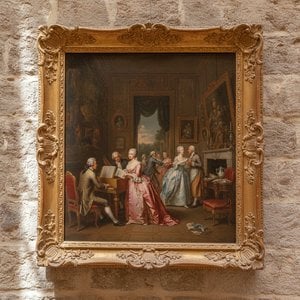
The Dancing Lesson

Pieter Jacobsz Codde's 'The Dancing Lesson' (1627) captures a lively domestic scene with a woman teaching dance, showcasing Dutch Golden Age genre painting’s realism and detail.

Pieter Jacobsz Codde (1599-1678) was a Dutch Golden Age painter known for genre scenes, musical companies & guardroom paintings. Discover his technically skilled style and notable works like 'Dancing Lesson' at the Louvre.

Rankų darbo aliejinės reprodukcijos

Rankiniu būdu tapytas aliejus ant droblio jūsų pageidaujamame dydį ir rėmuose – mūsų menininkų darbas pagal užsakymą. ( Perjungti į spausdinimą Perejti prie skaitmeninių vaizdų)

Corner sample of the P118B picture frame: lieto polistirolo, 5 cm wide and 3 cm thick
P118B €10
Corner sample of the P118H picture frame: lieto polistirolo, 5 cm wide and 3 cm thick
P118H €10
Corner sample of the P118W picture frame: lieto polistirolo, 5 cm wide and 3 cm thick
P118W €10
Corner sample of the P438Z picture frame: lieto polistirolo, 5.5 cm wide and 3.5 cm thick
P438Z €10
Corner sample of the P508JH picture frame: lieto polistirolo, 7 cm wide and 3.5 cm thick
P508JH €12
Corner sample of the P508YH picture frame: lieto polistirolo, 7 cm wide and 3.5 cm thick
P508YH €12
Corner sample of the P805H picture frame: lieto polistirolo, 5 cm wide and 3.5 cm thick
P805H €10
Corner sample of the P805Z picture frame: lieto polistirolo, 5 cm wide and 3.5 cm thick
P805Z €10
Corner sample of the P919BZ picture frame: lieto polistirolo, 7 cm wide and 3.5 cm thick
P919BZ €10
Corner sample of the P919G picture frame: lieto polistirolo, 7 cm wide and 3.5 cm thick
P919G €10
Corner sample of the P919XJ picture frame: lieto polistirolo, 7 cm wide and 3.5 cm thick
P919XJ €10
Corner sample of the P959ZH picture frame: lieto polistirolo, 5 cm wide and 3 cm thick
P959ZH €10
Corner sample of the P968JZ picture frame: lieto polistirolo, 6 cm wide and 4 cm thick
P968JZ €12
Corner sample of the W106C picture frame: solidus medžio, 5 cm wide and 3 cm thick
W106C €8
Corner sample of the W218G picture frame: solidus medžio, 5 cm wide and 3 cm thick
W218G €10
Corner sample of the W218JH picture frame: solidus medžio, 5 cm wide and 3 cm thick
W218JH €8
Corner sample of the W218Y picture frame: solidus medžio, 5 cm wide and 3 cm thick
W218Y €10
Corner sample of the W307PJ picture frame: solidus medžio, 6 cm wide and 3 cm thick
W307PJ €10
Corner sample of the W316G picture frame: solidus medžio, 6 cm wide and 3 cm thick
W316G €10
Corner sample of the W316PJ picture frame: solidus medžio, 6 cm wide and 3 cm thick
W316PJ €8
Corner sample of the W316Y picture frame: solidus medžio, 6 cm wide and 3 cm thick
W316Y €10
Corner sample of the W398PJ picture frame: solidus medžio, 5 cm wide and 3 cm thick
W398PJ €8
Corner sample of the W4111J picture frame: solidus medžio, 6.5 cm wide and 3.5 cm thick
W4111J €10
Corner sample of the W500HY picture frame: solidus medžio, 7 cm wide and 5 cm thick
W500HY €15
Corner sample of the W500JH picture frame: solidus medžio, 7 cm wide and 5 cm thick
W500JH €15
Corner sample of the W692G picture frame: solidus medžio, 8 cm wide and 4 cm thick
W692G €12
Corner sample of the W849H picture frame: solidus medžio, 5 cm wide and 3 cm thick
W849H €8
Corner sample of the W940BG picture frame: solidus medžio, 7.5 cm wide and 4.5 cm thick
W940BG €15
Corner sample of the W953PJ picture frame: solidus medžio, 6 cm wide and 3.5 cm thick
W953PJ €8

Standartinis
individualaus dydžio
CM
INCH

Pasirinkite iš mūsų nustatytų dydžių, atitinkančių originalaus meno kūrinio proporcijas.

plotis
aukštis

Įveskite jums reikiamą plotį ir aukštį, kad paveikslas atitiktų jūsų rėmą ar sieną. Kadangi šis darbas yra rankinio darbo, siekiant išgauti kitokio formos dydį, paveikslas gali būti šiek tiek didesnis (nuo kraštų bus palikta daugiau erdvės) arba mažesnis – pasirinkite jums patogiausią variantą. Prieš pradedant tapyti, atsiųsime jums skaitmeninį maketą patvirtinimui. Šioje puslapio nuotraukoje matomas vaizdas nėra galutinis rezultatas – jį parodys tik sukurtas maketas.

Ką galima pakeisti (pavyzdžiai): Pakeisti veidą į kliento nuotrauką; Pridėti augintinį (pvz., pakeisti katę šunimi); Įtraukti paslėptą žinutę fone; Pakeisti fono kraštovaizdį ar elementus.
Gavus užsakymą, WahooArt.com komanda susisieks su klientu el. paštu dėl instrukcijų ir pateiks maketo pavyzdį

Pristatymas visame pasaulyje () per 3–4 savaites, o ne įprastai – per 5 savaites. (22 spalis). Kokybė lieka nepakeičiama.

Nemokamas greitasis pristatymas visame pasaulyje
Aukštos kokybės lininis drobė
Pilnas siuntimo draudimas
Muitinės mokesčių grąžinimo garantija
Tikro spalvų atitikimo garantija
100 dienų grąžinimo politika (tik esant įtaigoms)
100% pinigų grąžinimo garantija
Nuolaida dideliems užsakymams

Bendroji kaina

€ 239

The Dancing Lesson

Reprodukcijos technika

Reprodukcijos dydis

-

Visų pasirinktų variantų kaina

€ 239

Pagrindinė informacija

  • Title: The Dancing Lesson
  • Movement: Dutch Golden Age
  • Year: 1627
  • Artist: Pieter Jacobsz Codde

A Glimpse into the Golden Age: The Elegance of Motion

In the quiet, sun-drenched interiors of the seventeenth-century Netherlands, moments of domestic grace were often captured with profound reverence. Pieter Jacobsz Codde’s "The Dancing Lesson," painted in 1627, serves as a breathtaking window into this era of refined social ritual. At the heart of this composition stands a woman, her presence commanding yet graceful, draped in a striking black dress that anchors the scene's visual weight. As she guides her pupils through the rhythmic steps of a dance, the painting transcends a mere instructional moment, becoming a poetic meditation on poise, etiquette, and the structured beauty of Dutch social life. The room around her is alive with the subtle energy of a gathering, where the soft interplay of light and shadow breathes life into every figure and object.

The mastery of Codde lies in his ability to weave a complex narrative through meticulous detail and a sophisticated use of chiaroscuro. Influenced by the legendary Frans Hals, Codde employs a technique that emphasizes naturalism and psychological depth. Notice how the light falls upon the ruffled collar of the central figure, creating a brilliant contrast against the dark fabric of her gown, drawing the eye immediately to the focal point of the lesson. The surrounding figures, though partially obscured in the periphery, contribute to a sense of atmospheric depth, their positions suggesting a layered, bustling environment. Every element, from the heavy wooden chair to the books resting upon the dining table, is rendered with such precision that one can almost feel the stillness of the room punctuated by the soft shuffling of feet.

Technical Brilliance and the Dutch Aesthetic

For the discerning collector or interior designer, this piece offers a masterclass in the silvery-gray tonalities that defined the Dutch Golden Age. Codde’s brushwork captures the tactile reality of the era—the crispness of linen, the weight of dark wool, and the smooth surface of polished wood. The composition is balanced yet dynamic; while the central figure provides a stable vertical axis, the scattered arrangement of people and objects creates a rhythmic flow that mimics the dance itself. This careful orchestration of space makes the artwork an exceptional choice for creating a focal point in a room, offering both a sense of historical gravity and a light, airy sophistication.

Beyond its technical brilliance, "The Dancing Lesson" carries a profound emotional resonance. There is a sense of nostalgic tranquility in the scene—a celebration of a world where time moved to the tempo of music and social interaction was governed by a graceful, shared decorum. It invites the viewer to step back into a period of burgeoning prosperity and cultural refinement. Whether placed in a formal study or a contemporary living space, this reproduction serves as more than mere decoration; it is an invitation to contemplate the enduring beauty of human connection and the quiet elegance found in life's most simple, choreographed moments.

问答 (or more naturally for a website heading): Klausimai ir atsakymai

Ar galima atsisiųsti „The Dancing Lesson“?

Galimybę atsisiųsti „The Dancing Lesson“ galima rasti šio kūrinio Atsisiųsti puslapį, kuriame siūloma aukštos raiškos skaitmeninio vaizdo atsisiuntimas.

Kaip emocijos ir dovanojimo progos susilieja su kūryiniu darbu „The Dancing Lesson“, autorius – Pieter Jacobsz Codde?

Savo Calm emociniu tonu „The Dancing Lesson“, autorius – Pieter Jacobsz Codde rekomenduojamas kaip dovana Anniversary.

Su kokia emocija siejama „The Dancing Lesson“?

„The Dancing Lesson“, autorius – Pieter Jacobsz Codde perteikia Calm emocinę nuotaiką.


Autoriaus biografija

The Silvery Light of the Dutch Golden Age

Pieter Jacobsz Codde, a name synonymous with the refined elegance of the seventeenth-century Dutch Golden Age, lived a life as textured and layered as the canvases he produced. Born in Amsterdam in 1599 to a family of modest means—his father serving as a city official responsible for port fees—Codde emerged from an environment steeped in the maritime commerce and burgeoning prosperity of the Netherlands. While historical records regarding his early training remain somewhat enigmatic, whispers of an apprenticeship under the legendary Frans Hals have long circulated among art historians. However, more recent scholarship suggests he may have refined his technical prowess under Barent van Someren or Cornelis van der Voort. Regardless of his specific master, Codde’s development was marked by a profound ability to capture the quiet, often silvery-gray tonalities that would become his aesthetic signature.

His early years were not merely defined by the brush, but also by a literary sensibility that added depth to his visual narratives. In the early decades of the 1600s, Codde was known to engage with the poetic and dramatic arts, appearing in publications such as Hollande Nachtegaelken. This intersection of word and image allowed him to approach genre painting not just as a recorder of reality, but as a storyteller capable of weaving classical and amorous themes into the fabric of everyday life. His move to the fashionable Sint Antoniesbreestraat in Amsterdam placed him at the very heart of the artistic community, surrounded by the vibrant energy of a city defining its cultural identity.

Mastery of the Genre and the Guardroom

As his career matured, Codde became a master of several distinct genres, most notably the guardroom scene, the musical company, and the intimate portrait. His work is celebrated for its meticulous attention to detail and a sophisticated use of chiaroscibility—the dramatic interplay of light and shadow that breathes life into inanimate objects and human subjects alike. In his guardroom paintings, he captured the rugged, often tense atmosphere of military life, yet he infused these scenes with a technical grace that elevated them beyond mere reportage. His ability to render the cold glint of steel, the heavy texture of fabric, and the soft glow of candlelight created an immersive experience for the viewer.

Beyond the martial themes, Codde found immense success in depicting the social harmonies of his era. His musical compositions are particularly evocative, capturing moments of shared leisure and artistic devotion. In works such as Dancing Lesson and The Lute Player, one can sense the rhythmic pulse of the music through his precise brushwork. These paintings often feature a delicate, silvery palette that lends a dreamlike, nostalgic quality to the scenes, making them feel both immediate and timeless. Through these small-scale masterpieces, Codde invited the viewer into the private, harmonious corners of Dutch domesticity, where melody and movement converged.

A Legacy Etched in Light and Shadow

The life of Pieter Codde was not without its shadows, mirroring the darker tones found in his more somber compositions. His personal history was marked by turbulence, including a high-profile legal accusation and a divorce that saw his wife move into the home of the painter Paulus Potter. Yet, even amidst personal upheaval, his professional trajectory remained one of significant achievement. By 1657, he had secured a prestigious residence on the Keizersgracht, a testament to the stability and success his talent had afforded him. His later years were spent in the very heart of Amsterdam's grandeur, continuing to refine the techniques that would influence generations of Dutch painters.

The historical significance of Codde lies in his role as a bridge between the raw naturalism of the early Golden Age and the more refined, polished aesthetics of the mid-seventeenth century. His contributions to the development of genre painting provided a blueprint for how light could be used to sculpt emotion and atmosphere. Today, his works reside in some of the world's most esteemed institutions, including:

  • The Louvre, where his Dancing Lesson serves as a pinnacle of his musical genre.
  • The Rijksmuseum, housing his profound religious works like the Adoration of the Shepherds.
  • The Uffizi Gallery, which preserves his delicate conversational scenes.
  • The Philadelphia Museum of Art, home to his evocative Lute Player.

Ultimately, Pieter Jacobsz Codde remains a vital figure in the canon of Western art, remembered not just for his technical skill, but for his ability to capture the fleeting, luminous essence of human connection and the quiet dignity of everyday existence.

Trumpa informacija apie kūrėją

  • Full Name: Pieter Jacobsz Codde
  • Nationality: Dutch
  • Date Of Birth: 1599
  • Date Of Death: 1678
  • Place Of Birth: Amsterdam, Netherlands
  • Notable Artworks:
    • The Music Lesson
    • Dancing Lesson
    • Merry Company
  • Artistic Movement Or Style: Dutch Golden Age
  • Artists Who Influenced This Artist: ['Frans Hals']
  • Artists Or Movements Influenced By This Artist: ['Golden Age Art']