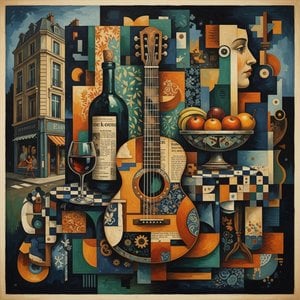
Pablo Picasso’s ‘Violin’: A Fragmented Symphony of Modernity
Pablo Picasso's 'Violin,' painted in 1913 during his pivotal Synthetic Cubist period, isn’t merely a depiction of an instrument; it’s a radical exploration of perception and representation. This work, rendered primarily with charcoal on cardboard—a surprising choice that contributes significantly to its textured surface—demands attention not just for its subject matter but for the innovative techniques Picasso employs to dismantle and reassemble reality onto the canvas. It's a piece brimming with intellectual curiosity and a bold rejection of traditional artistic conventions, firmly establishing Picasso as a key figure in the birth of modern art.
The painting immediately captivates with its fragmented composition. The violin itself is not presented as a unified form but rather as a collection of geometric shards—a series of interlocking planes and angles that suggest both its structural integrity and inherent instability. This deliberate fracturing, characteristic of Synthetic Cubism, moves beyond the analytical deconstruction of earlier Cubist works, opting instead to reassemble these fragments into a recognizable subject while simultaneously disrupting our ability to perceive it as a whole. Surrounding the violin are carefully placed elements: two birds, rendered with similar geometric simplification, and three books—each contributing to the overall sense of controlled chaos and layered perspectives. These additions aren’t merely decorative; they serve to heighten the painting's complexity, inviting the viewer to actively engage in deciphering the scene.
Synthetic Cubism: A Rebirth of Form
‘Violin’ exemplifies Synthetic Cubism’s shift from the analytical approach that preceded it. While Analytical Cubism focused on breaking down objects into their fundamental geometric components and presenting them simultaneously from multiple viewpoints, Synthetic Cubism sought to reintegrate these fragmented forms into more recognizable images. Picasso achieves this through a clever use of collage—incorporating elements like newspaper clippings and cardboard—to create a textured surface that adds depth and visual interest. The painting’s flatness is deliberate; it rejects the illusionistic space of traditional painting in favor of a flattened, graphic style reminiscent of printmaking. This flattening wasn't simply an aesthetic choice but a reflection of Picasso’s growing interest in exploring the possibilities of two-dimensional art.
Contextualizing the Innovation: Collaboration and Influence
Picasso’s experimentation during this period was deeply intertwined with his collaboration with Georges Braque, another pivotal figure in Cubism. Together, they pushed the boundaries of representation, challenging established notions of perspective and form. ‘Violin’ stands alongside other works from this era—including “Woman with guitar” and “Bottle, glass, violin”—forming a cohesive body of work that showcases their shared exploration of Synthetic Cubist techniques. The influence of Crystal Cubism is also evident here; the use of cardboard and the emphasis on surface texture echo the experiments conducted by artists like Juan Gris, who sought to create paintings that resembled stained-glass windows or mosaics.
A Legacy of Modernity
'Violin' isn’t just a beautiful painting; it’s a testament to Picasso’s relentless pursuit of innovation and his profound impact on the development of modern art. It represents a radical departure from traditional representation, embracing abstraction, fragmentation, and experimentation. The work’s enduring appeal lies in its ability to simultaneously challenge and engage the viewer, prompting us to reconsider our own perceptions of reality. It's a powerful reminder that art can be both intellectually stimulating and emotionally resonant—a legacy that continues to inspire artists and collectors alike.
WahooArt.com offers high-quality, handmade oil painting reproductions of famous artworks like Picasso’s ‘Violin’. These reproductions are crafted with meticulous attention to detail, ensuring that the essence of the original piece is preserved.
问答 (or more naturally for a website heading): Klausimai ir atsakymai
Kaip galiu peržiūrėti „Violin“, autorius – Pablo Pikaso reprodukciją?
Prežiūrėti „Violin“, autorius – Pablo Pikaso galima puslapio Peržiūra kūrinio peržiūros puslapyje.
Ar galiu naudoti papildytojąjį realybę, kad pamatytumėte „Violin“, autorius – Pablo Pikaso savo kambaryje?
„Violin“, autorius – Pablo Pikaso galite išbandyti ant savo sienos naudodami papildytoji realybės funkciją suderinamame įrenginyje per šio kūrinio AR peržiūra puslapį.
Kaip galiu įsigyti „Violin“, autorius – Pablo Pikaso spausdinį?
Šio kūrinio „Violin“, autorius – Pablo Pikaso spausdinį galite užsakyti tiesiogiai ši ši puslapį: aukščiausios kokybės spausdinys ant medžio siuvinėjamų audinių arba archyvinio kanvas tipo popieriaus.
Kokio dydžio rekomenduojama spausdinti kūrinį „Violin“?
Rekomenduojamas spausdinimo dydis kūriniui „Violin“, autorius – Pablo Pikaso yra Vidutinis dydis.
Kokio atspalvio link tendencija yra „Violin“?
Dominuojantis „Violin“, autorius – Pablo Pikaso spalvos tonas yra Nuo ochros iki sepijos. Šis tonas yra pagrindinė paletės spalva.
Ar „Violin“, autorius – Pablo Pikaso spalvos yra ryškios ar išblukusios?
Kūrinys „Violin“, autorius – Pablo Pikaso užfiksuotas su Ryški spalvų išraiška nasyginimu ir Vividūs intensyvumu.
Kur ir kokiam tikslui rekomenduojamas kūrinys „Violin"]?
„Violin“ siūloma naudoti Akcentas, o rekomenduojama erdvė – Popieriaus svetainė.
Kokią nuotaiką ir emociją išreiškia „Violin“, autorius – Pablo Pikaso?
Įtvirtinta „Violin“, autorius – Pablo Pikaso nuotaika yra Modernus, o emocinis tonas – Refleksyvus.



 Peržiūrėti realaus dydžio版
 Pirkti rankomis tapytą reprodukciją
 Siųsti
 Dalintis
 Išsamiau
 Vadovas

 Atsisiųsti
 Panašūs eksponatai
 Rentgeno spindulių nuotrauka
 Diaporama
 Statistika


 Rodyti daugiau






































 Stiklo variantas prieinamas tik pasirinkus dydį iki 110 cm