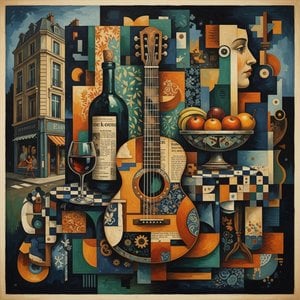
The Guitar: A Synthesis of Form and Music
Pablo Picasso's "The Guitar," created in 1916, stands as a pivotal work within the Synthetic Cubism movement. This painting transcends mere representation; it’s an exploration of form, space, and perception, embodying Picasso's revolutionary approach to art. The artwork is characterized by its fragmented composition, geometric planes, and innovative use of materials, marking a significant departure from earlier Analytic Cubism.
Context and Style: Synthetic Cubism Unveiled
Emerging around 1912, Synthetic Cubism represented a shift in Picasso's artistic practice. Unlike the analytical approach that dissected objects into their constituent parts, Synthetic Cubism focused on constructing images from simplified shapes and incorporating elements of collage – specifically *papier collé*. This style emphasizes flat surface activity and large, overlapping geometric planes, creating a sense of dynamism and abstraction. "The Guitar" exemplifies this movement perfectly, showcasing Picasso's ability to deconstruct the familiar form of a guitar and reassemble it into an innovative visual puzzle. The painting isn’t about depicting a realistic guitar; it’s about capturing its essence through abstract forms and spatial relationships.
Composition and Technique: A Geometric Harmony
The composition of "The Guitar" is striking in its complexity. Picasso depicts the instrument from multiple perspectives simultaneously, presenting three distinct views – the strings, the body, and the neck – interwoven within a geometric framework. The painting utilizes oil on canvas, allowing for a vibrant yet controlled color palette dominated by reds, whites, and blacks. A small circle near the center adds an intriguing focal point, disrupting the otherwise angular composition. The brushstrokes are visible, contributing to the textured surface and emphasizing the artist's hand in the creation process. The layering of shapes and colors creates depth and visual interest, drawing the viewer into a dynamic interplay of forms.
Artistic Significance and Legacy: Influencing Modern Art
"The Guitar" is more than just an aesthetically pleasing artwork; it’s a testament to Picasso's pioneering role in Cubism. It encapsulates the movement's core principles – fragmentation, abstraction, and multiple perspectives – while demonstrating Picasso's unique artistic vision. The painting’s influence extends far beyond Cubism itself, impacting subsequent art movements including Orphism, abstract art, Futurism, Suprematism, Dada, Constructivism, De Stijl, and Art Deco. The "Crystal Cubist" period, to which this work belongs, is particularly notable for its emphasis on order and aesthetic purity. Picasso’s innovative approach paved the way for new artistic explorations and continues to inspire artists today.
Symbolism and Emotional Impact: Music and Deconstruction
Beyond its formal qualities, "The Guitar" carries symbolic weight. The guitar itself represents music, creativity, and perhaps even artistic expression. However, its fragmented representation suggests a deconstruction of form – a questioning of traditional perspectives and an exploration of the subjective nature of perception. The painting evokes a sense of dynamism and intellectual curiosity, inviting viewers to engage with the artwork on multiple levels. It’s a visual puzzle that challenges conventional notions of representation while simultaneously celebrating the power of abstraction.
问答 (or more naturally for a website heading): Klausimai ir atsakymai
Iš kur renkasi „The guitar“, autorius – Pablo Pikaso lankytojai?
Eksistuoja Statistika puslapis kūriniui „The guitar“. Jame pateikiama mėnesio apžiūrų diagrama, apimanti šį kūrinį bei kitus šio kūrybinio veikėjo darbus, su skirstymu pagal šalis ir kalbas.
Kaip „The guitar“, autorius – Pablo Pikaso spalvos susiję su jo emocine išraiška?
„The guitar“, autorius – Pablo Pikaso sujungia Tamsūs tonai paletę su Refleksyvus tonu.
Kokia yra „The guitar“, autorius – Pablo Pikaso dominuojanti spalva?
Per „The guitar“, autorius – Pablo Pikaso bėgioja Nuo ochros iki sepijos atspalvis.



 Peržiūrėti realaus dydžio版
 Perjungti į spausdinimą
 Siųsti
 Dalintis
 Išsamiau
 Vadovas

 Atsisiųsti
 Panašūs eksponatai
 Rentgeno spindulių nuotrauka
 Diaporama
 Statistika


 Rodyti daugiau






































 Stiklo variantas prieinamas tik pasirinkus dydį iki 110 cm