A Quiet Moment of Rural Life: Decoding Picasso’s “Sleeping Peasants”
Pablo Picasso's "Sleeping Peasants" (1919) offers a compelling glimpse into the artist’s exploration of Synthetic Cubism, moving beyond mere representation towards a powerful distillation of form and emotion. This large-scale oil on canvas isn’t simply *about* sleeping figures; it’s an investigation into how we perceive reality, memory, and the enduring connection between humanity and the land.
Subject & Composition: A Fragmented Pastoral
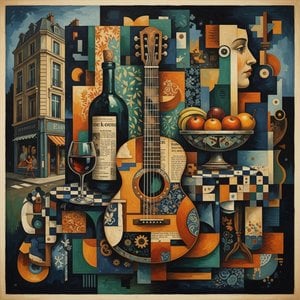
The painting depicts two peasants resting on the ground, surrounded by a collection of everyday objects – a guitar, bottles, and various implements suggestive of rural labor. However, Picasso doesn’t present this scene realistically. Instead, he fractures the figures and objects into geometric shapes, presenting multiple viewpoints simultaneously. This fragmentation isn't chaotic; it creates a dynamic composition where forms interlock and resonate with one another. The limited color palette, dominated by earthy tones – ochres, browns, and muted greens – reinforces the connection to the soil and the simplicity of peasant life.
Style & Technique: Synthetic Cubism in Practice
“Sleeping Peasants” exemplifies Picasso’s mature Synthetic Cubist style. Emerging around 1912, this phase moved away from the analytical deconstruction of objects towards a rebuilding of form using simplified shapes and collage-like elements (though no actual collage is present here). Notice how Picasso uses planes of color to suggest volume and depth without relying on traditional perspective or shading. The figures aren’t modeled in a realistic way; they *are* the arrangement of planes. This technique emphasizes the two-dimensionality of the canvas while simultaneously creating a sense of spatial ambiguity.
Historical Context: Post-War Reflections & A Return to Classicism
Created in the aftermath of World War I, “Sleeping Peasants” reflects a broader cultural shift towards a desire for order and stability. Following years of upheaval, Picasso began exploring more traditional subjects – portraits, still lifes, and scenes of rural life – while continuing to innovate with Cubist forms. This period (roughly 1918-1925) is often referred to as his “classicizing” phase. The painting can also be seen in relation to Picasso’s lifelong fascination with the works of Old Masters like Poussin and Courbet, whose compositions often featured monumental figures in pastoral settings.
Symbolism & Emotional Impact: Rest, Resilience, and Remembrance
The sleeping peasants themselves are laden with symbolism. Sleep can represent peace, vulnerability, or even death. In this context, their slumber might be interpreted as a metaphor for the resilience of the rural working class, who continue to find moments of rest amidst hardship. The surrounding objects – the guitar suggesting music and community, the bottles hinting at sustenance and celebration – add layers of meaning. The overall effect is one of quiet contemplation and melancholic beauty. Despite the fragmented forms, the painting evokes a powerful sense of human connection to the land and to each other.
For Collectors & Designers: Integrating “Sleeping Peasants” into Your Space
- A Statement Piece: Its large size and bold composition make it an impactful focal point in any room.
- Color Palette Versatility: The earthy tones complement a wide range of interior styles, from rustic farmhouse to modern minimalist.
- Conversation Starter: The painting’s complex symbolism and historical context invite discussion and appreciation.
- Harmonious Pairing: Consider pairing it with furniture featuring natural materials – wood, linen, or leather – to enhance the connection to its rural subject matter.
“Sleeping Peasants” is more than just a painting; it’s a testament to Picasso's genius and his ability to transform everyday subjects into profound artistic statements. It invites viewers to slow down, contemplate, and connect with the enduring themes of life, loss, and resilience.
问答 (or more naturally for a website heading): Klausimai ir atsakymai
Kokią emociją sukelia „sleeping peasants“, autorius – Pablo Pikaso spalvos?
„sleeping peasants“, autorius – Pablo Pikaso sujungia Earthy paletę su Melancholic tonu.
Ar „sleeping peasants“ yra būdingas tam, ką Pablo Pikaso paprastai kūrė?
„sleeping peasants“ vaizduoja cubism, peasants, grief, mourning, geometric, abstract, rural, fragmented, o įrašytos Pablo Pikaso temos yra braque, synthetic styles, geometric abstraction, classical period shift, human form exploration, cubist evolution, rural hardship, loss. Šių dviejų palikimų lyginimas parodo, kaip šis kūrinys susijęs su įprastais šio kūrybinio veiksmo objektais.
Kokia naudojimo paskirtis ir erdvė rekomenduojama „sleeping peasants“, autorius – Pablo Pikaso?
„sleeping peasants“ siūloma naudoti Statement, o rekomenduojama erdvė – Living Room.



 Peržiūrėti realaus dydžio版
 Perjungti į spausdinimą
 Siųsti
 Dalintis
 Išsamiau
 Vadovas

 Atsisiųsti
 Panašūs eksponatai
 Rentgeno spindulių nuotrauka
 Diaporama
 Statistika

 Rodyti daugiau






































 Stiklo variantas prieinamas tik pasirinkus dydį iki 110 cm