A Silent Landscape: Picasso’s Parisian Reverie
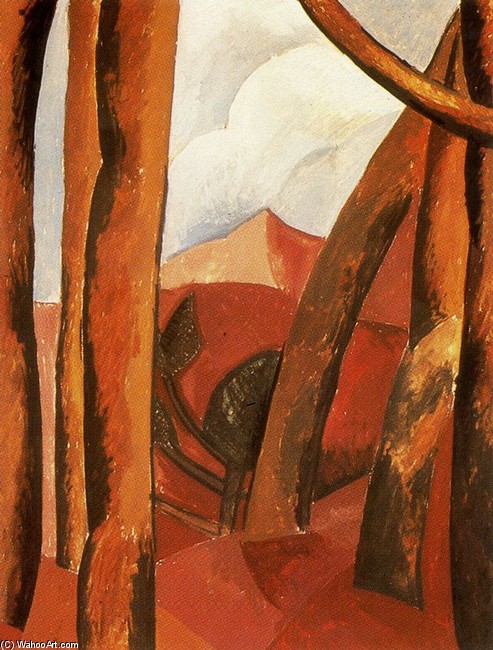
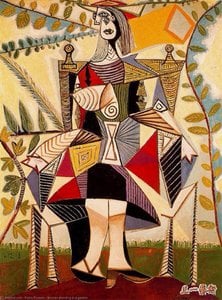
Pablo Picasso's "Landscape," painted in Paris during the spring of 1908, isn’t a depiction of a specific place but rather a distillation of atmosphere and feeling. It’s a deceptively simple work—a wash of muted greens, blues, and browns layered over a subtly undulating hillside—yet within its quiet composition resides a profound exploration of perception and the relationship between observer and observed. This piece, housed in the collection of Leonard A. Lauder and generously offered to the Metropolitan Museum of Art, offers a glimpse into Picasso’s evolving artistic language during this pivotal period, bridging his earlier naturalistic training with the nascent experimentation that would define Cubism.
The painting's technique is remarkably understated, almost hesitant. Picasso employs a combination of gouache and charcoal on paper, creating a surface texture that feels both delicate and robust. Notice the meticulous layering—thin washes of color built upon each other, punctuated by sharp, deliberate strokes of charcoal. These marks aren’t meant to define precise forms but rather to suggest contours, volumes, and spatial relationships. The use of dots and zig-zag lines adds a dynamic element, hinting at movement and energy beneath the surface tranquility. It's a technique that anticipates his later explorations with constructed reality, where objects are fragmented and reassembled in unconventional ways.
Echoes of Rousseau and the Dawn of Cubism
While Picasso’s work during this period is often associated with the burgeoning movement of Cubism, “Landscape” stands as a crucial precursor. The influence of Henri Rousseau, a French painter known for his dreamlike depictions of tropical landscapes, is palpable. Picasso admired Rousseau's ability to capture the essence of nature through simplified forms and vibrant colors—a stark contrast to the academic realism prevalent at the time. However, Picasso moves beyond mere imitation; he retains a degree of ambiguity, refusing to offer a definitive representation. The figures are almost childlike in their simplicity, reminiscent of a naive style, yet they’re imbued with an underlying sense of tension and complexity.
The painting's composition is deliberately ambiguous. The horizon line is indistinct, the trees appear as fragmented shapes rather than distinct entities, and the background merges seamlessly into the foreground. This blurring of boundaries challenges our conventional understanding of perspective and spatial relationships—a key characteristic of Cubism. Picasso isn’t simply depicting a landscape; he’s presenting it as an experience, a series of visual sensations that are filtered through his own perception.
Symbolic Resonance: Melancholy and the Passage of Time
Despite its apparent simplicity, “Landscape” carries a subtle undercurrent of melancholy. The muted palette—dominated by cool greens and blues—evokes a sense of stillness and introspection. The presence of dead or dying trees in the foreground adds to this feeling of decay and loss. Some art historians interpret these elements as reflecting Picasso’s personal experiences during this period, particularly the loss of his sister Conchita, an event that profoundly impacted his artistic vision.
Furthermore, the painting can be viewed as a meditation on time and memory. The fragmented forms and ambiguous spatial relationships suggest a fleeting moment captured in time—a snapshot of a landscape that is constantly shifting and transforming. It’s a reminder of the ephemeral nature of beauty and the inevitability of change. “Landscape” isn't just a depiction of a scene; it’s an invitation to contemplate the mysteries of perception, memory, and the human condition.
A Timeless Masterpiece for Your Collection
WahooArt offers meticulously crafted hand-painted reproductions of Pablo Picasso’s “Landscape,” allowing you to bring this iconic work into your home or office. Our skilled artists faithfully recreate Picasso's unique style, capturing the subtle nuances of color, texture, and composition with exceptional detail. Whether you are an art enthusiast, a collector, or simply seeking to elevate your interior décor, our reproduction provides an authentic representation of this timeless masterpiece. Explore our range of sizes and framing options to find the perfect addition to your collection—a testament to Picasso’s enduring legacy.