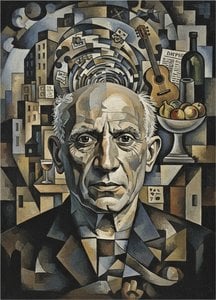
A Fragmented Urban Vision
In the evocative charcoal drawing Hombre sentado, Pablo Picasso invites us into a world where the boundaries between the human spirit and the built environment begin to dissolve. Though the title suggests a singular, seated figure, the viewer is instead met with a mesmerizing, abstract cityscape that pulses with the raw energy of early Modernism. This work serves as a profound exploration of urban density, utilizing a monochromatic palette to strip away the distractions of color, leaving only the essential architecture of form and shadow. The composition is anchored by a powerful vertical thrust, dominated by an imposing triangular structure that commands the eye, much like a skyscraper piercing a heavy, charcoal-laden sky.
The technique employed here is nothing short of visceral. Picasso utilizes the gritty, tactile nature of charcoal to build layers of tonal depth, creating a sense of movement through overlapping planes and receding lines. There is no traditional perspective to guide the wandering eye; instead, we navigate a labyrinth of geometric shapes—rectangles, sharp triangles, and sweeping curves—that suggest the skeletal framework of a city in flux. The texture is intentionally rough and uneven, capturing the spontaneous, almost frantic energy of a hand moving swiftly across paper. This tactile quality lends the piece an organic soul, preventing the rigid geometry from feeling cold or mechanical.
The Pulse of Cubist Innovation
To understand Hombre sentado, one must look through the lens of Picasso’s revolutionary approach to reality. The artwork leans heavily into the principles of Cubism, where the subject is not merely observed but dismantled and reconstructed. By flattening the perspective and fragmenting the urban landscape, Picasso challenges the viewer to perceive the city not as a collection of static buildings, but as a dynamic, multidimensional experience. This stylistic choice reflects the broader historical shift of the early 20th century, mirroring the rapid industrialization and the psychological complexity of modern life.
Within this fractured landscape, subtle symbolic elements emerge to whisper stories of nature intertwined with industry. A delicate suggestion of foliage in the upper corner provides a poignant contrast to the sharp, aggressive angles of the charcoal structures, reminding us of the persistent presence of the natural world amidst human construction. This tension between the organic and the geometric creates a profound emotional resonance, evoking feelings of both the overwhelming scale of the metropolis and the quiet, enduring strength of life itself.
An Inspiration for Modern Interiors
For the discerning collector or interior designer, Hombre sentado offers an unparalleled opportunity to introduce a sense of intellectual depth and avant-garde sophistication to a space. The stark, black-and-white aesthetic makes it a versatile masterpiece, capable of anchoring a minimalist gallery-style room or adding a layer of historical gravity to a contemporary study. Its monochromatic intensity provides a striking focal point that complements both neutral palettes and bold, colorful accents.
Owning a high-quality reproduction of this work is more than an act of decoration; it is an invitation to daily contemplation. It brings into the home the restless, searching mind of Picasso, offering a window into a moment of pure creative evolution. Whether placed in a professional setting to inspire innovation or in a private sanctuary to provoke thought, this piece remains a timeless testament to the power of abstraction and the enduring allure of the modern urban dream.
问答 (or more naturally for a website heading): Klausimai ir atsakymai
Kokios temos pasireiškia kūrynioje „Hombre sentado“, autorius – Pablo Pikaso?
Darbos „Hombre sentado“ temos yra abstract cityscape, geometric forms, urban landscape, charcoal drawing, modern art, cubist style, dynamic composition.
Kas yra „Hombre sentado“ autorius ir kokiu stiliaus metu?
Pablo Pikaso sukūrė „Hombre sentado“, priklausantį Cubism stiliui.
Kokia yra „Hombre sentado“ paletės ryškumas?
„Hombre sentado“ paletės spalvų nasyginimas yra Muted.



 Peržiūrėti realaus dydžio版
 Perjungti į spausdinimą
 Siųsti
 Dalintis
 Išsamiau
 Vadovas

 Atsisiųsti
 Panašūs eksponatai
 Rentgeno spindulių nuotrauka
 Diaporama
 Statistika

 Rodyti daugiau






































 Stiklo variantas prieinamas tik pasirinkus dydį iki 110 cm