A Playful Echo of Picasso’s Hand
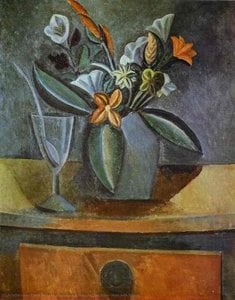
This vibrant flower bouquet, rendered with a captivating immediacy reminiscent of Pablo Picasso's later years, isn’t merely a depiction of blossoms; it’s an invitation into the heart of his expressive style. The artwork immediately draws the eye to its central composition – a joyful arrangement of flowers held within the embrace of hands. These aren’t meticulously detailed representations but rather loose, gestural forms, echoing Picasso's shift away from strict realism and towards a more emotionally driven approach. The simplicity of the background, a stark white plane, amplifies the energy and color of the floral subject, creating an almost childlike quality that belies the artist’s profound influence.
Picasso’s stylistic choices here are deeply rooted in his exploration of folk art and naive painting – movements he embraced as a means to bypass academic constraints and tap into raw emotion. The bold use of primary colors—a riot of red, blue, yellow, and orange—is characteristic of this period, injecting the image with an exuberant vitality. Notice how the hands, rendered in a muted beige/tan, provide a grounding counterpoint to the flamboyant blooms, suggesting a sense of gentle containment and perhaps even playful interaction. The thick, flowing lines that define the flowers and hands contribute significantly to the artwork’s dynamic feel, conveying movement and spontaneity – as if captured mid-gesture.
The Influence of a Master
This piece firmly places itself within the lineage of Picasso's mature work, particularly his period following World War I. It shares stylistic similarities with works like “Mother and Child Behind the Bouquet of Flowers” (1901) and “Woman with Bouquet” (1936), both of which explore themes of maternal tenderness and surreal beauty through simplified forms and vibrant color palettes. These earlier paintings demonstrate Picasso’s fascination with capturing fleeting moments and conveying emotional resonance rather than striving for photographic accuracy. The deliberate flattening of perspective, a hallmark of his later style, further emphasizes the two-dimensional nature of the image and directs the viewer's attention directly to the subject matter – the captivating bouquet itself.
Further research reveals Picasso’s deep engagement with folk art traditions, evident in the artwork’s simplified shapes and expressive lines. His exploration of these styles stemmed from a desire to break free from traditional artistic conventions and connect with a more primal, intuitive mode of expression. The influence of naive painting, characterized by its directness and lack of illusionism, is particularly apparent here, contributing to the artwork's immediate appeal and emotional impact.
Symbolism and Emotional Resonance
Beyond its aesthetic qualities, this flower bouquet carries a potent symbolic weight. Flowers themselves are universally associated with joy, beauty, and renewal – themes that resonate deeply within the composition. The vibrant colors amplify these associations, creating an atmosphere of pure delight. The hands holding the bouquet can be interpreted as symbols of care, protection, or perhaps even affection—suggesting a connection between giver and recipient. Considering Picasso’s own life experiences, including his loss of family members, one might also perceive a subtle undercurrent of melancholy beneath the surface of this seemingly cheerful image.
The artwork evokes feelings of simple pleasure, spontaneity, and childlike wonder. It's a celebration of beauty in its most unadorned form—a testament to Picasso’s ability to distill complex emotions into strikingly direct visual language. This reproduction captures the essence of his artistic vision, offering a window into a world where color, line, and gesture combine to create an unforgettable experience.



 Peržiūrėti realybėje
 Perejti prie spausdinimo
 Pasidalinti
 Dalintis
 Išsamiau

 Atsisiųsti
 Panašūs eksponatai
 Rentgeno nuotrauka
 Automatinė diorama
 Statistika

 Skaityti daugiau