Pablo Picasso’s “Figures at the Seaside” – A Study in Melancholy and Modernity
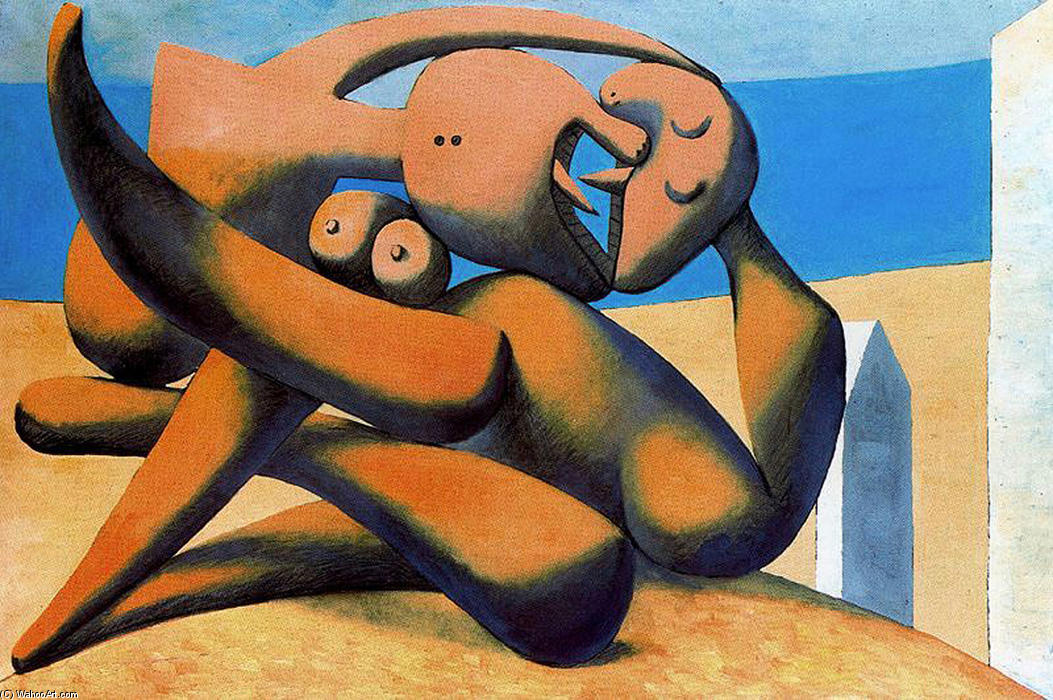
Pablo Picasso's "Figures at the Seaside," painted in 1931, isn’t merely a depiction of a beach scene; it’s a profound meditation on human connection, isolation, and the unsettling undercurrents of the modern world. This work, rendered in oil on canvas, exemplifies Picasso’s evolving Cubist sensibilities while simultaneously retaining a haunting emotional resonance that transcends stylistic categorization. The painting immediately draws the viewer into a carefully constructed tableau – two nude figures, ambiguously male and female, occupy the foreground, their bodies intertwined yet separated by an almost impenetrable distance. They are not embracing in a conventional sense; rather, they seem to be caught in a silent, weighty exchange, their gazes averted, creating a palpable atmosphere of melancholy and unspoken tension.
Picasso’s masterful use of fractured forms and flattened perspective is central to the painting's impact. The figures are not presented with anatomical accuracy but rather as geometric shapes – blocks of color and angular lines that suggest volume and presence without resorting to traditional representation. This deliberate distortion mirrors the fragmentation of modern life, where individuals often feel disconnected despite being physically proximate. The background, a hazy expanse of sand and sea, further contributes to this sense of disorientation, blurring the boundaries between reality and dream.
The Context of 1931: A World on Edge
To fully appreciate “Figures at the Seaside,” it’s crucial to understand the historical context in which it was created. 1931 marked a period of significant political and social upheaval across Europe, with rising tensions leading up to the imminent outbreak of World War II. Picasso himself was living in Paris during this time, navigating a complex personal life and grappling with the anxieties of his era. The painting can be interpreted as a reflection of these broader societal concerns – a visual representation of the loneliness and uncertainty that permeated the collective consciousness.
Furthermore, the work emerged from Picasso’s exploration of Surrealist ideas, though he resisted being strictly categorized within the movement. He was deeply influenced by the works of Giorgio de Chirico, whose paintings often featured enigmatic figures in desolate landscapes, evoking a sense of unease and psychological depth. “Figures at the Seaside” shares this unsettling quality, inviting viewers to contemplate the hidden emotions beneath the surface of seemingly ordinary scenes.
Symbolism and Interpretation: A Dance of Distance
The symbolism within "Figures at the Seaside" is deliberately ambiguous, encouraging multiple interpretations. The intertwined bodies suggest a potential connection, yet their averted gazes and the spatial distance between them highlight a fundamental lack of communication. Some art historians believe that the figures represent Picasso himself and his muse, Fernande Olivier, whose relationship was often fraught with tension and emotional complexity. Others see them as archetypal representations of humanity – individuals struggling to connect in an increasingly impersonal world.
The presence of several smaller, partially obscured figures scattered throughout the scene adds another layer of intrigue. These secondary characters seem to be caught in their own private dramas, further emphasizing the theme of isolation and detachment. The single, solitary figure on the beach in the background could represent a lost soul, yearning for connection but unable to bridge the gap between himself and others.
A Legacy of Emotional Resonance
“Figures at the Seaside” remains a powerfully evocative work of art, captivating viewers with its haunting beauty and profound emotional depth. Picasso’s innovative use of Cubist techniques, combined with his masterful command of color and composition, creates an image that is both visually arresting and psychologically complex. It's a testament to the artist's ability to capture the essence of human experience – the longing for connection, the pain of isolation, and the unsettling realities of modern life.
Reproductions of this iconic painting offer a remarkable opportunity to bring Picasso’s vision into any space, inviting contemplation and sparking dialogue. The enduring appeal of “Figures at the Seaside” lies in its ability to resonate with viewers on a deeply personal level, reminding us of our shared humanity and the universal challenges of navigating an increasingly fragmented world.


 Peržiūrėti realybėje
 Perejti prie spausdinimo
 Pasidalinti
 Dalintis
 Išsamiau

 Atsisiųsti
 Panašūs eksponatai
 Rentgeno nuotrauka
 Automatinė diorama
 Statistika

 Skaityti daugiau


