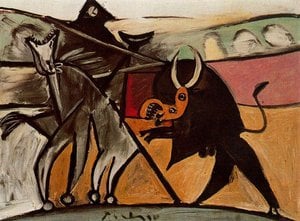
The Raw Intensity of Corrida de Toros 4
Pablo Picasso’s “Corrida de toros 4,” a striking black and white drawing executed in 1961, isn't merely a depiction of a bullfight; it’s a visceral exploration of human drama, primal instinct, and the unsettling beauty of violence. This work, part of Picasso’s late-career series exploring bullfighting, transcends simple illustration, becoming a potent meditation on courage, fear, and the precarious balance between life and death. The drawing captures a pivotal moment within the spectacle – a man perched precariously atop a horse, holding aloft a vibrant red cape, directly confronting the looming threat of the bull.
Picasso’s masterful use of line and shadow immediately establishes an atmosphere of heightened tension. The figures are rendered with a deliberate lack of detail, emphasizing their essential forms rather than precise representation. The horse, a powerful, almost skeletal presence, dominates the left side of the composition, its musculature taut with anticipation. The man on horseback is similarly simplified, his posture conveying both determination and vulnerability. Notice how Picasso uses jagged lines to define the bull’s horns and charging form – these aren't gentle curves; they are sharp, aggressive indicators of impending attack. The background is largely obscured, drawing all attention to this central confrontation.
Cubism and the Fragmented Spectacle
“Corrida de toros 4” firmly anchors itself within Picasso’s late Cubist style, though it departs from the geometric fragmentation of his earlier works. Here, the subject matter is broken down into fundamental shapes – planes and angles – yet these elements are interwoven with a remarkable sense of dynamism. The drawing isn't about recreating reality; it’s about capturing the *feeling* of the event—the energy, the chaos, the underlying brutality. The influence of his earlier explorations with African masks and Iberian sculpture is evident in the stylized forms and the deliberate distortion of perspective. This approach allows Picasso to convey multiple viewpoints simultaneously, mirroring the experience of a spectator caught within the swirling drama of the bullfight.
The monochromatic palette – primarily shades of black, white, and grey – further amplifies the drawing’s emotional impact. It evokes the starkness of newsprint photographs, lending the scene an air of documentary realism while simultaneously stripping it of sentimentality. The absence of color forces the viewer to focus on form, line, and composition, intensifying the sense of urgency and danger.
Symbolism and the Human Condition
Beyond its formal qualities, “Corrida de toros 4” is rich in symbolic meaning. The bull itself represents not just brute force but also primal instinct, aggression, and perhaps even a confrontation with mortality. The red cape, a traditional element of the bullfight, becomes a beacon of both courage and vulnerability – a desperate attempt to control the uncontrollable. The man on horseback embodies the human spirit’s willingness to face danger, albeit with a palpable sense of risk.
Interestingly, Picasso included other figures within the scene—a dog observing the action, and a lone individual positioned near the top left corner. These additions suggest a broader commentary on humanity's fascination with spectacle and violence. The dog’s presence hints at the animalistic nature of the event, while the solitary observer underscores the detached yet deeply engaged perspective of the audience.
A Legacy of Raw Emotion
“Corrida de toros 4” remains a powerfully evocative work, demonstrating Picasso's ability to distill complex emotions and dramatic narratives into deceptively simple forms. It’s a testament to his enduring fascination with human behavior and his willingness to confront uncomfortable truths through art. Reproductions of this drawing offer a unique opportunity to experience the intensity of Picasso’s vision – a glimpse into the heart of a spectacle that continues to captivate and disturb audiences worldwide. Its stark beauty and profound symbolism make it a compelling addition to any collection, offering both aesthetic pleasure and intellectual stimulation.
问答 (or more naturally for a website heading): Klausimai ir atsakymai
Kokią temą ir atmosferą sujungia „Corrida de toros 4“, autorius – Pablo Pikaso?
„Corrida de toros 4“ vaizduoja bullfight, spain, picasso, toros, violence, horse, crowd, action, o jo perteikiama nuotaika yra Dramatic.
Kokią nuotaiką „Corrida de toros 4“, autorius – Pablo Pikaso išreiškia Cubist Expression kontekste?
„Corrida de toros 4“ pasižymi Melancholic emociniu tonu, priklausančiu Cubist Expression stiliui.
Ar galiu peržiūrėti „Corrida de toros 4“, autorius – Pablo Pikaso prieš užsakant?
Norėdami peržiūrėti „Corrida de toros 4“, autorius – Pablo Pikaso reprodukciją, atidarykite kūrinio Peržiūra puslapį.



 Peržiūrėti realaus dydžio版
 Pirkti rankomis tapytą reprodukciją
 Siųsti
 Dalintis
 Išsamiau
 Vadovas

 Atsisiųsti
 Panašūs eksponatai
 Rentgeno spindulių nuotrauka
 Diaporama
 Statistika

 Rodyti daugiau






































 Stiklo variantas prieinamas tik pasirinkus dydį iki 110 cm