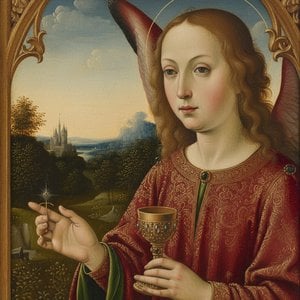
A Divine Encounter Captured in Oil
In the quiet, luminous atmosphere of Hans Memling’s The Annunciation, time seems to suspend itself, inviting the viewer into a sacred moment of profound spiritual significance. This masterpiece, dating from approximately 1465, captures the pivotal instant when the Archangel Gabriel delivers the divine message to the Virgin Mary. The scene is not merely a depiction of a biblical event but a breathtaking window into the soul of the Early Netherlandish movement. Through his masterful command of light and shadow, Memling transforms a religious narrative into an intimate, palpable encounter that resonates with both reverence and human tenderness.
The composition draws the eye through a meticulously rendered landscape where the earthly and the divine converge. As the angel approaches, the viewer is struck by the incredible depth achieved through Memling’s signature technique of glazing. By layering thin, translucent coats of oil paint, the artist creates a sense of inner radiance, making the fabrics of the robes appear heavy with texture and the skin of the figures glow with a lifelike vitality. This luminosity serves a higher purpose, symbolizing the divine light descending upon the world, turning a simple architectural setting into a vessel for the miraculous.
The Legacy of Mastery and Detail
To understand the brilliance of this work, one must look to Memling’s formative years in the workshop of Rogier van der Weyden. As an apprentice to one of the greatest titans of Flemish painting, Memling inherited a devotion to sculptural modeling and an almost scientific precision in observing the natural world. In The Annunciation, this lineage is evident in every minute detail—from the delicate feathers of a bird perched in the periphery to the intricate patterns of the architectural elements. Every brushstroke serves to ground the supernatural event in a reality so vivid that it feels within reach.
For the discerning collector or interior designer, this painting offers more than just aesthetic beauty; it provides a focal point of profound intellectual and emotional depth. The interplay between the vibrant reds of the doorway and the serene, naturalistic background creates a balanced palette that can anchor a sophisticated space, whether in a classical gallery setting or a contemporary study. It is a piece that demands contemplation, offering a sense of peace and historical grandeur that transcends the centuries.
Symbolism and Emotional Resonance
Beyond its technical perfection, the painting is a tapestry of symbolic meaning. The architectural threshold acts as a metaphor for the boundary between the celestial realm and our mortal existence. As Mary kneels in humble acceptance, her posture reflects the profound piety that defined the era, while the surrounding figures and subtle environmental details whisper stories of faith and devotion. Memling’s ability to blend these complex theological themes with such accessible, breathtaking realism ensures that the artwork remains as emotionally stirring today as it was in the fifteenth century.
Owning a reproduction of such a monumental work allows one to bring the quiet majesty of the Bruges masters into the modern home. It is an invitation to experience the meticulous craftsmanship of the Northern Renaissance—a testament to a time when art was the ultimate bridge between the human spirit and the divine.
问答 (or more naturally for a website heading): Klausimai ir atsakymai
Kas yra „The Annunciation“?
„The Annunciation“, autorius – Hansas Memlingas temos apima religious iconography, virgin mary, gabriel angel, annunciation scene, flemish painting, byzantine influence, detail art, medieval art. Kartu jie apibendrina šio kūrinio tematiką.
Iš kur renkasi „The Annunciation“, autorius – Hansas Memlingas lankytojai?
„The Annunciation“, autorius – Hansas Memlingas puslapio Statistika statistika rodo viešųjų apsilankymų duomenis: šio kūrinio mėnesinius apsilankymus, palyginimą su daugiausia peržiūrėtomis šio autoriaus dalimis bei tai, iš kur ateina lankytojai.
Kur šiandien galima pamatyti kūrinį „The Annunciation“, autorius – Hansas Memlingas?
Kūrinys „The Annunciation“, autorius – Hansas Memlingas rodomas Metropolitano muziejus, New York, United States of America. Nuoroda į muziejų nurodo originalą, o ne reprodukciją.



 Peržiūrėti realaus dydžio版
 Pirkti rankomis tapytą reprodukciją
 Siųsti
 Dalintis
 Išsamiau
 Vadovas

 Atsisiųsti
 Panašūs eksponatai
 Rentgeno spindulių nuotrauka
 Diaporama
 Statistika


 Rodyti daugiau






































 Stiklo variantas prieinamas tik pasirinkus dydį iki 110 cm