

Muziejų lygio „giclée“ arba drobos spausdinimas: greita gamyba ir lankstios apdailos parinktys. ( Pirkti rankų darbo tapybą Perejti prie skaitmeninių vaizdų)





























Pasirinkite iš mūsų nustatytų dydžių, atitinkančių originalaus meno kūrinio proporcijas.

Įveskite jums reikiamą plotį ir aukštį, kad atvaizdas derėtų prie jūsų rėmo ar sienos. Spausdiną galima tik sumažinti, bet nepadidinti virš originalaus paveikslėlio dydžio, todėl keičiant proporcijas, dalis vaizdo prarandama. Prieš spausdinimą atsiųsime jums skaitmeninį maketą patvirtinimui. Šioje puslapio nuotraukoje matomas pjūvis nėra tikslus – jį rodo tik maketas.
Pristatymas visame pasaulyje () per 2 weeks, o ne įprastas 4/5 savaičių laikotarpis. (12 lapkritis)
Quappi and Indian
Reprodukcijos matmenys
In 1928, Max Beckmann painted Quappi and Indian. This portrait captures a quiet, heavy moment between two figures. A woman, identified as Quappi, sits beside a man. He possesses a seemingly Indian appearance, his presence anchored against a stark, crimson backdrop. They exist together in a shared, silent space.
The composition centers on these two souls. The woman’s closed eyes suggest a retreat inward, a private stillness amidst the red expanse. Beside her, the man’s gaze reaches outward. Their proximity creates a tension that lingers in the air between them. It is a study of two people caught in a singular, unmoving instant.
Two figures sit side-by-side in an outdoor setting, anchored against a stark crimson backdrop. The red space presses inward, a heavy weight behind the seated pair. On the left, a candle flickers, its small light held against the encroaching shadows. In the foreground, several apples lie scattered across the ground, their shapes resting in the stillness.
The woman sits with her eyes closed, her face turned toward an internal silence. Beside her, the man directs his gaze outward, his eyes searching the space beyond the frame. A tension exists in the distance between their postures, a quiet friction held within the stillness of the scene. The red field remains unyielding.
Beckmann employs a signature style of deliberate distortion to fracture the surface of the canvas. The figures emerge through angular lines and flattened planes, rejecting the soft curves of traditional realism. This geometry creates a sense of compression, as if the subjects are held tight within the frame. Dark, heavy outlines define their forms, pushing the figures forward into a shallow space that offers no room for escape.
The artist applied tempera paint to the canvas, building a textural richness through meticulous layering. These layers of color create a luminous surface that catches the light, even amidst the shadowed recesses of the composition. The pigment carries a palpable weight. It settles into the grain of the cloth, turning the act of painting into a physical struggle against the void.
The crimson backdrop acts as a heavy weight of color. It is a solid, unyielding presence behind the seated figures. This saturation of red meets the dark, heavy outlines of the subjects, creating a tension that vibrates within the stillness. The light does not fall; it emerges from the layers themselves. A quiet, heavy stillness remains.
The artist’s hand moved through many seasons of shadow and light. In 1919, he painted The Night. By 1922, his vision captured The Iron Bridge (View of Frankfurt). These early works carry the weight of a changing era, much like the tension held within a single frame. The brushwork remains heavy, a physical presence on the canvas.
Later years brought different configurations of the human form. He produced Self-Portrait with Trumpet in 1938. By 1946, the subject shifted to Actresses. The final movements of his career include The Prodigal Son, painted in 1949. Each piece acts as a quiet marker of time passing. The paint settles into the grain of the canvas.
Norėdami užsisakyti „Quappi and Indian“ – Maxas Beckmannas spausdinį, tiesiog jį užsisakykite puslapio Kūrinio spausdinimas aukščiausia kokybe skiltyje: aukščiausios kokybės spausdinys ant medžio siuvinėjamų audinių arba archyvinio kanvas tipo popieriaus.
„Quappi and Indian“ bendroji ryškumas yra balanced, o švytėjimas – Gentle Luminance.
„Quappi and Indian“ sukurta naudojant Oil On Canvas, German Expressionism stiliuje.


Explore the profound psychological depth of Expressionist portraiture. From Munch to Schiele, discover how distorted forms and visceral brushstrokes unmask raw human emotion in this definitive guide for art enthusiasts and collectors.

Explore the vibrant evolution of Post-Impressionism. From Seurat's revolutionary Pointillism to the emotional depth of masters, discover how this movement redefined modern art history through color, structure, and unparalleled creative expression.

Explore the transformative era of Post-Impressionism. Discover how masters like Cézanne and Matisse revolutionized color and form, moving beyond Impressionism to shape modern art history through structural innovation and expressive emotion.
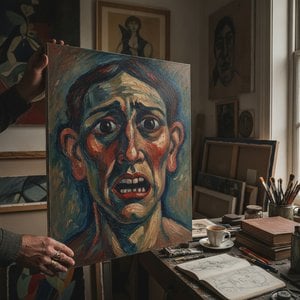
Discover the profound power of Expressionist art. From the raw intensity of Edvard Munch to the visceral textures of Neo-Expressionism, explore how subjective emotion and distorted reality define this movement. An expert guide for discerning collectors seeking depth and soul in fine art.

Atraskite impresionizmo ir postimpresionizmo šviesos bei emocijų magiją. WahooArt siūlo aukščiausios kokybės rankų darbo aliejinius šedevrus, atkurdančius didžiųjų meistrų stilių. Profesionalus meno konsultavimas ir prabangi tapyba jūsų išskirtiniam interjerui.
 Peržiūrėti realaus dydžio版
 Pasidalinti
 Dalintis
 Išsamiau
 Vadovas

 Atsisiųsti
 Panašūs eksponatai
 Rentgeno spindulių nuotrauka
 Automatinė diorama
 问答
问答
 Statistika


 Skaityti daugiau









 Stiklo variantas prieinamas tik pasirinkus dydį iki 110 cm


