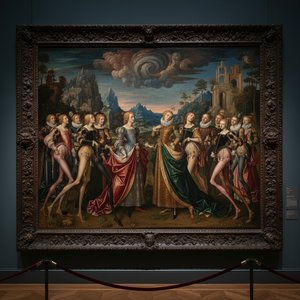
The Crucifixion by Lucas Cranach the Elder: A Detailed Examination
- Artist: Lucas Cranach the Elder
- Birth Year: 1472
- Death Year: 1553
- Origin: Germany
Subject and Historical Context
This engraving, "The Crucifixion," is a significant work by Lucas Cranach the Elder, created shortly after his initial foray into depicting this pivotal biblical scene around 1502. Cranach served as court painter to the Elector of Saxony from 1505 onwards, and this piece reflects the artistic climate of the German Renaissance. The early 16th century was a period of immense religious upheaval, marked by the burgeoning Protestant Reformation. Cranach's close association with Martin Luther is well-documented, and while his earlier works often adhered to Catholic traditions, this engraving hints at a shift towards themes that would resonate with the emerging Protestant movement. The print’s existence as the only known copy of the woodcut underscores its importance in understanding Cranach’s artistic development.
Style and Technique: Mannerism and Engraving Mastery
“The Crucifixion” exemplifies the Mannerist style, characterized by elongated forms, dramatic gestures, and a complex composition. Unlike earlier Renaissance art that prioritized naturalistic representation, Mannerism embraced distortion and exaggeration to convey heightened emotion and spiritual intensity. Cranach’s skill as an engraver is evident in the meticulous detail achieved through hatching and cross-hatching. This technique involves using closely spaced parallel lines (hatching) and intersecting lines (cross-hatching) to create shading, texture, and a sense of depth. The engraving technique itself demonstrates a mastery of line work, transforming a two-dimensional surface into a dynamic and emotionally charged scene.
Compositional Elements and Symbolism
The composition is densely packed with figures arranged in overlapping layers, creating a feeling of chaos and emotional turmoil. Christ occupies the central position on the cross, his body rendered with stark realism amidst a throng of mourners, soldiers, and onlookers. Symbolic elements are interwoven throughout the scene: instruments of torture (nails, rope) emphasize the brutality of the event; the expressions of grief and despair among the figures amplify the sense of suffering. The inclusion of specific details, such as the young boy learning from an older man at the foot of the cross, suggests a didactic purpose – conveying religious lessons through visual storytelling.
Emotional Impact and Artistic Legacy
“The Crucifixion” evokes profound feelings of sorrow, religious devotion, and human suffering. The dramatic lighting, achieved through skillful use of hatching, casts deep shadows across the scene, intensifying the gravity of the moment. While rooted in a specific historical context, the engraving’s themes of sacrifice, redemption, and faith continue to resonate with audiences today. Cranach's work significantly influenced subsequent generations of artists, solidifying his position as one of the most important figures in German Renaissance art.



 Peržiūrėti realaus dydžio版
 Perjungti į spausdinimą
 Siųsti
 Dalintis
 Išsamiau
 Gidas
Gidas

 Atsisiųsti
 Panašūs eksponatai
 Rentgeno spindulių nuotrauka
 Diaporama
 Statistika


 Rodyti daugiau






































 Stiklo variantas prieinamas tik pasirinkus dydį iki 110 cm