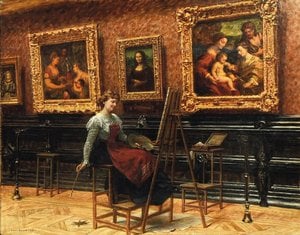
Chambre du Baron Schlichting by Louis Beroud: A Window Into Parisian Elegance
Louis Béroud’s “Chambre du baron Schlichting” (1908) isn't merely a depiction of an interior; it’s a meticulously crafted snapshot of Belle Époque Paris—a testament to the artist’s unwavering dedication to realism infused with a profound understanding of psychological nuance. Examining this chromolithograph reveals layers of artistic intention and offers a glimpse into the opulent tastes of its commissioner, Charles de Noailles.
Composition & Perspective: The artwork centers around a spacious bedroom bathed in diffused natural light—a deliberate choice by Beroud to convey tranquility and sophistication. Linear perspective skillfully guides the viewer’s gaze across the room, emphasizing depth and creating a sense of grandeur. Furniture pieces – a desk, sofa, chaise lounge – are positioned strategically to draw attention to key elements within the scene.
Color Palette & Texture: Dominating the wall space is a muted emerald green—a color associated with serenity and refinement—contrasting beautifully with accents of gold adorning furniture details and framing artwork. Warm tones like brown and beige permeate upholstery fabrics and wooden furnishings, contributing to an overall atmosphere of warmth. Beroud’s masterful use of texture – smooth polished wood surfaces juxtaposed against soft fabric textures – adds tactile richness to the composition.
Style & Technique: Beroud adheres firmly to Academic tradition while subtly incorporating Impressionistic influences. The chromolithograph technique guarantees exceptional detail and color accuracy, capturing the nuances of light and shadow with remarkable precision. Layers of pigment were applied to create depth and luminosity, reflecting Beroud’s meticulous attention to artistic craft.
Symbolism & Emotional Impact: “Chambre du baron Schlichting” transcends a simple visual record; it embodies the spirit of its time—a celebration of aristocratic culture and intellectual curiosity. The abundance of framed artworks speaks volumes about the commissioner's passion for art and contemplation, evoking feelings of nostalgia and transporting viewers back to a bygone era of elegance and refinement.
Historical Context: Created during the Belle Époque (roughly 1871-1914), this artwork reflects the artistic fervor of the period—a reaction against Impressionism's fleeting aesthetic. Beroud’s work stands as a cornerstone of Parisian art history, capturing the grandeur and sophistication that defined the era.
Further Research: Explore Louis Béroud’s biography on Wikipedia (https://en.wikipedia.org/wiki/Louis_B%C3%A9roud) and delve into his celebrated depictions of the Louvre Museum and Opera Garnier. Discover more about Charles de Noailles (https://collections.louvre.fr/en/artists/louis-francois-baron-lejeune-en/) and his patronage of the arts.
Additional Information: You can find “Chambre du baron Schlichting” at Musée Carnavalet (https://collections.louvre.fr/en/art/louis-beroud-chambre-du-baron-schlichting-AR2GFU-en/) and The Louvre (https://collections.louvre.fr/en/ark:/53355/cl010063818).



 Peržiūrėti realaus dydžio版
 Pirkti rankomis tapytą reprodukciją
 Siųsti
 Dalintis
 Išsamiau
 Gidas
Gidas

 Atsisiųsti
 Panašūs eksponatai
 Rentgeno spindulių nuotrauka
 Diaporama
 Statistika


 Rodyti daugiau






































 Stiklo variantas prieinamas tik pasirinkus dydį iki 110 cm