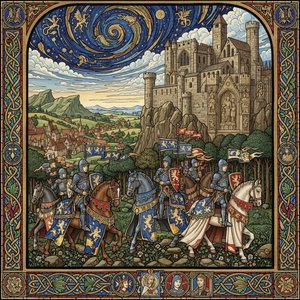
The Master of Steel: The Legacy of Kaspar Rieder
In the twilight of the fifteenth century, amidst the burgeoning splendor of the Renaissance, a unique form of artistry emerged from the heat of the forge and the rhythmic strike of the hammer. Kaspar Rieder (1452-1499), born in the quiet Austrian town of Mühlau, stands as a monumental figure in this specialized tradition. While many artists of his era sought expression through pigment and canvas, Rieder mastered the language of metal, transforming cold, utilitarian steel into breathtaking works of sculptural elegance. He is most renowned for his creation of stechzeug—the elaborate, highly decorative armor specifically engineered for the high-stakes spectacle of jousting tournaments.
The life of Rieder remains partially shrouded in the mists of history, as the archival records of medieval craftsmen are often as fragmented as the eras they inhabited. However, the brilliance of his surviving work allows us to reconstruct a narrative of profound skill and cultural connection. It is widely believed by scholars that Rieder underwent his formative training within the vibrant artistic hub of Innsbruck, Austria. This apprenticeship likely exposed him to the cutting-scale metallurgical techniques of the period and the sophisticated sculptural aesthetics that defined the late Gothic and early Renaissance transition. His style suggests a deep dialogue with Flemish armorers, reflecting a broader European movement where craftsmanship transcended borders to create a unified language of prestige and power.
The Artistry of Stechzeug: Beyond Defense
To understand Rieder’s contribution to art history, one must look beyond the functional necessity of protection. The stechzeug he produced was not merely a suit of defense; it was a canvas for heraldry and high fashion. Unlike standard field armor designed for the chaos of battle, jousting armor required a level of ornamentation that could withstand the scrutiny of the royal court. Rieder’s mastery lay in his ability to manipulate steel through intricate processes such as:
- Embossing: Raising patterns from the reverse side of the metal to create three-dimensional relief.
- Etching: Using acid to bite delicate, swirling designs into the polished surface.
- Gilding: Applying thin layers of gold to highlight heraldic emblems and floral motifs, ensuring the knight shimmered under the sun.
These techniques allowed Rieder to weave complex narratives of lineage and status directly into the armor itself. A single piece, such as the exquisitely preserved sallet housed in the Kunsthistorisches Museum in Vienna, reveals a meticulous attention to detail where subtle textures and light-reflecting surfaces converge. Through his hands, the heavy weight of steel was visually lightened by the grace of floral patterns and the prestige of noble iconography.
Historical Significance and Enduring Influence
The historical significance of Kaspar Rieder extends far beyond the tournament grounds of the 1400s. He represents a pivotal moment in European history when the artisan rose to the level of the fine artist, blurring the lines between functional weaponry and high sculpture. His work served as a vital instrument of political communication, where a knight's very silhouette announced his wealth, his alliances, and his bravery.
Today, Rieder’s legacy is preserved not in galleries of oil paintings, but in the silent, gleaming halls of museums, where his steel masterpieces continue to command awe. He remains a testament to the ingenuity of the Renaissance spirit—a period defined by the belief that even the most rugged materials could be refined into something transcendent. His ability to marry the strength required for combat with the delicacy required for art ensures his place as one of the most significant master armorers in the annals of European history.



 Peržiūrėti realaus dydžio版
 Pirkti rankomis tapytą reprodukciją
 Siųsti
 Dalintis
 Išsamiau
 Gidas
Gidas

 Atsisiųsti
 Panašūs eksponatai
 Rentgeno spindulių nuotrauka
 Diaporama
 Statistika


 Rodyti daugiau






































 Stiklo variantas prieinamas tik pasirinkus dydį iki 110 cm