


Šiame puslapyje rodomas meno kūrinys yra saugomas autorių teisių įstatymais, todėl neturime teisės legaliai kurti ar parduoti jo identiškos reprodukcijos. Ši apsauga užtikrinama remiantis tokiais tarptautiniais susitarimais kaip Bernės konvencija ir pagal nacionalines įstatymų nuostatas, įskaitant tas, kurias nurodo JAV autoriškos teisės įstatymas – 17-asis skyrius.
Šis metodas visiškai atitinka autorių teises, nes jame nėra saugomo kūrinio kopijavimo ar dubliavimo. Tai yra kūrybinė reinterpretacija – naujas paveikslas, kurį įkvėpė originalas, tačiau kuris nėra jo identiškas.
Muziejų lygio „giclée“ arba drobos spausdinimas: greita gamyba ir lankstios apdailos parinktys. ( Pirkti rankų darbo tapybą Perejti prie skaitmeninių vaizdų)





























Pasirinkite iš mūsų nustatytų dydžių, atitinkančių originalaus meno kūrinio proporcijas.

Įveskite jums reikiamą plotį ir aukštį, kad atvaizdas derėtų prie jūsų rėmo ar sienos. Spausdiną galima tik sumažinti, bet nepadidinti virš originalaus paveikslėlio dydžio, todėl keičiant proporcijas, dalis vaizdo prarandama. Prieš spausdinimą atsiųsime jums skaitmeninį maketą patvirtinimui. Šioje puslapio nuotraukoje matomas pjūvis nėra tikslus – jį rodo tik maketas.
Pristatymas visame pasaulyje () per 2 weeks, o ne įprastas 4/5 savaičių laikotarpis. (8 lapkritis)
Orange Impulse
Reprodukcijos matmenys
A red circle with a yellow center anchors the composition, acting as a focal point amidst a field of shifting shapes. Surrounding this central form, various colors and dark, black elements create a sense of tension and contrast. The arrangement suggests a sudden release of energy, a visual pulse captured in 1955. The work moves away from literal representation, favoring a language of pure color and form to communicate movement and cosmic force.
The application of pigment creates a sense of depth, inviting a close examination of the interplay between the organic and the geometric. Through this abstraction, the canvas attempts to translate the intangible rhythms of life into a tangible visual experience.
Created during a period of significant transformation in Canadian modernism, this work reflects a departure from traditional landscape painting. It aligns with the mid-century movement toward spiritualized abstraction, where the artist seeks to express the essence of time and space rather than the physical world.
The piece exemplifies the shift toward a universal, modernist dialogue, moving beyond regionalism to explore the internal mechanics of emotion and motion. It remains a significant example of the era's push to redefine the boundaries of North American art through non-representational expression.
Įrašytas kūrinio „Orange Impulse“ – James Williamson Galloway Macdonald šviesumas yra Soft Shadow.
Rekomenduojamas naudojimas (Focal) ir erdvė (Coworking) – tai dvi rekomendacijos, nurodytos kūriniui „Orange Impulse“ – James Williamson Galloway Macdonald.
„Orange Impulse“ – James Williamson Galloway Macdonald perteikia Energetic pojūtį bendroje Bold nuotaikoje.

James Williamson Galloway Macdonald, known affectionately to the art world as Jock Macdonald, stands as a monumental figure in the evolution of Canadian modernism. Born in the rugged, atmospheric landscape of Thurso, Scotland, in 1897, his early life was steeped in the dramatic textures of his homeland. This foundational connection to nature would later become the heartbeat of his abstract explorations. After honing his technical prowess at the prestigious Glasgow School of Art, Macdonald embarked on a transformative journey across the Atlantic in 1926. Arriving in Canada, he did not merely join an existing art scene; he arrived to ignite a revolution, bringing with him a sophisticated understanding of European avant-garde movements such as Cubism and Surrealism that would eventually dismantle the boundaries of representational painting in North America.
As his career unfolded, Macdonald’s work underwent a profound metamorphosis, moving away from the literal depiction of the world toward a deeper, more spiritualized abstraction. He became a master of capturing the intangible, seeking to translate the very essence of movement, time, and cosmic energy onto the canvas. His palette was as diverse as his imagination, utilizing traditional oils and watercolors alongside experimental industrial materials like Duco and Lucite. This willingness to embrace new media allowed him to achieve a unique sense of depth and luminosity. In masterpieces such as Orange Impulse, one witnesses a vibrant explosion of red and yellow shapes that pulse with the dynamic energy of mid-century modernism, inviting the viewer into a realm where color itself becomes a language of pure emotion.
Macdonald’s contribution to art history extends far beyond his individual canvases; he was a pivotal educator and a catalyst for collective change. Through his influential teaching positions at the Vancouver School of Decorative and Applied Arts and the Ontario College of Art, he nurtured a new generation of Canadian artists, encouraging them to look inward and toward the abstract. As a prominent member of the Painters Eleven, he helped establish a movement that challenged the dominance of landscape painting in Canada, pushing the national identity toward a more universal, modernist dialogue.
His thematic preoccupations often revolved around the organic rhythms of life, frequently utilizing motifs such as birds and aquatic forms to explore the concept of space, time, and motion. Whether it is the whimsical, mid-century charm found in Music Hour, where a vibrant yellow fish serves as a captivating centerpiece, or the more somber, textured reflections in works like Rust of Antiquity, Macdonald’s oeuvre remains a testament to the power of abstraction to touch upon the profound. His ability to blend the organic with the geometric created a visual vocabulary that continues to resonate, ensuring his place as a pioneer who redefined the limits of Canadian art.

1897 - 1960 , United Kingdom

Atraskite 10 geometrinės abstrakcijos šedevrų – nuo Mondriano iki Malevičiaus! Sužinokite apie Piet Mondrian, Kazimir Malevič ir kitus menininkus. Meno kūriniai jūsų interjerui | WahooArt.com
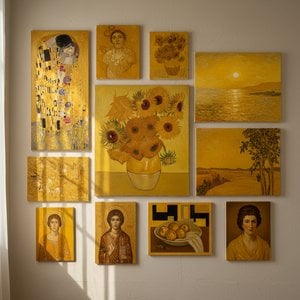
Explore 10 iconic paintings bathed in golden yellow ochre! From Van Gogh's sunflowers to Monet’s haystacks, discover the stories behind these masterpieces. Find museum-quality art reproductions & elevate your home decor on .

Atraskite 10 legendinių abstraktus ekspresionizmo kūrinių! Pažinkite Pollocko, Rothko ir kitų genijų istorijas bei jų spalvingas meno interpretacijas. Puikios meninės reprodukcijos jūsų namams – WahooArt.com

Atraskite 25 įspūdingiausius Mark Rothko kūrinius! Gilinkitės į abstraktaus meno spalvų laukus, ekspresionizmą ir jaustmingas tapybas. Meno reprodukcijos aukščiausia kokybe – WahooArt.com

Explore 25 iconic Kandinsky masterpieces and the birth of abstraction. Discover the full collection online at WahooArt.com.
 Peržiūrėti realaus dydžio版
 Pasidalinti
 Dalintis
 Išsamiau
 Vadovas

 Atsisiųsti
 Panašūs eksponatai
 Rentgeno spindulių nuotrauka
 Automatinė diorama
 问答
问答
 Statistika


 Skaityti daugiau









 Stiklo variantas prieinamas tik pasirinkus dydį iki 110 cm


