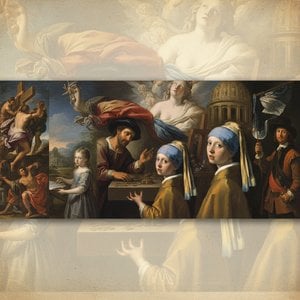
Tintoretto’s Vision of Divine Grace
Jacopo Tintoretto (1518 – 1594), born Jacopo Robusti in Venice, stands as an unparalleled titan amongst Venetian artists of his era—a figure whose turbulent life and revolutionary artistic vision continue to fascinate scholars and inspire collectors alike. Unlike many contemporaries who honed their skills under established masters like Titian, Tintoretto forged his own path with unwavering determination, prioritizing observation and experimentation above all else.
His early years were marked by familial discord; Titian’s dismissal of the young Robusti fueled a rebellious spirit that propelled him toward independent artistic pursuits. While brief encounters with Titian yielded little satisfaction, Tintoretto swiftly established himself as a singular force in Venetian painting—a painter who dared to challenge convention and redefine the boundaries of artistic expression.
A Dramatic Synthesis: Style and Technique
Tintoretto’s distinctive style is characterized by an astonishing dynamism—a palpable sense of movement that imbues his canvases with an almost theatrical quality. He eschewed traditional illusionistic techniques, favoring instead a method known as “sfumato,” which subtly blends colors to create atmospheric depth and luminosity. This masterful manipulation of light and shadow distinguishes Tintoretto’s work from the polished surfaces favored by other Venetian artists.
- Compositional Innovation: Tintoretto frequently employed asymmetrical arrangements, disrupting conventional hierarchies and creating compositions that demanded active engagement from the viewer.
- Dramatic Lighting: He utilized dramatic chiaroscuro—the stark contrast between light and dark—to heighten emotional intensity and convey a sense of urgency.
- Rapid Brushwork: Tintoretto’s technique involved applying paint in rapid, energetic strokes, capturing fleeting moments of action and conveying an unparalleled immediacy.
Echoes of Antiquity and Biblical Narrative
Tintoretto's artistic sensibilities were profoundly influenced by classical sculpture and humanist thought—particularly the works of Michelangelo Buonarroti. He meticulously studied anatomical detail, striving to achieve a level of realism that surpassed anything seen in Venetian painting since Titian’s time.
However, Tintoretto’s most enduring legacy resides in his masterful depiction of biblical narratives—a realm where he seamlessly blended dramatic storytelling with profound spiritual contemplation. His paintings frequently explore themes of faith, redemption, and divine grace, resonating powerfully with audiences across centuries.
Symbolism and Emotional Resonance
Throughout his oeuvre, Tintoretto employed a rich tapestry of symbolic imagery—references to classical mythology, Christian iconography, and Venetian folklore—to enrich the narrative dimension of his canvases. Recurring motifs such as angels, saints, and biblical figures convey complex ideas about morality, spirituality, and human destiny.
More than mere representations of historical events or religious doctrines, Tintoretto’s paintings evoke visceral emotions—awe, wonder, compassion, and terror—capturing the sublime beauty of God's creation and confronting viewers with the inescapable realities of human suffering. His works continue to inspire contemplation and provoke debate about the enduring power of art to illuminate the human condition.
A Legacy Enduring Through Reproduction
Today, Tintoretto’s monumental canvases reside in prestigious museums across Europe and North America—testaments to his unparalleled artistic achievement. High-quality reproductions offer an opportunity to experience the brilliance of his vision firsthand, allowing art lovers, collectors, and interior designers alike to appreciate the transformative impact of his revolutionary style.



 Peržiūrėti realybėje
 Perejti prie spausdinimo
 Pasidalinti
 Dalintis
 Išsamiau

 Atsisiųsti
 Panašūs eksponatai
 Rentgeno nuotrauka
 Automatinė diorama
 Statistika
 Skaityti daugiau






































 Stiklo variantas prieinamas tik pasirinkus dydį iki 110 cm