Muziejų lygio „giclée“ arba drobos spausdinimas: greita gamyba ir lankstios apdailos parinktys. ( Pirkti rankų darbo tapybą Perejti prie skaitmeninių vaizdų)
Pasirinkite iš mūsų nustatytų dydžių, atitinkančių originalaus meno kūrinio proporcijas.

Įveskite jums reikiamą plotį ir aukštį, kad atvaizdas derėtų prie jūsų rėmo ar sienos. Spausdiną galima tik sumažinti, bet nepadidinti virš originalaus paveikslėlio dydžio, todėl keičiant proporcijas, dalis vaizdo prarandama. Prieš spausdinimą atsiųsime jums skaitmeninį maketą patvirtinimui. Šioje puslapio nuotraukoje matomas pjūvis nėra tikslus – jį rodo tik maketas.
Pristatymas visame pasaulyje () per 2 weeks, o ne įprastas 4/5 savaičių laikotarpis. (10 lapkritis)
The Emigrants
Reprodukcijos matmenys
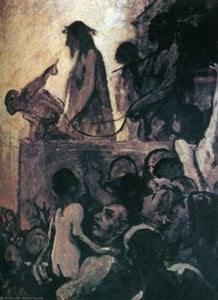
In the somber, monochromatic depths of Honoré Daumier’s “The Emigrants,” we are not merely observers of a sculpture, but witnesses to a profound human tragedy. Created around 1850, this evocative work—rendered in tinted grey plaster—serves as a haunting meditation on the psychological and physical toll of political upheaval. The figures, huddled together in an uncertain outdoor space, embody the very essence of exile. Daumier masterfully captures a spectrum of motion and emotion; some subjects slump under the crushing weight of despair, their bodies surrendered to hopelessness, while others maintain a rigid, upright posture, a silent testament to the dignity one clings to when all else is lost. The composition functions as a dynamic tableau, where the subtle interaction between the figures suggests a shared, collective journey through the shadows of displacement.
The power of this piece lies in its ability to transform a moment of stillness into a narrative of movement and struggle. As one gazes upon the textured folds of their clothing and the weary contours of their limbs, there is an undeniable sense of weight—both literal and metaphorical. For the discerning collector or interior designer, "The Emigrants" offers more than just a visual focal point; it provides a profound emotional anchor. It is a work that invites contemplation, making it an ideal centerpiece for spaces designed for reflection, such as a private study, a sophisticated library, or a gallery-style living area where art is intended to provoke thought and conversation.
Daumier’s technical execution in "The Emigrants" reveals his deep roots in classical influences, particularly the dramatic chiaroscuro reminiscent of Rubens. However, he eschews the idealized beauty of antiquity in favor of a piercing, unvarnished realism. The use of plaster, tinted with a muted grey, allows for a masterful play of light and shadow that emphasizes the three-dimensional anatomy of each figure. Every crease in the fabric and every slumped shoulder is rendered with meticulous detail, imbuing the sculpture with a palpable sense of life and vulnerability.
This commitment to anatomical accuracy and psychological nuance is what elevates the work from mere caricature to high art. Daumier does not shy away from the "unpolished" truths of the human condition; instead, he uses his sculptural prowess to highlight the textures of suffering and the resilience of the spirit. The monochromatic palette ensures that the viewer is not distracted by color, but is instead drawn into the raw, emotional landscape of the subjects. For those seeking a high-quality reproduction, this piece offers an unparalleled opportunity to bring the gravitas of 19th-century French Realism into a contemporary setting, adding a layer of historical depth and intellectual sophistication to any curated collection.
Onorė Domjė kūrybos enceklopedijoje kūrinys „The Emigrants“ priskiriamas Mature Period laikotarpiui. Šis etapas leidžia palyginti jį su kitais šio autoriaus kūriniais.
„The Emigrants“ – Onorė Domjė technika – Plaster. Kopijos siekia atkartoti šios technikos vaizdą.
Kataloge „The Emigrants“ – Onorė Domjė priskirtas kategorijai Sculpture. Ši kategorija padeda rasti panašius kūrinius.


1808 - 1879 , Prancūzija

Journey through art history with 10 legendary bronze sculptures – from Michelangelo's David to Rodin’s Thinker. Explore the stories, techniques & timeless beauty of these masterpieces. Find museum-quality reproductions & elevate your home decor on WahooArt.com.

Explore the life & work of Honoré Daumier, a master of 19th-century French realism and satire. Discover his powerful lithographs, paintings, and sculptures critiquing society – and his lasting influence on modern art.

Journey through art history with our Top 10 bronze sculptures! Explore masterpieces by Rodin, Michelangelo & more. Discover stories behind iconic statues and find museum-quality reproductions for your home decor at WahooArt.com.

Explore 10 defining masterpieces of Romantic Realism! Discover Courbet, Millet & Daumier's powerful paintings—capturing emotion and social realities. Find museum-quality reproductions for your home at WahooArt.com.

Explore the rich history of sculpture from ancient masterpieces to contemporary innovations. Discover key techniques, influential artists & investment potential for discerning art collectors.
 Pasidalinti
 Dalintis
 Išsamiau
 Vadovas

 Atsisiųsti
 Panašūs eksponatai
 Automatinė diorama
 问答
问答
 Statistika


 Skaityti daugiau






































 Stiklo variantas prieinamas tik pasirinkus dydį iki 110 cm