Gaukite spausdinimui paruoštą failą, kurio kokybė gerokai viršija internetinę peržiūrą. Kiekvienas mūsų parduodamas skaitmeninis vaizdas yra ištrauktas iš aukštos raiškos pagrindinio failo mūsų duomenų bazėje — paprastai jis siekia nuo 5 000 iki 15 000 pikselių plotio — todėl galite drąsiai spausdinti didelius formatus, apkirpti vaizdą ar reprodukcija užtikrins visas smulkias detales.
Mūsų studijoje nė viena kopija nelieka neapdorota. Skaitmeninio vaizdo ekspertas, lygiu su originaliu paveikslu, patikrina spalvas ir, jei reikia, jas koreguoja, o tada profesionaliais retušavimo įrankiais padidina aiškumą bei detales — visada išlaikydamas ištikimybę autoriaus teptuko traukoms ir stiliui. Rezultatas – vaizdas, kuris atrodo kaip tikras paveikslas, o ne kaip su filtrais apdorotas skenavimas.
Patvirtinate prieš užsakymo pabaigą: mūsų ekspertas per 72 valandas el. laišku atsiųsta vaizdą jūsų peržiūrai. Nepasitenkinate rezultatu? Paprašykite patobulinimų ar pataisymų arba prašykite pinigų grąžinimo, jei kokybė neatitinka jūsų lūkesčių.
Ši kokybė yra patikima leidybos įstaigoms, dizaino studijoms, galerijoms ir spaudos įmonėms.
Atsisiųskite didelės raiškos failą asmeniniam naudojimui, spausdinimui ir kūrybiniams projektams. ( Perjungti į spausdinamus版作品 Pirkti rankų darbo tapybą)
Pasirinkę WahooArt.com, jūs ne tik gaunate paveikslėlį – jūs gaunate profesionaliai patobudintą skaitmeninį kūrinį, sukurtą itin tikniai ir užtikrinantį pasitenkinimą. Štai viską, kas automatiškai pritékia jūsų užsakymui:
Jūsų aukštos raiškos skaitmeninis vaizdo failas bus išsiųstas el. paštu per 72 valandas nuo užsakymo – jis bus paruoštas naudoti be jokių papildomų veiksmų.
Jūsų meno kūrinys profesionaliai optimizuojamas naudojant pažangius dirbtinio intelekto įrankius ir rankinį redagavimą, užtikrinant maksimalią detalę, aiškumą ir spalvų tikslumą.
Atsitiktinai ištrytikote ar praradote savo failą? Nebijokite – bet kuriuo metu atsiųsime jį jums vėl nemokamai.
Mėgaukitės savo meno kūrynu be jokių muitinės mokesčių, įkainų ar pristatymo išlaidų – skaitiniai failai visada yra neapmokestinami.
Naudodami profesionalią įrangą ir spalvų valdymo sistemas, užtikriname, kad jūsų skaitmeninis vaizdas kuo tiksliau atspindėtų originalias spalvas.
Jei nebuvosite patenkinti įsigyto skaitmeninio vaizdo, mes jį tališkai koreguosime arba grąžinsime 100% sumą per 100 dienų – be jokių klausimų.
Nesitenkinate? Gaukite visą sumokėtą sumą per 100 dienų nuo skaitmeninio failo gavimo – be jokių papildomų klausimų.
Pirkti 3 nuotraukas – 10% nuolaida – Pirkti 5 – 15% nuolaida – Pirkti 10 ir daugiau – 20% nuolaida. Puikiai tinka kūrybiniams projektams, galerijoms bei agentūroms.

Erik Olson was born on 9 May 1901 in Halmstad, Sweden. Growing up in Halmstad, he was part of an artistic environment that included his brother, the artist Axel Olson. His early path was not set on a creative life; his father had expected him to become an engineer. Instead, Olson spent his evenings cultivating his interest in drawing and painting by studying at the Halmstad Technical School. This period of self-directed study provided the foundation for a career that would eventually move far beyond the technical constraints his father had envisioned.
The trajectory of his training shifted significantly through contact with the avant-garde. In 1919, Olson participated in an amateur show in Halmstad secondary school alongside his brother and cousin Waldemar Lorentzon. This exhibition brought him into contact with Gosta Adrian-Nilsson, a meeting that fundamentally altered his artistic direction. By 1924, Olson had moved to Paris with Lorentzon. They enrolled at the Academie Moderne, studying under Fernand Léger. This formal training in the school spirit of cubism provided the technical rigor that would define his later explorations of surrealism and complex spatial perspectives.
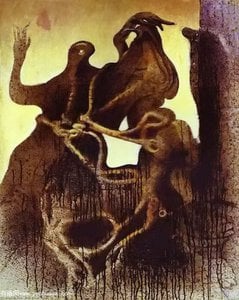
Olson’s reputation rests on his command of Swedish surrealism. He moved away from the rigid structures of cubism to embrace a style defined by dream-like, over-realistic depictions. His canvases do not merely represent objects; they construct entire psychological landscapes. These works often feature ecstatic and erotic space travels, pushing the viewer into environments that defy standard logic. He utilized light paintings to define these spaces, creating a sense of depth that feels both physical and hallucinatory.
The technical execution of his work relies on the use of labyrinthine spaces and impossible perspectives. He rejected the comfort of a stable horizon, opting instead to build complex, winding environments that trap the eye. Within these distorted geometries, he placed mythological figures that feel grounded by their hyper-realistic rendering. This tension between the recognizable detail of the subject and the irrationality of the setting is what gives his visionaries such weight. He did not rely on abstraction to create unease; he used clarity to make the impossible feel tangible.
Olson’s career was defined by a restless movement between the avant-garde circles of Europe and the regional art scene of Sweden. In 1915, he helped form the group Gnistan, an early step that preceded his significant shift toward international modernism. His time in Paris was particularly decisive. While studying at the Académie Moderne, he became part of the concrete art group Cercle et Carré, a connection that solidified his standing within the European avant-garde. This period was not merely about learning; it was about positioning himself within the most radical shifts of the era.
His commitment to collective identity was a recurring theme. In 1929, he became a co-founder of Halmstadgruppen, a group that would become a central force in Swedish art. This membership was not a static affiliation; it remained a constant throughout his professional life. His influence also extended across borders, as he became a member of a Danish surrealist group in Copenhagen after moving to Denmark in 1935. Even when political tensions forced him to flee occupied Denmark in 1944, his ties to the Halmstadgruppen remained intact, anchoring his return to Sweden.
Olson’s artistic trajectory shifted significantly in 1950 when he converted to Catholicism. This spiritual turn redirected his focus toward religious art, moving away from the earlier surrealist explorations that defined his mid-career. His later years were marked by a renewed engagement with sacred themes, translating his visual language into the medium of glass.
His contribution to ecclesiastical architecture is most visible in his stained glass commissions. He moved beyond the canvas to manipulate light through glass, creating works that occupy specific liturgical spaces. These installations demonstrate how his formal training in composition was applied to the structural requirements of church interiors.
Olson’s presence in major institutional collections confirms his standing within the Swedish and international canon. His works are represented at the National Museum, ensuring his contribution to the country's visual history remains accessible. On a global scale, his pieces are held by the Museum of Modern Art, placing his surrealist explorations within a broader context of twentieth-century modernism.
The reach of his legacy extends through significant exhibition histories in Sweden. His paintings have been featured at Liljevalchs konsthall in Stockholm, a venue that has hosted his work alongside other major movements. Additionally, his art has been exhibited at the Malmö museum, marking his continued relevance in regional art discourse. These locations provide the necessary physical evidence of his influence on the development of surrealism and cubism in the Nordic region.

1901 - 1986 , Švedija
 Peržiūrėti realaus dydžio版

 Pasidalinti
 Dalintis
 Išsamiau
 Vadovas


 Atsisiųsti
 Panašūs eksponatai
 Rentgeno spindulių nuotrauka
 Automatinė diorama
 问答

 Statistika


 Skaityti daugiau