


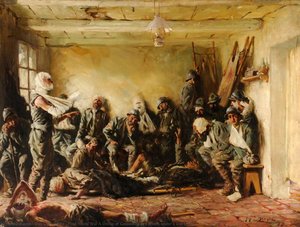
 1917
1917 148.0 x 192.0 cm
Įsigykite aukštos skiriamosios raiškos, patobulintą skaitmeninį vaizdą, gerokai pranašesnį už internetinę peržiūrą.
Kiekvieną failą mūsų specialistai kruopščiai paruošia naudojant pažangias technologijas ir profesionalų rankinį retušavimą. Užtikriname, kad kiekvienas vaizdas pasižymėtų išskirtiniu aiškumu, tikslia spalvų atspalviu ir smulkiomis detalėmis.
Baigiamas failas el. paštu pristatomas per 72 valandas; jis optimizuotas nedelsiant naudojimui profesionalioje, redakcinėje ir spausdinimo aplinkoje. Tai ta pati kokybė, kuria pasitiki aukščiausios klasės dizaino studijos, leidyklos ir galerijos.
Atsisiųskite didelės raiškos failą asmeniniam naudojimui, spausdinimui ir kūrybiniams projektams. ( Pirkti spaudinį Pirkti rankomis tapytą paveikslą)
Pasirinkę WahooArt.com, jūs ne tik gaunate paveikslėlį – jūs gaunate profesionaliai patobudintą skaitmeninį kūrinį, sukurtą itin tikniai ir užtikrinantį pasitenkinimą. Štai viską, kas automatiškai pritékia jūsų užsakymui:

Jūsų aukštos raiškos skaitmeninis vaizdo failas bus išsiųstas jums el. paštu per 72 valaudas nuo užsakymo – paruoštas naudojimui be jokių papildomų veiksmų.

Jūsų meno kūrinys profesionaliai optimizuojamas naudojant pažangius dirbtinio intelekto įrankius ir rankinį redagavimą, užtikrinant maksimalią detalę, aiškumą ir spalvų tikslumą.

Atsitiktinai ištrytikote ar praradote savo failą? Nebijokite – bet kuriuo metu atsiųsime jį jums vėl nemokamai.

Mėgaukitės savo meno kūriniu akimirka – skaitiniai failai visada yra neapmokestinami, todėl nereikės mokėti muitinės, mokesčių ar pristatymo mokesčių.

Naudodami profesionalią įrangą ir spalvų valdymo sistemas, užtikriname, kad jūsų skaitmeninis vaizdas kuo tiksliau atspindėtų originalias spalvas.

Jei nebuvate patenkinti savo skaitinio vaizdo, per 100 dienų jį pertaisysime arba grąkinsime 100% sumą – be jokių klausimų.

Nepat 만족inti? Gaukite visą sumokėtą sumą per 100 dienų nuo skaitmeninio failo gavimo – be jokių papildomų klausimų.

Pirkti 3 nuotraukas – pasiūla 10% - Pirkti 5 – pasiūla 15% - Pirkti 10 ir daugiau – pasiūla 20%. Puikiai tinka kūrybiniams projektams, galerijoms bei agentūroms.

Guy Lipscombe (1881 – 1952) remains a captivating figure in the annals of British art, a painter whose brush possessed the rare ability to oscillate between the serene beauty of the natural world and the harrowing realities of human conflict. Born in Teddington, London, on August 22, 1881, Lipscombe’s artistic journey was forged in some of the most prestigious institutions of his era. His meticulous training at Hatherley’s School of Art and the Slade School of Art, further enriched by a coveted scholarship at the Royal Academy Schools, provided him with a formidable technical foundation. This rigorous academic background allowed him to master the nuances of light and form, a skill that would later serve him both in the sun-drenched landscapes of Cornwall and the somber, gas-lit rooms of the Italian Front.
Before he became a chronicler of war and landscape, Lipscombe established himself as a masterful illustrator. In the early years of the twentieth century, his keen eye for movement and mechanical precision found a home in the pages of “The Motor,” a publication founded in 1903. His ability to capture the kinetic energy of early automobiles—most notably seen in his depiction of the 1907 French Grand Prix—solidified his reputation as an artist capable of rendering both speed and intricate detail. This period of his life, characterized by a fascination with the burgeoning age of technology, instilled in him a precision that would later lend a profound sense of realism to his more emotive works.
While his early career was defined by the mechanical, Lipscombe’s heart belonged to the landscape. Influenced heavily by the St Ives School, he embraced the plein air tradition, seeking to capture the ephemeral qualities of light as it danced across the Cornish coastline. His canvases from this period are celebrated for their vibrant palettes and expressive brushwork, reflecting an emotional depth that sought to convey the very soul of the landscape. He did not merely paint scenery; he painted the atmosphere, the salt spray, and the ethereal glow that defines the British coast.
However, the trajectory of his life and art was irrevocably altered by the outbreak of the Great War. Driven by a sense of duty, Lipscombe volunteered as a driver for the British Red Cross Society, serving with the No. 3 British Red Cross Ambulance Unit on the Italian Front. This transition from observer of light to witness of tragedy brought about a profound shift in his creative output. The landscapes of peace were replaced by the stark, often devastating imagery of combat and its aftermath. His experiences in Italy yielded several monumental oil paintings that serve as haunting historical documents, including:
These works, several of which were commissioned by and now reside within the prestigious collection of the Imperial War Museum, stand as powerful testimonies to the era’s anxieties. Through his art, Lipscombe bridged the gap between the aesthetic beauty of the natural world and the visceral, often grim, realities of history. His ability to navigate these two extremes—the tranquil Cornish light and the shadows of the Italian Front—ensures his enduring significance as an artist who captured the full spectrum of the human experience during one of the most transformative periods in modern history.
1881 - 1952

 Peržiūrėti realybėje
 Pasidalinti
 Dalintis
 Išsamiau

 Atsisiųsti
 Panašūs eksponatai
 Rentgeno nuotrauka
 Automatinė diorama
 Skaityti daugiau


