A Celestial Ascent: Delving into Gustave Moreau’s Symbolist Vision
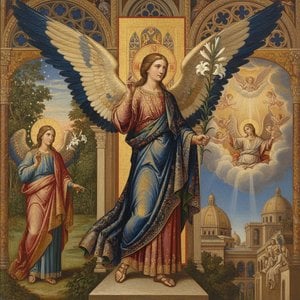
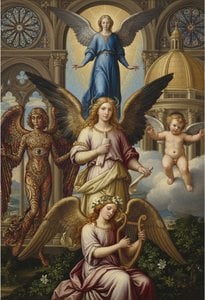
Gustave Moreau's untitled painting, cataloged as 8351, is not merely an image; it’s an invitation to a realm of ethereal beauty and profound contemplation. The work embodies the core tenets of Symbolism, a movement that prioritized emotional resonance and subjective experience over strict representational accuracy. Here, we encounter an angelic figure rising from a rugged coastline towards a luminous sunset – a scene steeped in mystery and suggestive of spiritual transcendence. It’s a painting that doesn't offer answers but instead sparks questions about faith, hope, and the journey between earthly existence and something beyond.
The Language of Dreams: Style and Technique
Moreau was a pivotal figure in the Symbolist movement, and this piece exemplifies his distinctive style. Rejecting the immediacy of Realism and Impressionism, he sought to express deeper, often mystical, truths through evocative imagery. The angel itself is not sharply defined; its form blends with the atmospheric effects, emphasizing its otherworldly nature. This deliberate ambiguity isn’t a lack of skill but rather a conscious choice – a way to suggest the intangible and invite viewers into a space of personal interpretation. The technique is characterized by loose brushstrokes and a masterful use of atmospheric perspective, creating an ethereal quality that feels akin to a dreamscape. Notice how Moreau doesn't prioritize precise detail; instead, he relies on suggestion and mood to convey his vision. The painting’s surface seems to shimmer with light and shadow, further enhancing its sense of mystery.
Echoes of the Past, Visions of the Future
To understand this work fully, it's essential to consider its historical context. Gustave Moreau (1826-1898) flourished during a period of significant artistic upheaval in France. He deliberately turned away from academic conventions, embracing mythological and biblical themes and imbuing them with personal symbolism. He was deeply influenced by Renaissance masters like Michelangelo and Leonardo da Vinci – echoes of their dramatic compositions and expressive figures can be subtly discerned – but he forged his own unique path. Moreau’s bold use of color and expressive forms profoundly impacted later artists, including Henri Matisse and Georges Rouault, who admired his ability to convey complex emotions through visual language. A visit to the Musée Gustave Moreau in Paris, housed in his former studio-home, offers an unparalleled glimpse into his artistic world and the environment that nurtured such visionary creations.
Symbolism Unveiled: A Journey of Interpretation
The painting is rich with symbolic meaning, inviting multiple interpretations. The angel’s wings represent spiritual liberation and the potential for transcendence, a yearning to rise above earthly constraints. Below, the turbulent water can be seen as symbolizing the challenges and chaos inherent in life, while the sunset often signifies endings, transitions, or a gateway to another realm. The hazy atmosphere contributes significantly to this sense of mystery and ambiguity, allowing viewers to project their own emotions and experiences onto the scene. Is it an image of hope? Redemption? Or simply a poignant meditation on mortality? The power of Moreau’s work lies in its ability to resonate with each viewer on a deeply personal level.
An Aesthetic Resonance: Bringing the Vision Home
This artwork evokes a range of emotions – awe, wonder, longing, and perhaps even a touch of melancholy. The dramatic lighting, with its warm glow emanating from the sunset, creates a sense of spiritual intensity. The painting’s ethereal quality makes it particularly well-suited for spaces seeking to inspire contemplation and reflection. Its muted color palette and expressive brushwork would complement both traditional and contemporary interiors, adding a touch of timeless elegance and artistic depth. A high-quality reproduction allows art enthusiasts to experience Moreau’s vision firsthand, bringing the beauty and mystery of this Symbolist masterpiece into their homes or offices as a statement piece that invites conversation and inspires the soul.
问答 (or more naturally for a website heading): Klausimai ir atsakymai
Kokia erdvė rekomenduojama šiam kūriniui „untitled (8351)“, autorius – Gustavas Moreaus?
„untitled (8351)“ reprodukcija puikiai tinka į Living Room.
Kiek šviesos, kaip atrodo, atspindi „untitled (8351)“ spalvos?
„untitled (8351)“ spalvos pasižymi Gentle Luminance šviesos intensyvumu.
Kur galiu rasti statistiką apie „untitled (8351)“, autorius – Gustavas Moreaus?
Statistika apie „untitled (8351)“, autorius – Gustavas Moreaus pateikiama kūrinio Statistika puslapio: mėnesiniai kūrinio apsilankėjimai, kūrinio autorių darbų apsilankėjimai bei neseniai apsilankiusiųjų skirstymas pagal šalis ir kalbas.



 Peržiūrėti realaus dydžio版
 Perjungti į spausdinimą
 Siųsti
 Dalintis
 Išsamiau
 Vadovas

 Atsisiųsti
 Panašūs eksponatai
 Rentgeno spindulių nuotrauka
 Diaporama
 Statistika
 Rodyti daugiau






































 Stiklo variantas prieinamas tik pasirinkus dydį iki 110 cm