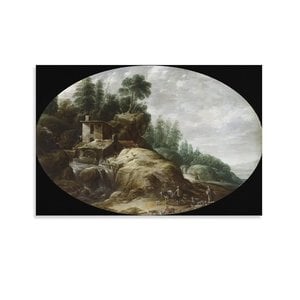
The Verdant Visions of Gillis Peeters
In the golden age of Flemish Baroque, few artists captured the intersection of terrestrial beauty and maritime exploration as poignantly as Gillis Peeters. Born in the vibrant artistic hub of Antwerp in 1612, Peeters was a product of a lineage deeply embedded in the craft of painting. He emerged from a family of remarkable talent, including his siblings Catharina, Jan, and Bonaventura, whose collective work helped define the landscape and marine traditions of the seventeenth century. His early years were shaped by the rigorous training characteristic of the Antwerp Guild of Saint Luke, where he achieved master status in 1634 alongside his brother. This foundation allowed him to weave together the technical precision of the Flemish tradition with a burgeoning sense of worldly curiosity.
The artistry of Peeters was never static; it was an evolving dialogue between the established masters and the uncharted territories of the New World. While his early stylistic inclinations drew heavily from the atmospheric, idealized landscapes of Paul Bril, he moved away from mere imitation to find a voice that favored tonal subtlety over grandiosity. His work often eschewed the opulent, dramatic flourishes seen in the works of Rubens, opting instead for a more tranquil, contemplative approach to nature. This sensitivity to light and atmosphere allowed him to transform simple vistas into emotive experiences, where the play of shadow across a meadow or the soft haze over a distant riverbank invited the viewer into a state of quiet wonder.
Voyages to the Brazilian Frontier
Perhaps the most defining chapter of Peeters’ life was his role as a visual chronicler of colonial expansion. Unlike many of his contemporaries who remained tethered to the European landscape, Peeters’ spirit was one of adventure. It is widely believed that he undertook expeditions to Brazil, likely traveling in the company of Johan Maurits van Nassau-Siegen, the governor of Dutch Brazil. These journeys, potentially occurring around 1636 and 1640, fundamentally altered the trajectory of his oeuvre. He was not merely a traveler but an observer tasked with documenting the lush, exotic vistas of a burgeoning colonial enterprise.
These Brazilian commissions represent a monumental achievement in his career, as they bridged the gap between European landscape conventions and the raw, vibrant reality of South American ecology. His paintings from this period served a dual purpose: they were aesthetic triumphs that captured the breathtaking beauty of the tropics, and they functioned as vital visual records for administrators and settlers. Through his brush, the dense foliage and unique light of Brazil were translated into a language understood by the European eye, blending the familiar techniques of Flemish landscape painting with the unprecedented subject matter of the Atlantic frontier.
A Legacy of Light and Water
The historical significance of Gillis Peeters lies in his ability to harmonize the domestic tranquility of Flanders with the expansive horizons of global exploration. His contributions to marine art and landscape painting helped expand the boundaries of what Flemish art could represent, moving it beyond the borders of Europe. Even as he collaborated with figures like his brother Bonaventura or drew inspiration from masters like Anthony Claesz the Younger, Peeters maintained a singular focus on the atmospheric essence of his subjects.
Today, his work remains a testament to an era of profound transition. His paintings are more than mere depictions of scenery; they are windows into a period when the world was rapidly expanding through trade, conquest, and discovery. Whether portraying a quiet watermill in the Belgian countryside or a sun-drenched vista in Brazil, Peeters’ legacy is defined by a masterful command of light and an enduring ability to capture the soul of the landscape.



 Peržiūrėti realybėje
 Perejti prie spausdinimo
 Pasidalinti
 Dalintis
 Išsamiau

 Atsisiųsti
 Panašūs eksponatai
 Rentgeno nuotrauka
 Automatinė diorama
 Statistika
 Skaityti daugiau