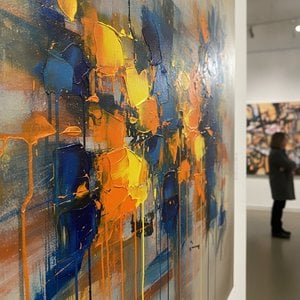
A Study in Controlled Chaos: Exploring Gerhard Richter’s “Dark”
Gerhard Richter's "Dark," painted in 1968, is not merely an abstract composition; it’s a carefully constructed meditation on memory, displacement, and the very nature of perception. This close-up view reveals a canvas saturated with vibrant hues – bold reds and oranges battling against cooler blues – all rendered through Richter's signature technique of layered brushstrokes and subtly blurred surfaces. The painting immediately evokes a sense of unease, a feeling amplified by the deliberate ambiguity at its core. It’s a work born from a specific historical moment: Germany in the turbulent years following World War II, a nation grappling with the aftermath of unimaginable destruction and profound moral questions.
- Abstract Expressionism Revisited: While firmly rooted in the abstract expressionist movement, Richter's approach transcends simple imitation. He doesn’t employ the raw emotionality often associated with artists like Pollock; instead, he channels a more controlled, almost clinical energy into his work.
- Technique and Texture: The painting’s surface is a complex tapestry of applied paint – thick impasto in areas contrasted by thinner washes. Richter's use of glazing techniques creates an illusion of depth and luminosity, while the deliberate blurring introduces an element of uncertainty, mirroring the fragmented nature of memory itself.
The Weight of History
Richter’s personal history profoundly informs “Dark.” Born in Dresden in 1932, he experienced firsthand the instability and trauma of a nation divided. His childhood was shaped by displacement – his family repeatedly relocated during the war – an experience that instilled within him a deep-seated sense of disorientation. This biographical context is crucial to understanding the painting’s emotional resonance. The intense colors, particularly the reds and oranges, can be interpreted as echoes of the fires and destruction that ravaged Germany during the conflict, while the blues represent a yearning for peace and stability – a desire perhaps never fully realized.
The blurred areas within the composition are not accidental; they actively disrupt our ability to grasp a definitive image. This technique subtly suggests the fallibility of memory, the way in which experiences can be distorted or obscured over time. Richter masterfully utilizes this ambiguity to invite viewers into a dialogue with the work, prompting them to confront their own interpretations and emotional responses.
Symbolism and Emotional Impact
"Dark" resists easy categorization or definitive interpretation. The title itself suggests a preoccupation with shadow – not just literal darkness, but also the hidden aspects of human experience. The painting’s power lies in its ability to evoke a profound sense of melancholy and introspection. It's a work that demands attention, inviting viewers to contemplate themes of loss, uncertainty, and the enduring impact of historical trauma.
- Color as Emotion: Richter’s masterful use of color is central to the painting’s emotional impact. The vibrant reds and oranges convey passion, intensity, and perhaps even a hint of danger, while the blues offer a counterpoint of calm and reflection.
- The Blur – A Key Element: The blurred areas are not simply stylistic choices; they represent the subjective nature of perception and the difficulty of accessing objective truth.
A Masterpiece of Controlled Ambiguity
Gerhard Richter’s “Dark” is a testament to his extraordinary skill as an artist and his profound understanding of human psychology. This painting, created in 1968, remains a powerful example of abstract expressionism's ability to convey complex emotions and ideas through the manipulation of color, texture, and form. A hand-painted reproduction offers a unique opportunity to experience this captivating artwork firsthand, bringing Richter’s vision into your space and inviting contemplation for years to come.
问答 (or more naturally for a website heading): Klausimai ir atsakymai
Kokio meno kryžmės dalis yra „Dark“, autorius – Gerhardas Richter?
Kūrinio „Dark“, autorius – Gerhardas Richter stilius – Abstract Expressionism. Ši klasifikacija leidžia šį darbą įtraukti į bendrą susijusių menininkų ir kūrinių kontekstą.
Kokią Gerhardas Richter kūrybos etapą atitinka „Dark“ data, nurodyta kaip 1968?
1968 m. data įtraugia "Dark" į Gerhardas Richter kūrybinio plėtojimo Mature Period laikotarpį.
Kur galiu įsigyti „Dark“, autorius – Gerhardas Richter skaitmeninį vaizdą?
Skaitmeninį „Dark“, autorius – Gerhardas Richter vaizdą galima įsigyti šio kūrinio puslapio Skaitmeninis vaizdas skiltyje: aukštos raiškos skaitmeninio vaizdo atsisiuntimas.



 Peržiūrėti realaus dydžio版
 Perjungti į spausdinimą
 Siųsti
 Dalintis
 Išsamiau
 Vadovas

 Atsisiųsti
 Panašūs eksponatai
 Rentgeno spindulių nuotrauka
 Diaporama
 Statistika

 Rodyti daugiau






































 Stiklo variantas prieinamas tik pasirinkus dydį iki 110 cm