


Rankiniu būdu tapytas aliejus ant droblio jūsų pageidaujamame dydį ir rėmuose – mūsų menininkų darbas pagal užsakymą. ( Pirkti spaudinį Pirkti vaizdą)





























Pasirinkite iš mūsų nustatytų dydžių, atitinkančių originalaus meno kūrinio proporcijas.

Galite įvesti savo matmenis, kad jie atitiktų konkretų rėmą ar erdvę. Jei pasirinktas dydis neatitinka originalaus paveikslėlio proporcijų, mes arba apkropsime meno kūrinį, arba papildysime tapybą rankomis dažytい elementais. Prieš pradėdami gamybą, jūsų patvirtinimui atsiųsime skaitmeninį maketą.
Atkreipkite dėmesį, kad ekrane rodomas vaizdas neatspindi tikrojo apkarpymo ar papildymo. Tik maketas tiksliai parodys galutinę kompoziciją.
Nors galima rinktis ir individualius dydžius, rekomenduojame pasirinkti matmenis iš nustatytos sąrašo, kad būtų išlaikytos originalios proporcijos.
Pristatymas visame pasaulyje () per 3–4 savaites, o ne įprastai – per 5 savaites. (6 rugsėjis). Kokybė lieka nepakeičiama.


The Models
Reprodukcijos matmenys
Georges Pierre Seurat’s “The Models” presents a captivating tableau of modern life, a snapshot of leisure and observation rendered with the revolutionary precision that would define his legacy. The painting depicts three nude women – positioned with an almost scientific detachment – engaged in a quiet moment before a wall adorned with images, suggesting a space of contemplation or perhaps a salon gathering. This is not merely a portrait; it’s a carefully constructed exploration of light, color, and the burgeoning concerns of Parisian society at the turn of the 20th century.
Seurat’s development of Pointillism was a radical departure from Impressionism, which focused on capturing immediate sensory impressions. While Impressionists sought to depict the *effect* of light, Seurat aimed to analyze and reproduce it scientifically. He meticulously studied the work of Eugène Louis Pradé, a physician who had researched color perception, and applied these findings to his artistic practice. This dedication to scientific rigor is evident in the almost mathematical precision with which he built up the painting’s surface – a testament to his intellectual curiosity and unwavering commitment to innovation.
Beyond its technical brilliance, "The Models" possesses a subtle emotional depth. The women’s averted gazes suggest a private moment of reflection or perhaps a shared understanding. The inclusion of the framed pictures on the wall adds another layer of meaning, hinting at themes of art, culture, and intellectual discourse. The scattered bottles – a detail often overlooked – could represent conviviality, indulgence, or even the fleeting nature of pleasure.
"The Models" stands as a pivotal work in the history of modern art, representing a crucial bridge between Impressionism and Post-Impressionism. Its innovative technique, intellectual rigor, and subtle emotional resonance continue to captivate viewers today. A hand-painted reproduction offers an unparalleled opportunity to experience the brilliance of Georges Seurat’s vision – a testament to his genius and a timeless celebration of light, color, and the human condition.


1859 - 1891 , Prancūzija
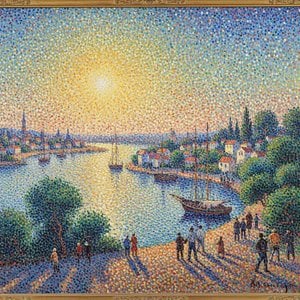
Embark on a sophisticated journey into the luminous world of Neo-Impressionism. Uncover the scientific brilliance of Pointillism, from Georges Seurat’s revolutionary color theory to the mesmerizing magic of the dot. An expert exploration for true art history enthusiasts.
Discover the mesmerizing world of Pointillism. Explore the revolutionary techniques of Georges Seurat, the science of optical color mixing, and the enduring legacy of Neo-Impressionism in this expert guide for classical art enthusiasts.

Explore the scientific brilliance of Seurat and Signac. Discover how Pointillism revolutionized color through optical mixing and light, offering a profound look into the Neo-Impressionist movement for true art connoisseurs and collectors.

Explore the vibrant evolution of Post-Impressionism. From Seurat's revolutionary Pointillism to the emotional depth of masters, discover how this movement redefined modern art history through color, structure, and unparalleled creative expression.

 Peržiūrėti realybėje
 Pasidalinti
 Dalintis
 Išsamiau

 Atsisiųsti
 Panašūs eksponatai
 Rentgeno nuotrauka
 Automatinė diorama

 Skaityti daugiau







 Stiklo variantas prieinamas tik pasirinkus dydį iki 110 cm


