Muziejų lygio „giclée“ arba drobos spausdinimas: greita gamyba ir lankstios apdailos parinktys. ( Pirkti rankomis tapytą reprodukciją
Perejti prie skaitmeninių vaizdų)
Pasirinkite iš mūsų nustatytų dydžių, atitinkančių originalaus meno kūrinio proporcijas.
Galite nurodyti savo matmenis, kad vaizdas atitiktų konkretų rėmą ar erdvę. Jei pasirinktas dydis nesutaps su originalaus paveikslėlio proporcijomis, mes arba apkirpsime kūrinį, arba išplėsime vaizdą naudojant veideliu atspindėtą arba vientisą šoną. Skaitmeninis maketas bus išsiųstas jums patvirtinti prieš pradedant gamybą.
Atkreipkite dėmesį, kad ekrane matomas vaizdinys neatspindi tikrojo apkirpimo ar išplėtimo. Tik maketas tiksliai parodytų galutinę kompoziciją.
Nors galima rinktis ir individualius dydžius, rekomenduojame pasirinkti vieną iš išanksti nustatytų matmenų, kad būtų išlaikytos originalios proporcijos.
Pristatymas visame pasaulyje () per 2 weeks, o ne įprastas 4/5 savaičių laikotarpis. (23 rugsėjis)
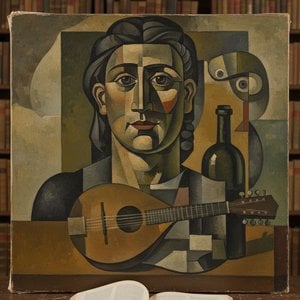
Woman With A Mandolin 1
Reprodukcijos dydis
In the quiet revolution of 1910, Georges Braque birthed a visual language that would forever dismantle the traditional window of art. Woman With A Mandolin 1 is not merely a portrait; it is a profound exploration of how we perceive reality through the lens of fragmentation and reconstruction. At first glance, the viewer encounters a complex tapestry of interlocking planes and geometric shapes, where the boundaries between the subject and her environment begin to dissolve. The woman, seated with her instrument, becomes part of a larger architectural rhythm, her form broken into cubes and cylinders that echo the structural experiments of Paul Célamine. This is the essence of Analytic Cubism—a deliberate rejection of illusionistic depth in favor of a multidimensional truth that challenges the eye to piece together a musical reverie from scattered shards of light and shadow.
The technical mastery behind this masterpiece lies in Braque’s ability to evoke texture and weight through a remarkably restrained palette. Eschewing the vibrant, distracting colors of the Fauvists, Braque turned toward an earthy, contemplative spectrum of browns, ochres, and muted greys. This subdued chromatic range serves a vital purpose: it directs the viewer's attention away from surface decoration and toward the materiality of the paint itself. By applying oil pigment in thin, deliberate layers, he creates a sense of spatial ambiguity, where the mandolin seems to vibrate within a shallow, textured space. For the discerning collector or interior designer, this piece offers a sophisticated anchor for a room, providing a neutral yet intellectually stimulating focal point that rewards prolonged observation with new discoveries in every corner of its composition.
Beyond its formal innovations, Woman With A Mandolin 1 carries an emotional resonance rooted in the tension between order and chaos. The presence of secondary elements—the subtle suggestion of a clock on the wall or the delicate placement of vases—adds layers of domestic intimacy to the radical abstraction. These objects act as anchors of reality within the fractured landscape, reminding us of the tangible world even as Braque deconstructs it. There is a certain melancholy in this fragmentation, a sense of capturing a fleeting moment of musical contemplation before it dissolves into the ether of memory. The composition achieves a delicate balance; while the arrangement may feel unsettlingly disrupted to those accustomed to classical symmetry, there is an underlying harmony found in the rhythmic repetition of shapes.
To possess a reproduction of this work is to invite a dialogue into one's living space. It is an invitation to question the stability of our surroundings and to appreciate the beauty found in complexity. For those seeking to curate an environment of intellectual depth and timeless elegance, Braque’s vision provides more than just decoration; it offers a window into the very mechanics of human perception. This artwork stands as a testament to a pivotal moment in art history when the canvas ceased to be a mirror of nature and instead became a laboratory for the modern soul.
Georges Braque, gimęs Argenteuil mieste Francijoje 1882 metais, įvykdė kelionę į meno pasaulį, kurią iš tikrųjų simbolizavo XX amžiaus meno vystymosi kraštovaizdis. Jo vaikystė šeimoje, kurioje veikė namų dažytojai ir dekoratorių meistrai, ne tik suteikė jam praktinę meistriškumą medžiagoms, bet ir ankstyvą įvertinimą formasiai ir struktūrai. Nepaisant pradėti vykti savo tėvo keliu, Braque’s šlovingos kūrybinės instinkcijos greitai vedė jį į akademinę mokslą Argenteuil mieste Francijoje 1882 metais.
Pervažiuodamas Paryžiui 1902 metais, Braque tęsė savo studijas Humberto akademijoje, prisijungdamas prie Paryžiaus meno gyvenimo šlovingos aplinkos. Čia jis susitikęs su artistas Marie Laurencin ir Francis Picabia, kuriuos įvykdė šlovingą kūrybinę instinkciją Francijoje 1882 metais.

Braque’s pasirinkimas fauvistinių principų – išraiškos spalvos ir emocijų – yra įvykdė šlovingą kūrybinę instinkciją Francijoje 1882 metais. Šis laikotarpis buvo pažymiškas eksperimentais su spalvomis Paryžiui 1902 metais.
Švietimo akademijoje Humberto Paryžiui 1902 metais, Braque tęsė savo studijas Paryžiaus meno gyvenimo šlovingą aplinkos. Čia jis susitikęs su artistas Marie Laurencin ir Francis Picabia, kuriuos įvykdė šlovingą kūrybinę instinkciją Francijoje 1882 metais.
1882 - 1963 , Prancūzija