Georges Braque’s "The Musician": A Window into Cubist Innovation
“The Musician,” painted in 1918 by Georges Braque, is far more than just a depiction of a man playing the cello; it's a profound statement about perception, form, and the very nature of artistic representation. This pivotal work, created during the height of Synthetic Cubism’s experimentation, offers a captivating glimpse into Braque’s revolutionary approach to art – one that shattered traditional notions of perspective and realism in favor of fragmented geometry and layered visual experiences.
A Symphony of Geometric Forms
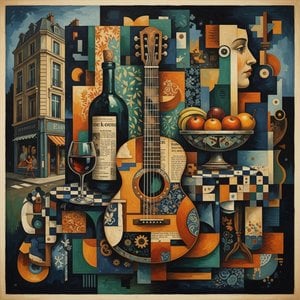
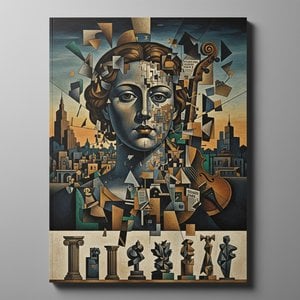
Braque's masterful use of color and form is immediately striking. The painting isn’t concerned with a literal representation of the musician or his instrument; instead, it dissects them into their fundamental geometric components. The cello itself is rendered as a series of interlocking planes – rectangles, triangles, and sharp angles – creating an almost architectural effect. This fragmentation reflects the Cubist movement's core principle: to show multiple viewpoints simultaneously, challenging the viewer’s eye to actively reconstruct the image.
Palette and Technique: A Dance of Color
The color palette—dominated by rich browns, deep greens, fiery reds, and touches of purple—is far from arbitrary. Braque employs a bold contrast between warm and cool tones to heighten the visual impact and create a sense of dynamic energy. His technique is characterized by distinct brushstrokes – thick, textured areas juxtaposed with smoother, more controlled passages. This layering adds depth and complexity to the composition, inviting close observation and rewarding repeated viewing.
Historical Context: Reflection in a Time of Change
“The Musician” was created during a period of immense social and artistic upheaval – the aftermath of World War I. Braque’s Cubist explorations can be seen as a response to this trauma, a desire to rebuild order from chaos through the deconstruction and reconstruction of visual forms. This work is inextricably linked with the collaboration between Braque and Pablo Picasso, who were instrumental in developing Synthetic Cubism – a movement that pushed the boundaries of artistic expression even further.
Symbolic Resonance: Music and Perception
Beyond its formal qualities, “The Musician” carries significant symbolic weight. The cello itself represents not just musical performance but also introspection, contemplation, and the power of art to evoke emotion. Braque’s fragmented portrayal suggests a deeper exploration of identity and perception – how we see the world and how our understanding is shaped by multiple viewpoints. This artwork invites us to consider the relationship between sound, vision, and the human experience.
Perfect for Your Space
A high-quality reproduction of “The Musician” will bring a touch of modernist brilliance into any setting. Its bold style and intricate details make it an ideal focal point in contemporary interiors, adding intellectual depth and visual excitement to your space. Whether you’re an art collector, interior designer, or simply someone who appreciates the beauty of innovative art, this piece is sure to inspire and captivate.
问答 (or more naturally for a website heading): Klausimai ir atsakymai
Kiek šviesos, kaip atrodo, atspindi „Švedimas“ spalvos?
Kūrinys „Švedimas“, autorius – Žoržas Brakas pasižymi Švelni apšvietimo intensyvumas šviesos intensyvumu. Šviesos intensyvumas apibūdina, kiek šviesos, kaip atrodo, atspindi spalvos.
Kaip galima panaudoti „Švedimas“, autorius – Žoržas Brakas namų interjere?
„Švedimas“, autorius – Žoržas Brakas rekomenduojamas Akcentas, idealiai – Viešbučio svetainė. Naudojimo būdas ir erdvė kartu padeda suprasti, kur geriausiai tiktų reprodukcija.
Kaip galiu įsigyti „Švedimas“, autorius – Žoržas Brakas spausdinį?
„Švedimas“ galima įsigyti kaip aukščiausios kokybės spausdinys ant medžio siuvinėjamų audinių arba archyvinio kanvas tipo popieriaus. Užsakymus galima pateikti Kūrinio spausdinimas puslapyje, pasirinkti jūsų pageidaujamame dydžiu.



 Peržiūrėti realaus dydžio版
 Pirkti rankomis tapytą reprodukciją
 Siųsti
 Dalintis
 Išsamiau
 Vadovas

 Atsisiųsti
 Panašūs eksponatai
 Rentgeno spindulių nuotrauka
 Diaporama
 Statistika


 Rodyti daugiau






































 Stiklo variantas prieinamas tik pasirinkus dydį iki 110 cm