Georges Braque’s “The Plow”: A Study in Rural Simplicity and Cubist Fragmentation
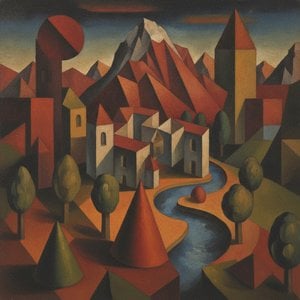
Georges Braque's "The Plow," painted in 1961, offers a deceptively simple yet profoundly layered glimpse into the artist’s evolving artistic vision. This work, rendered in a restrained palette of blues and yellows – colors often associated with the vastness of the French countryside – immediately draws the eye to its central subject: a weathered plow resting within a field. However, to reduce “The Plow” to a mere depiction of agricultural labor would be a significant oversight. Braque, a pivotal figure in the development of Cubism, employs his signature techniques not just to represent form but to deconstruct and reimagine it, inviting the viewer into a complex interplay of perspective and abstraction.
The painting’s style firmly places it within the Expressionist movement, though with a distinctly Braquean twist. Unlike the vibrant hues often associated with Fauvism, which marked his earlier work, here we see a deliberate restraint, a muted quality that emphasizes texture and form over immediate visual impact. The two wheels of the plow are rendered with meticulous detail, their surfaces suggesting both solidity and vulnerability. The geometric shapes—the wheel’s curves, the plow’s frame—are subtly fractured and rearranged, echoing the Cubist principles of simultaneous viewpoints that Braque pioneered alongside Pablo Picasso. This fragmentation isn't chaotic; rather, it creates a sense of dynamic equilibrium, as if the plow is simultaneously present in multiple spatial dimensions.
The Seeds of Cubism: Deconstructing Reality
Understanding “The Plow” requires acknowledging its crucial role within the broader context of Braque’s artistic journey. Following his early explorations with Fauvism and his intense collaboration with Picasso, Braque began to systematically dismantle traditional notions of representation. He moved away from single-point perspective, instead presenting multiple viewpoints within a single image – a technique directly inspired by Paul Cézanne's emphasis on geometric forms and the underlying structure of nature. This approach is brilliantly demonstrated in “The Plow,” where the plow itself appears to be simultaneously viewed from above, below, and at an oblique angle. The birds soaring overhead further contribute to this sense of spatial ambiguity, adding another layer of visual complexity.
Braque’s use of color also plays a significant role in conveying meaning. The blues evoke a sense of vastness and the open sky, while the yellows suggest the warmth of the earth and the sun. These colors aren't applied with smooth gradients; instead, they are built up through layers of broken brushstrokes, creating a textured surface that invites close examination. This tactile quality reinforces the painting’s connection to the physical world – the feel of the soil beneath the plow, the weight of the metal frame.
Symbolism and Rural Life
While “The Plow” is undeniably an exercise in formal experimentation, it also carries a subtle symbolic resonance. The plow itself represents labor, fertility, and the cyclical rhythms of rural life. It’s a potent image of human effort connected to the land – a theme that resonated deeply with Braque, who spent much of his life observing and depicting the landscapes of France. The birds, often interpreted as symbols of freedom and aspiration, suggest a potential for transcendence within this seemingly simple scene.
Furthermore, the painting’s quietude—the absence of figures or any other elements beyond the plow and the field—creates an atmosphere of contemplative stillness. It invites the viewer to pause and consider the relationship between humanity and nature, between tradition and progress. “The Plow” is not merely a representation of a rural object; it's a meditation on the essence of human experience.
A Legacy in Reproduction
WahooArt offers meticulously crafted hand-painted reproductions of Georges Braque’s "The Plow," allowing art lovers to bring this iconic work into their homes or offices. Our skilled artists faithfully recreate Braque's nuanced brushwork, color palette, and compositional techniques, ensuring that the essence of the original painting is preserved with exceptional detail. Whether you are a seasoned collector or simply seeking to add a touch of artistic sophistication to your space, our reproduction provides an authentic and accessible way to appreciate this pivotal work in modern art.
问答 (or more naturally for a website heading): Klausimai ir atsakymai
Kokią vietą Žoržas Brakas kūrybos ešėlyje užima „Plow“?
„Plow“ priklauso Žoržas Brakas Cubist Landscape kūrybai, kurios įrašytoms temoms priskiriamas cézanne’s geometric forms, rural life, simplicity”, “braque’s experimentation”, “cubist exploration, abstraction”, landscape, quiet contemplation”.
Kokia „Plow“, autorius – Žoržas Brakas emocinė nuotaika?
Emocinis tonas, nurodytas kūriniui „Plow“, autorius – Žoržas Brakas, yra Reflective. Jis apibūdina jausmą, kurį išreiškia šis darbas.
Kuriam menininkui priskiriamas kūrinys „Plow“?
„Plow“ kūrybinį darbą sukūrė Žoržas Brakas. Šioje puslapio informacijoje aprašomas Žoržas Brakas originalus kūrinys.
Ar „Plow“, autorius – Žoržas Brakas spalvos yra ryškios ar išblukusios?
„Plow“, autorius – Žoržas Brakas spalvos pasižymi Subtle Color nasyginimu ir Balanced intensyvumu.
Kokia spalva labiausiai išsiskiria kūryniame „Plow“?
Dominuojanti „Plow“, autorius – Žoržas Brakas spalva yra Gray (#658085).
Kaip galiu įsigyti „Plow“, autorius – Žoržas Brakas spausdinį?
„Plow“ galima įsigyti kaip aukščiausios kokybės spausdinys ant medžio siuvinėjamų audinių arba archyvinio kanvas tipo popieriaus. Užsakymus galite pateikti ši ši puslapį, pasirinkę jums tinkamą dydį.
Ar galiu užsisakyti „Plow“ aliejinį reprodukciją?
„Plow“ galima įsigyti kaip rankomis dažyta aliejų reprodukcija ant lininio drobos. Užsakymą galite padaryti ši ši puslapį, pasirinkdami tinkamą dydį.



 Peržiūrėti realaus dydžio版
 Pirkti rankomis tapytą reprodukciją
 Siųsti
 Dalintis
 Išsamiau
 Vadovas

 Atsisiųsti
 Panašūs eksponatai
 Rentgeno spindulių nuotrauka
 Diaporama
 Statistika

 Rodyti daugiau






































 Stiklo variantas prieinamas tik pasirinkus dydį iki 110 cm