A Cubist Still Life: Deconstructing Domesticity in Braque’s “Pedestal Table 1”
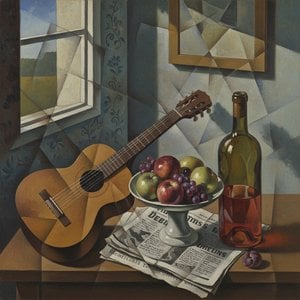
Georges Braque's "Pedestal Table 1" is a pivotal example of Analytical Cubism, a revolutionary art movement he pioneered alongside Pablo Picasso. Painted around 1911-1912 (precise dating varies), this work isn’t simply *depicting* objects; it’s dissecting and reassembling them on the canvas, challenging traditional notions of representation. The painting presents a fragmented view of everyday items – a chair, a table (the titular pedestal table), books, and notably, two clocks – all rendered in a muted palette dominated by browns, greys, and ochres.
Decoding the Composition & Technique
Braque employs a masterful technique of breaking down forms into geometric shapes—cubes, cylinders, and cones—and presenting multiple viewpoints simultaneously. This isn’t about optical illusion; it's about conveying a more complete understanding of an object by showing all its facets at once. The collage-like effect, achieved through the layering of these fractured planes, creates a dense and intellectually stimulating composition. Notice how objects aren’t clearly delineated but rather bleed into one another, sharing lines and forms. This deliberate ambiguity forces the viewer to actively participate in reconstructing the scene.
The limited color palette further emphasizes the formal elements – shape, line, and texture – over purely aesthetic concerns.
Historical Context: The Birth of Cubism
“Pedestal Table 1” emerges from a period of intense artistic experimentation. Dissatisfied with the limitations of traditional perspective, Braque and Picasso sought new ways to represent reality. Inspired by Paul Cézanne’s emphasis on geometric structure and non-naturalistic color, they began dismantling objects into their basic components. This painting represents a high point in Analytical Cubism, before the introduction of brighter colors and collage elements that would characterize Synthetic Cubism.
It's important to remember this work wasn't intended as a literal depiction but rather an exploration of perception itself.
Symbolism & Interpretation
The objects within “Pedestal Table 1” are not arbitrary. The inclusion of clocks is particularly significant, often interpreted as representing the passage of time and the Cubist attempt to capture multiple moments in a single image. Books suggest intellect and knowledge, while the table and chair represent domesticity and everyday life. However, Braque doesn’t imbue these objects with sentimental meaning; instead, he uses them as vehicles for formal exploration.
The fragmentation itself can be seen as symbolic of the breakdown of traditional values and the anxieties of a rapidly changing modern world.
Emotional Impact & Aesthetic Appeal
Despite its intellectual rigor, “Pedestal Table 1” possesses a subtle emotional resonance. The muted colors and fragmented forms create a sense of quiet contemplation and introspection. While not overtly expressive, the painting evokes a feeling of mystery and invites prolonged viewing. Its sophisticated composition and innovative technique make it a compelling work for art lovers and collectors alike.
For interior designers, this piece offers a timeless aesthetic that complements modern and contemporary spaces, adding depth and intellectual weight to any room.
Key Features at a Glance
- Style: Analytical Cubism
- Medium: Oil on canvas
- Dominant Colors: Browns, greys, ochres
- Subject Matter: Still life – table, chair, books, clocks
- Key Characteristics: Fragmentation, multiple perspectives, geometric forms, muted palette



 Užsisakyti kopiją
 Pasidalinti
 Dalintis
 Išsamiau

 Atsisiųsti
 Panašūs eksponatai
 Rentgenogramą
 Automatinė diorama
 Skaityti daugiau






































 Stiklo variantas prieinamas tik pasirinkus dydį iki 110 cm