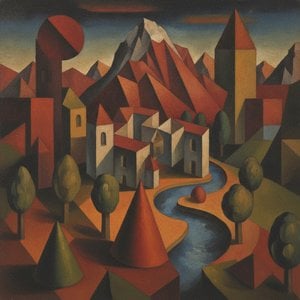
A Fragmented World: The Genesis of Cubism
Georges Braque's "Musical Instruments and Fruit" isn’t merely a still life; it’s a carefully orchestrated dismantling of perception, a visual embodiment of the revolutionary ideas taking shape in early 20th-century Paris. Painted in 1927, during a period of intense collaboration with Pablo Picasso, this work represents a pivotal moment in the development of Cubism – an artistic movement that sought to redefine how we see and represent reality. The canvas isn’t concerned with replicating a single, unified view; instead, it presents multiple viewpoints simultaneously, as if peering through fractured lenses at a commonplace scene. This deliberate fragmentation reflects the burgeoning anxieties and intellectual shifts of the era, mirroring a world grappling with rapid industrialization, technological advancements, and a growing sense of instability.
Braque’s approach was deeply rooted in Cézanne's geometric explorations, particularly his emphasis on analyzing objects into their fundamental forms. Cézanne’s influence is palpable in the painting’s flattened perspective and the reduction of recognizable elements – the bowl, the sheet of paper, the draped cloth – to a series of interlocking planes and angles. This isn’t an attempt at photographic realism; rather, it's a conscious rejection of traditional representation, prioritizing the exploration of form, space, and the very nature of seeing itself. The muted color palette—primarily ochres, browns, and grays—further enhances this sense of detachment from the tangible world, contributing to the painting’s contemplative mood.
The Language of Geometry: Form and Structure
The composition is dominated by a rigorous geometric vocabulary. Rectangular blocks define the table and its contents, while triangular shapes suggest the contours of the fruit bowl and draped cloth. These forms aren't smoothly blended; they are sharply delineated, creating a dynamic tension between solidity and instability. Notice how Braque uses overlapping planes to create an illusion of depth – not through linear perspective, but by layering geometric shapes that seem to shift and rearrange themselves before your eyes. This technique is central to Cubism’s challenge to traditional spatial representation, forcing the viewer to actively engage with the painting and reconstruct its form in their mind.
- The Bowl of Fruit: Representing abundance and fertility, the fruit itself becomes a collection of fragmented shapes, mirroring the overall fractured composition.
- The Sheet of Paper: Suggests intellectual activity and documentation – perhaps reflecting Braque’s own role as an artist documenting his explorations of form.
- The Draped Cloth: Adds a layer of complexity to the arrangement, its folds and creases contributing to the overall sense of dynamism and instability.
Musicality in Monochrome: Symbolism and Emotion
Beyond its purely formal qualities, “Musical Instruments and Fruit” resonates with a subtle emotional depth. The inclusion of musical instruments – specifically a mandolin – introduces an element of melody and rhythm into the composition. This suggests that Braque wasn’t simply interested in dissecting objects; he was also exploring their inherent relationships and the ways they could evoke feelings and associations. The painting's title itself hints at this interplay between visual form and auditory experience, inviting the viewer to imagine a silent symphony of shapes and colors.
Furthermore, the still life genre traditionally held symbolic weight, often representing the five senses. Braque’s choice to depict fruit and musical instruments aligns with this tradition, suggesting an exploration of pleasure, nourishment, and artistic creation. The muted color palette contributes to a sense of quiet contemplation, inviting viewers to reflect on the beauty and complexity of everyday objects.
A Legacy in Fragments: Reproduction and Interpretation
Reproductions of “Musical Instruments and Fruit” offer a remarkable opportunity to appreciate Braque’s groundbreaking innovations. The painting's fragmented composition and geometric forms are particularly well-suited to digital reproduction, allowing viewers to examine the intricate details of its construction. Whether displayed in a modern interior or a dedicated art gallery, this work continues to challenge our perceptions of reality and inspire new ways of seeing the world – a testament to Braque’s enduring legacy as one of the most influential artists of the 20th century.



 Peržiūrėti realybėje
 Pirkti rankomis tapytą paveikslą
 Pasidalinti
 Dalintis
 Išsamiau

 Atsisiųsti
 Panašūs eksponatai
 Rentgeno nuotrauka
 Automatinė diorama
 Statistika
 Skaityti daugiau






































 Stiklo variantas prieinamas tik pasirinkus dydį iki 110 cm