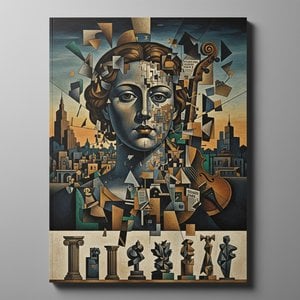
A Symphony of Fragmented Serenity
In the quietude of Georges Braque’s 1958 masterpiece, “Bird and its Nest,” we encounter a profound dialogue between the delicate intimacy of nature and the revolutionary language of Cubism. At first glance, the composition offers a moment of pure, unadulterated tranquility: a solitary bird perched with grace upon its nest, nestled in the lower corner of the canvas. Yet, beneath this peaceful surface lies a complex architectural feat of visual perception. Braque does not merely depict a scene; he deconstructs it, inviting the viewer to witness the world through a lens of overlapping planes and multifaceted perspectives. The rugged mountain landscape in the background, bathed in a soft, diffused light, provides a sense of immense depth that paradoxically feels both expansive and intimately contained within the geometric fragments of the artist's vision.
The emotional resonance of this work lies in its ability to balance tension with peace. There is a palpable stillness in the way the bird gazes toward the viewer, a silent connection that pierces through the fractured landscape. For the collector or interior designer, this piece serves as a sophisticated focal point, offering a meditative quality that can anchor a room with its earthy, muted palette of browns and greens. It is an artwork that demands slow looking, rewarding the observer with subtle gradations of tone and a sense of atmospheric haze that evokes the quiet majesty of the French countryside.
The Legacy of the Cubist Vision
To understand the technical brilliance of “Bird and its Nest,” one must look back to the seismic shifts Braque initiated alongside Pablo Picasso. By 1958, Braque had long since moved past the initial, analytical rigors of early Cubism, arriving at a more lyrical and expressive stage of his career. This painting represents the culmination of decades spent interrogating the very nature of sight. Rather than relying on traditional, single-point perspective—which creates the illusion of a window into another world—Braque utilizes fragmented forms to present multiple viewpoints simultaneously. Each element, from the textured twigs of the nest to the jagged peaks of the mountains, is rendered as a series of interlocking projections.
This technique serves a deeper symbolic purpose: it reflects the complexity of human experience. Just as we never perceive an object from only one angle or at a single moment in time, Braque’s canvas captures the multifaceted essence of reality. The artist’s background in decorative arts is evident in his masterful control over texture and pigment. Through meticulous layering of oil on canvas, he creates a tactile surface where light seems to caught within the very grain of the paint, lending the mountains a weathered, ancient quality and the bird a soft, living presence.
An Essential Addition for the Discerning Collector
For those seeking to curate a space that celebrates the intersection of modern history and natural beauty, “Bird and its Nest” offers unparalleled inspiration. It is a piece that transcends mere decoration, acting as a bridge between the avant-garde movements of the 20th century and the timeless allure of the natural world. Whether displayed in a contemporary gallery setting or integrated into a classic, richly textured interior, the painting’s ability to evoke both intellectual curiosity and emotional calm makes it a truly versatile treasure.
Owning a high-quality reproduction of this work allows one to bring the revolutionary spirit of Braque into the home. It is an invitation to contemplate the beauty found in fragmentation and to find peace within the complexity of our visual world. As a testament to the enduring legacy of French modernism, this artwork remains a profound statement on how we perceive, interpret, and ultimately fall in love with the world around us.



 Peržiūrėti realybėje
 Pirkti rankomis tapytą paveikslą
 Pasidalinti
 Dalintis
 Išsamiau

 Atsisiųsti
 Panašūs eksponatai
 Rentgeno nuotrauka
 Automatinė diorama


 Skaityti daugiau






































 Stiklo variantas prieinamas tik pasirinkus dydį iki 110 cm