Fernand Léger: A Symphony of Steel and Soul
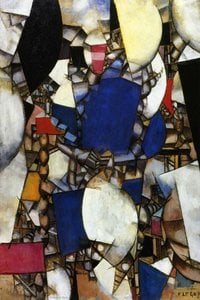
The world of Fernand Léger is one of exhilarating contradiction – a collision between the raw physicality of industrial machinery and an intensely personal, almost spiritual, vision. This particular work, a vibrant exploration of form and movement, exemplifies Léger’s groundbreaking approach to modern art, a departure from purely abstract concerns that sought to capture not just the *look* of the machine age, but its very essence – its energy, its rhythm, and its impact on human experience. It's a piece that demands attention, inviting the viewer into a world where geometric precision dances with organic fluidity.
Tubism: A New Visual Language
Léger’s artistic journey began in the early 20th century, a period of unprecedented technological advancement. Witnessing the rise of factories and the proliferation of steel structures profoundly influenced his thinking. He developed what he termed “Tubism,” a style that sought to represent objects – particularly those associated with industry – by breaking them down into their fundamental geometric shapes: cylinders, cones, and cubes. However, Tubism wasn’t simply about replicating mechanical forms; it was an attempt to imbue these shapes with life, with movement, and with a sense of underlying harmony. Notice how the figures aren't static representations but seem poised in perpetual motion, echoing the dynamism of the industrial landscape.
- Cylindrical Forms: The dominant use of cylinders represents the core elements of machinery – pistons, shafts, and structural supports.
- Conical Shapes: Cones suggest power, energy, and upward thrust, mirroring the ambition of technological progress.
- Cubed Elements: Cubes provide a grounding element, representing solidity and stability amidst the swirling forms.
Symbolism Within the Geometry
Beyond its purely formal qualities, Léger’s work is rich in symbolic meaning. The figures themselves are often interpreted as representations of humanity – individuals caught within the transformative forces of modernity. Their simplified forms suggest a loss of individuality, yet their vibrant colors and dynamic poses convey a sense of resilience and even joy. The bright palette—bold reds, yellows, and blues—contrasts sharply with the muted tones of the industrial backdrop, highlighting the tension between human aspiration and mechanical constraint.
Contextualizing Léger’s Innovation
Léger emerged as a key figure in the Parisian avant-garde scene of the early 20th century, alongside artists like Picasso and Braque. While initially influenced by Cubism, he quickly developed his own distinct style, one that was both intellectually rigorous and deeply expressive. His work anticipated many later developments in art, including Pop Art’s embrace of popular imagery and its exploration of the relationship between art and industry. The Fernand Léger National Museum in Biot, France, houses a comprehensive collection of his works, offering invaluable insight into the evolution of this singular artistic vision.
Emotional Impact & Collecting
This reproduction captures not just the visual impact of Léger’s original paintings but also the underlying emotional power. It's a piece that speaks to our fascination with technology, our anxieties about its potential consequences, and our enduring desire for beauty and harmony in a world increasingly dominated by machines. Whether adorning a contemporary interior or serving as a thoughtful addition to an art collection, this artwork offers a compelling dialogue between form, function, and the human spirit – a conversation that continues to resonate today.
问答 (or more naturally for a website heading): Klausimai ir atsakymai
Ar „untitled (7271)“ yra be autorinės teisės?
Autorių teisių statusas kūriniui „untitled (7271)“, autorius – Fernanas Ležė: kūrinys priklauso pripa принадле belongs to the public domain – jo autorinė teisė pasibaigusi. Tai nulemia, ar galima laisvai reprodukciuoti šį vaizdą.
Kaip „untitled (7271)“, autorius – Fernanas Ležė spalvos susiję su jo emocine išraiška?
Kūrynom šiame darbe „untitled (7271)“, Earthy spalvos lydi Powerful pojūtį.
Koks yra „untitled (7271)“ formatas?
„untitled (7271)“ formatas yra Landscape. Tai padeda planuojant, kur būtų patalpinta reprodukcija.



 Peržiūrėti realaus dydžio版
 Perjungti į spausdinimą
 Siųsti
 Dalintis
 Išsamiau
 Vadovas

 Atsisiųsti
 Panašūs eksponatai
 Rentgeno spindulių nuotrauka
 Diaporama
 Statistika

 Rodyti daugiau






































 Stiklo variantas prieinamas tik pasirinkus dydį iki 110 cm