A Symphony of Geometry: Reimagining the Morning Ritual
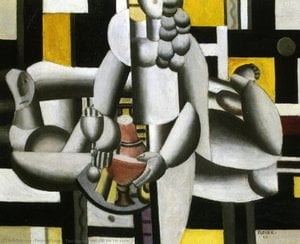
In the vibrant landscape of early 20th-century modernism, few works capture the rhythmic pulse of a changing era as strikingly as Fernand Léger’s The Breakfast. Painted in 1921, this masterpiece serves as a window into a world where the domestic and the industrial began to merge into a singular, dynamic vision. The scene presents a group of three women gathered around a dining table, yet they are far from traditional figures in a quiet portrait. Instead, through Léger’s revolutionary lens, the act of sharing a morning meal is transformed into a complex dance of fragmented planes and interlocking shapes. There is an undeniable energy radiating from the canvas, as if the very air around the breakfast table is vibrating with the mechanical precision of the modern age.
The composition is a masterclass in what critics famously termed Tubism or Mechanical Cubism. Rather than relying on soft, organic curves, Léger utilizes cylindrical and tubular forms to construct his subjects and their surroundings. The table, the bowl, the cup, and even the figures themselves are distilled into essential geometric components—circles, rectangles, and spheres. This technique creates a fascinating tension; while the subject matter is intimately domestic, the execution feels architectural and structural. By breaking down the scene into overlapping planes and multiple viewpoints, Léger invites the viewer to move around the table mentally, experiencing the breakfast scene not as a static moment, but as a multifaceted, living construction.
Color, Light, and the Industrial Spirit
The emotional impact of The Breakfast is driven largely by its bold and unapologetic color palette. Léger eschews subtle gradations in favor of high-contrast primary colors—vivid reds, yellows, and blues—juxtaposed against stark blacks, whites, and industrial greys. This deliberate use of flat, saturated color reinforces the painting's sense of strength and clarity. There is no soft morning light filtering through a window here; instead, the lighting is diffused and even, stripping away traditional shadows to emphasize the weight and volume of the geometric forms. This lack of traditional depth forces the eye to engage with the surface of the painting, celebrating the texture of the paint and the sharp, defined lines that delineate each shape.
For the discerning collector or interior designer, this artwork offers more than mere decoration; it provides a profound sense of movement and modernity. The painting captures the spirit of an era defined by rapid technological advancement—the rise of the machine, the factory, and the urban sprawl. In The Breakfast, the domestic ritual is imbued with the same vigor found in a locomotive or a spinning gear. It is a piece that commands attention through its structural integrity and its ability to turn a simple morning gathering into an avant-garde celebration of form. To possess a reproduction of this work is to bring a fragment of the Cubist revolution into one's space, offering a timeless dialogue between the beauty of human connection and the structured elegance of the machine age.
问答 (or more naturally for a website heading): Klausimai ir atsakymai
Kiek metų buvo Fernanas Ležė, kai sukūrė „The Breakfast“ 1921 m.?
Fernanas Ležė buvo 40 metų, kai 1921 m. sukūrė kūrinį „The Breakfast“. Amžius apskaičiuotas remiantis gimimo metais 1881.
Kas sukūrė „The Breakfast“ ir kokiu stiliumi tai atlikta?
Fernanas Ležė sukūrė „The Breakfast“, priklausantį Cubism stiliui.
Kokią emociją sukelia „The Breakfast“, autorius – Fernanas Ležė spalvos?
„The Breakfast“, autorius – Fernanas Ležė Neutrals paletė dera su jo Energetic emociniu tonu. Spalva yra vienas iš būdų, keliais kūrinys perteikia jausmus.
Kada buvo sukurta „The Breakfast“?
„The Breakfast“ sukurta 1921 m. Ši data leidžia įvardyti kūrinį Fernanas Ležė kūrybinėje karjeroje bei jo epochoje.
Ar galiu pamatyti „The Breakfast“, autorius – Fernanas Ležė skirtingame apšvietime?
Darbino „The Breakfast“, autorius – Fernanas Ležė puslapio Rentgenas veją yra interaktyvus naršyklė, leidžiantis peržiūrėti vienu metu vienąn ਤੋਂ vienas dvylkant optinių vaizdo sluoksnių, įskaitant rentgeno tipo vaizdą.
Kokiam istoriniam laikotarpiui priklauso „The Breakfast“, autorius – Fernanas Ležė?
Istorinis laikotarpis kūriniam „The Breakfast“, autorius – Fernanas Ležė yra Modern. Ši klasifikacija priskiria šį kūrinį konkrečiam meno istorijos etapui.
Kuriam menininkui priskiriamas kūrinys „The Breakfast“?
Kūrinį „The Breakfast“ sukūrė Fernanas Ležė. Darbas katalogizuojamas Fernanas Ležė vardu.



 Peržiūrėti realaus dydžio版
 Perjungti į spausdinimą
 Siųsti
 Dalintis
 Išsamiau
 Vadovas

 Atsisiųsti
 Panašūs eksponatai
 Rentgeno spindulių nuotrauka
 Diaporama
 Statistika

 Rodyti daugiau






































 Stiklo variantas prieinamas tik pasirinkus dydį iki 110 cm