A Symphony of Form and Industrial Soul
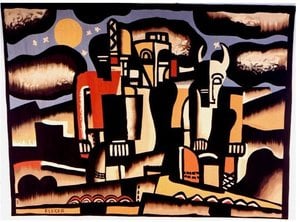
To stand before Fernand Léger’s 1925 masterpiece, “Fuel Pump,” is to step onto the stage of a futurist opera, where the static world suddenly begins to pulse with the rhythmic, metallic hum of a city in motion. The canvas explodes with a geometric precision that captures the very essence of the Machine Age—a riot of interlocking cubes, cylinders, and planes that dominate the visual field. More than just a depiction of an everyday roadside scene, this work represents Léger's audacious attempt to distill the anxieties and exhilarations of the burgeoning industrial revolution into a powerfully abstract visual language. The painting invites the viewer to find beauty within the most utilitarian structures, transforming a mundane gas station into a monumental celebration of modern life.
The composition is a masterclass in energetic dynamism. While the subject matter includes recognizable elements—a vintage vehicle navigating the station, figures moving through the space, and even a distant traffic light—these are rendered through a lens of structural integrity. Léger eschews traditional illusionistic depth, opting instead for a flattened surface that emphasizes the spatial relationships between overlapping shapes. This technique creates a palpable sense of movement; the rhythmic repetition of forms suggests the relentless progress of technology, making the artwork feel as though it is breathing with the mechanical heartbeat of the 1920s.
The Art of Tubism and Tactile Technique
Léger’s approach to painting departs significantly from traditional representational methods, firmly establishing itself within a unique evolution of Cubism. Often associated with his personal style known as "Tubism," Léger moved away from the melancholic fragmentation seen in the works of Picasso or Braque. Instead, he embraced the volume and robust presence of the cylinder and the sphere. His fascination with the strength of mechanical forms allowed him to rebuild the world through a lens of sculptural weight, where every line and edge feels engineered rather than merely drawn.
The physical presence of the painting is equally captivating. Léger meticulously applied thick impasto—heavy layers of pigment built up upon the canvas—to create tactile surfaces that invite viewers to engage physically with the artwork. This heavy application of paint lends a sense of permanence and strength to the industrial subjects, mirroring the very steel and iron of the machines he admired. For the collector or interior designer, this texture provides a profound depth that catches the light, making a high-quality reproduction a commanding focal point in any sophisticated space.
A Legacy for the Modern Collector
Historically, “Fuel Pump” serves as a vibrant window into a period of profound societal transformation. Created during the rapid urban sprawl and technological advancements of the interwar years, the painting captures the unsettling beauty of a world increasingly dominated by engineering. Léger’s ability to integrate modernity—its dynamism, its mechanical forms, and its very essence—into fine art makes this piece a cornerstone of twentieth-century modernism.
For those seeking to infuse their interiors with a sense of strength, movement, and historical significance, this artwork offers unparalleled inspiration. It is a piece that speaks to the bold, the progressive, and the lovers of structured beauty. Whether placed in a contemporary gallery setting or a curated residential collection, Léger’s vision remains a powerful declaration: that even in the most functional corners of our world, there exists a profound and rhythmic artistry waiting to be discovered.
问答 (or more naturally for a website heading): Klausimai ir atsakymai
Atsižvelgiant į spalvų paletę, kur rekomenduojama eksponuoti kūrinį „Fuel Pump"]?
Atsižvelgiant į jo Neutrals spalvas, kūrinys „Fuel Pump“ yra rekomenduojamas Living Room kambariui.
Ar kūrinys „Fuel Pump“, autorius – Fernanas Ležė yra šviesus ar tamsus?
Įrašytos „Fuel Pump“, autorius – Fernanas Ležė reikšmės: šviesos intensyvumas – brilliant, luminansas – Bright Balance.
Kaip kūrinys „Fuel Pump“ dera su Fernanas Ležė temomis ir stiliumi?
Fernanas Ležė kūryboje „Fuel Pump“ pasižymi Cubism stiliumi, derinant jį su machine age inspiration, industrial aesthetic, geometric abstraction, urban observation, léger’s visionary style temomis.



 Peržiūrėti realaus dydžio版
 Perjungti į spausdinimą
 Siųsti
 Dalintis
 Išsamiau
 Vadovas

 Atsisiųsti
 Panašūs eksponatai
 Rentgeno spindulių nuotrauka
 Diaporama
 Statistika

 Rodyti daugiau






































 Stiklo variantas prieinamas tik pasirinkus dydį iki 110 cm