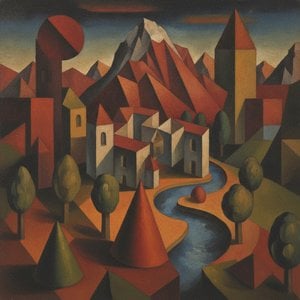
A Snapshot of Modern Life: Léger’s ‘Breakfast’
Fernand Léger's “The Breakfast,” painted in 1921, isn’t merely a depiction of a simple meal; it’s a bold declaration of Cubist principles and an ambitious attempt to translate the burgeoning dynamism of industrial society onto canvas. Created during a period marked by rapid technological advancement – the rise of automobiles, factories, and urban sprawl – Léger sought to capture this transformative era not through idealized landscapes or portraits, but through fractured geometric forms that mirrored the fragmented experience of modern existence. The painting’s stark black and white palette amplifies its impact, stripping away superfluous detail to focus on essential shapes and textures.
Cubist Innovation: Deconstructing Reality
Léger's stylistic approach firmly establishes him within the influential Cubist movement spearheaded by Pablo Picasso and Georges Braque. Unlike Impressionists who prioritized capturing fleeting moments of light and color, Cubists rejected illusionistic representation altogether. Instead, they dissected objects into multiple perspectives simultaneously, presenting them as interlocking planes that challenge conventional notions of space and form. In “The Breakfast,” this is evident in the elongated head of the figure—a deliberate distortion designed to convey movement and instability—and the fragmented arrangement of the table’s elements. These geometric shapes aren't simply decorative; they embody the underlying structure of reality itself, as perceived through the lens of industrial progress.
Technique and Texture: Pointillism Revisited
While primarily categorized as Cubist, Léger subtly incorporates techniques reminiscent of Neo-Impressionism—specifically Pointillism—to achieve a remarkable textural effect. Rather than blending pigments to create smooth gradations, Léger meticulously applied tiny dots of color – predominantly white and ochre – onto the canvas. This method maximizes luminosity and creates an illusion of shimmering surface texture that mimics the light reflecting off metal surfaces prevalent in the period. The artist’s painstaking attention to detail underscores his commitment to conveying both visual accuracy and emotional resonance.
Symbolism Beyond Representation
Beyond its formal innovations, “The Breakfast” carries symbolic weight. The table itself represents stability amidst chaos—a grounding element against which the fragmented figure asserts its presence. The bottle symbolizes nourishment and vitality, mirroring Léger’s fascination with the human body as a machine capable of adapting to new environments. Furthermore, the vase adds an element of organic beauty – a counterpoint to the dominant geometric forms – suggesting that even in the industrialized world, there remains space for contemplation and appreciation of nature.
Emotional Resonance: Capturing the Spirit of an Age
Ultimately, Léger’s “Breakfast” succeeds in conveying the emotional core of its time—a sense of optimism tempered by apprehension about the future. The painting isn't sentimental; it doesn’t strive to evoke nostalgia for a bygone era. Instead, it confronts viewers with a deliberately unsettling image that compels them to consider how humanity navigates change and embraces new possibilities. It remains a powerful testament to Léger’s artistic vision and his enduring legacy as one of the pioneers of modern art.
问答 (or more naturally for a website heading): Klausimai ir atsakymai
Kiek metų buvo Fernanas Ležė, kai sukūrė „Breakfast“ 1921 m.?
Kai 1921 m. buvo sukurta „Breakfast“, Fernanas Ležė – gimęs 1881 m. – buvo 40 metų amžiaus.
Kas yra „Breakfast“ kūrybos autorius?
„Breakfast“ priskiriamas Fernanas Ležė.
Ar yra vadovas kūriniui „Breakfast“, autorius – Fernanas Ležė?
Dėl „Breakfast“, autorius – Fernanas Ležė yra prieinama Gidas puslapio: spausdinamas informacinis lapelis apie kūrinį, skirtas studentams ir mokomajamiam procesui klasėje.
Kuriem metais buvo sukurta „Breakfast“, autorius – Fernanas Ležė?
„Breakfast“, autorius – Fernanas Ležė sukurtas 1921 m.
Kaip rasti panašių kūrinių kaip „Breakfast“, autorius – Fernanas Ležė?
Įrenginiai, panašūs į „Breakfast“, autorius – Fernanas Ležė, surinkti kūrinio Panašūs kūriniai puslapio.
Kiek plačiai žinomas kūrinys „Breakfast“, kurį sukūrė Fernanas Ležė?
Įrašytas „Breakfast“, autorius – Fernanas Ležė populiarumumo lygis yra Recognized.
Kur galiu įsigyti rankinio darbo „Breakfast“, autorius – Fernanas Ležė reprodukciją?
Rankumų „Breakfast“, autorius – Fernanas Ležė kopijos yra parduodamos šis internetinis svetainė: rankomis dažyta aliejų reprodukcija ant lininio drobos, užsisakomos per ši ši puslapį.



 Peržiūrėti realaus dydžio版
 Perjungti į spausdinimą
 Siųsti
 Dalintis
 Išsamiau
 Vadovas

 Atsisiųsti
 Panašūs eksponatai
 Rentgeno spindulių nuotrauka
 Diaporama
 Statistika


 Rodyti daugiau






































 Stiklo variantas prieinamas tik pasirinkus dydį iki 110 cm