Fernand Léger’s Abstract Composition: A Symphony of Geometric Form and Vibrant Color
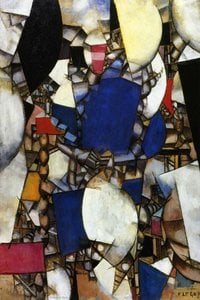
Fernand Léger's “Abstract Composition,” a striking piece housed in the Metropolitan Museum of Art, embodies the spirit of Cubist influence blended with Futurism—a daring fusion that cemented Léger’s place as one of the foremost innovators of early 20th-century art. This photograph captures not merely pigment on canvas but an essence of artistic exploration, reflecting Léger's fascination with the mechanized world and his desire to translate its dynamism into visual language.
Composition and Form: Embracing Dynamic Movement
The artwork’s asymmetrical arrangement immediately draws the eye, establishing a palpable sense of movement. Dominating the center is a vertical element reminiscent of architectural structure or perhaps even a stylized human figure—a deliberate choice mirroring Léger's preoccupation with industrial forms. Radiating outwards from this core are curving shapes and angular lines, skillfully interwoven to create a complex visual tapestry that defies static representation. The artist’s meticulous attention to balance ensures that the energy conveyed isn’t chaotic but rather purposeful, hinting at an underlying order amidst apparent randomness.
Color Palette: Bold Planes of Vibrant Hue
Léger employs a bold color palette characterized by flat planes of intense hues—primarily yellow, blue, red/orange, black, and white. These colors aren’t blended softly; instead, they are applied with sharp boundaries, contributing significantly to the artwork's geometric aesthetic. The deliberate use of contrasting shades amplifies the visual impact, mirroring the vibrancy and energy of the industrial landscape Léger sought to depict. This chromatic strategy underscores the artist’s commitment to conveying emotion through color—a hallmark of his distinctive style.
Technique and Texture: Thick Paint Application for Three-Dimensional Illusion
The photograph reveals a textured surface, indicative of thick paint application—likely utilizing oil or acrylic mediums—perhaps augmented with plaster or similar materials. This technique elevates the artwork beyond mere flatness, creating an illusion of depth and physicality that aligns perfectly with Léger’s Cubist sensibilities. The prominent black outlines defining many shapes further enhance this textural quality, emphasizing geometric precision and contributing to a graphic aesthetic reminiscent of Constructivism.
Symbolism and Emotional Resonance: Echoes of the Machine Age
"Abstract Composition" transcends mere visual pleasure; it speaks to broader themes—the influence of the machine age on artistic expression and the exploration of fundamental geometric forms. Léger’s work captures a feeling of dynamism, mirroring the rapid pace of industrial progress while simultaneously conveying an underlying sense of contemplation. It invites viewers to consider how art can communicate complex ideas about humanity's relationship with technology and the transformative power of visual abstraction.
问答 (or more naturally for a website heading): Klausimai ir atsakymai
Ką vaizduoja „Abstract composition“, autorius – Fernanas Ležė?
„Abstract composition“, autorius – Fernanas Ležė temos apima abstraction, geometric shapes, dynamic composition, color palette, futurist style, mechanical forms, bold colors. Kartu jie apibendrina šio kūrinio tematiką.
Kokio Fernanas Ležė kūrybos laikotarpio priklauso „Abstract composition“?
„Abstract composition“ priklauso Fernanas Ležė kūrybos karjeros Mature Period etapui. Ši klasifikacija susietas su kūrinio ryšiu su menininko evoliucija.
Kas yra „Abstract composition“ kūrybos autorius?
„Abstract composition“ priskiriamas Fernanas Ležė.
Kur galiu įsigyti rankinio darbo „Abstract composition“, autorius – Fernanas Ležė reprodukciją?
Ranko darbo „Abstract composition“, autorius – Fernanas Ležė reprodukciją galite užsakyti tiesiogiai ši ši puslapį: rankomis dažyta aliejų reprodukcija ant lininio drobos, gaminama pagal užsakymą.
Kaip judėjimas ir epocha susitinka kūryboje „Abstract composition“, autorius – Fernanas Ležė?
Karya `„Abstract composition“, autorius – Fernanas Ležė` kūryboje `Cubist Futurism` kryptis susilieja su `Modernizmas` laikotarpiu.
Kur galiu atsisiųsti „Abstract composition“, autorius – Fernanas Ležė?
Šio kūrinio „Abstract composition“, autorius – Fernanas Ležė vaizdą galite atsisiųsti iš puslapio Atsisiųsti: aukštos raiškos skaitmeninio vaizdo atsisiuntimas.
Kur galiu įsigyti „Abstract composition“, autorius – Fernanas Ležė spausdinį?
„Abstract composition“ galima įsigyti kaip aukščiausios kokybės spausdinys ant medžio siuvinėjamų audinių arba archyvinio kanvas tipo popieriaus. Užsakymus galite pateikti ši ši puslapį, pasirinkę jums tinkamą dydį.



 Peržiūrėti realaus dydžio版
 Pirkti rankomis tapytą reprodukciją
 Siųsti
 Dalintis
 Išsamiau
 Vadovas

 Atsisiųsti
 Panašūs eksponatai
 Rentgeno spindulių nuotrauka
 Diaporama
 Statistika

 Rodyti daugiau






































 Stiklo variantas prieinamas tik pasirinkus dydį iki 110 cm