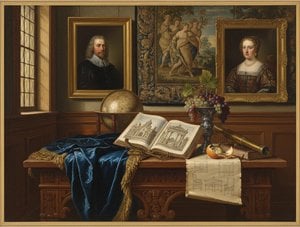
A Quiet Study in Baroque Abundance
To gaze upon this still life with Instruments is to step directly into the richly appointed study of a 17th-century maestro. Evaristo Baschenis, the Provincial Maestro of Bergamo, has gifted us a scene that transcends mere arrangement; it is a carefully curated meditation on knowledge, artistry, and the passage of time. The composition unfolds with an almost deliberate generosity, presenting a tableau brimming with objects—a celestial globe hinting at worldly exploration, the precise mechanism of a clock marking relentless moments, and scattered volumes suggesting lives spent in deep contemplation. These elements are not randomly placed; they coalesce into a visual conversation across the painted surface.
The Craftsmanship of Still Life
Baschenis’s mastery is most evident in his handling of texture and light. Observe how the artist renders the sheen on polished wood, the matte depth of aged paper from the scattered books, or the subtle drape of that nearby red curtain. His technique allows each object to possess its own distinct materiality, inviting the viewer's eye to linger over minute details. This is not simply a collection of items; it is an exercise in visual taxonomy, where every book spine and curved instrument contributes to the overall harmony. The composition achieves a remarkable balance between meticulous detail and overarching serenity.
Symbolism Woven into Objects
In Baroque art, nothing is accidental. This still life pulses with quiet symbolism. The inclusion of musical instruments speaks directly to Baschenis’s own passion and familial ties to Cremona's renowned violin makers—it celebrates the human capacity for structured beauty and emotional expression through sound. Meanwhile, the juxtaposition of the globe and the clock creates a poignant dialogue: the vastness of human knowledge against the finite measure of a single life. It suggests that while our understanding of the world is boundless, time itself remains the most precious, ticking commodity.
Bringing Baroque Intimacy Home
For the modern collector or designer, this piece offers an unparalleled depth for any interior space. Reproducing Baschenis’s vision allows one to infuse a room with the intellectual gravitas and warm, cultivated elegance of the Italian Golden Age. Imagine this scene anchoring a library, a sophisticated drawing-room, or even a richly paneled study. It serves not merely as decoration, but as an evocative centerpiece—a silent testament to culture, learning, and enduring artistic passion.



 Peržiūrėti realybėje
 Perejti prie spausdinimo
 Pasidalinti
 Dalintis
 Išsamiau

 Atsisiųsti
 Panašūs eksponatai
 Rentgeno nuotrauka
 Automatinė diorama
 Statistika


 Skaityti daugiau






































 Stiklo variantas prieinamas tik pasirinkus dydį iki 110 cm


![Jean De Dinteville Ir Georges De Selve Dvigubas Portretas (žinomas Kaip „ambassadoriai“) [detalė] — Hansas Holbeinas Mažesnysis, Šiaurės Renesansas](/media/artworks/images-thumb/42/81/42813dc49b2f72bce897aaf8b747ad5b.jpg)