Gaukite spausdinimui paruoštą failą, kurio kokybė gerokai viršija internetinę peržiūrą. Kiekvienas mūsų parduodamas skaitmeninis vaizdas yra ištrauktas iš aukštos raiškos pagrindinio failo mūsų duomenų bazėje — paprastai jis siekia nuo 5 000 iki 15 000 pikselių plotio — todėl galite drąsiai spausdinti didelius formatus, apkirpti vaizdą ar reprodukcija užtikrins visas smulkias detales.
Mūsų studijoje nė viena kopija nelieka neapdorota. Skaitmeninio vaizdo ekspertas, lygiu su originaliu paveikslu, patikrina spalvas ir, jei reikia, jas koreguoja, o tada profesionaliais retušavimo įrankiais padidina aiškumą bei detales — visada išlaikydamas ištikimybę autoriaus teptuko traukoms ir stiliui. Rezultatas – vaizdas, kuris atrodo kaip tikras paveikslas, o ne kaip su filtrais apdorotas skenavimas.
Patvirtinate prieš užsakymo pabaigą: mūsų ekspertas per 72 valandas el. laišku atsiųsta vaizdą jūsų peržiūrai. Nepasitenkinate rezultatu? Paprašykite patobulinimų ar pataisymų arba prašykite pinigų grąžinimo, jei kokybė neatitinka jūsų lūkesčių.
Ši kokybė yra patikima leidybos įstaigoms, dizaino studijoms, galerijoms ir spaudos įmonėms.
Atsisiųskite didelės raiškos failą asmeniniam naudojimui, spausdinimui ir kūrybiniams projektams. ( Perjungti į spausdinamus版作品
Pirkti rankų darbo tapybą)
Pasirinkę WahooArt.com, jūs ne tik gaunate paveikslėlį – jūs gaunate profesionaliai patobudintą skaitmeninį kūrinį, sukurtą itin tikniai ir užtikrinantį pasitenkinimą. Štai viską, kas automatiškai pritékia jūsų užsakymui:
Jūsų aukštos raiškos skaitmeninis vaizdo failas bus išsiųstas el. paštu per 72 valandas nuo užsakymo – jis bus paruoštas naudoti be jokių papildomų veiksmų.
Jūsų meno kūrinys profesionaliai optimizuojamas naudojant pažangius dirbtinio intelekto įrankius ir rankinį redagavimą, užtikrinant maksimalią detalę, aiškumą ir spalvų tikslumą.
Atsitiktinai ištrytikote ar praradote savo failą? Nebijokite – bet kuriuo metu atsiųsime jį jums vėl nemokamai.
Mėgaukitės savo meno kūrynu be jokių muitinės mokesčių, įkainų ar pristatymo išlaidų – skaitiniai failai visada yra neapmokestinami.
Naudodami profesionalią įrangą ir spalvų valdymo sistemas, užtikriname, kad jūsų skaitmeninis vaizdas kuo tiksliau atspindėtų originalias spalvas.
Jei nebuvosite patenkinti įsigyto skaitmeninio vaizdo, mes jį tališkai koreguosime arba grąžinsime 100% sumą per 100 dienų – be jokių klausimų.
Nesitenkinate? Gaukite visą sumokėtą sumą per 100 dienų nuo skaitmeninio failo gavimo – be jokių papildomų klausimų.
Pirkti 3 nuotraukas – 10% nuolaida – Pirkti 5 – 15% nuolaida – Pirkti 10 ir daugiau – 20% nuolaida. Puikiai tinka kūrybiniams projektams, galerijoms bei agentūroms.
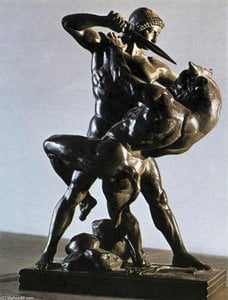
In the heart of the bronze medium lies a raw, unyielding energy that few artists can capture with such visceral precision as Émile Antoine Bourdelle. His sculpture, Heracles, is not merely a depiction of a mythological feat; it is a breathtaking embodiment of tension, movement, and the eternal struggle between civilization and the wild. As one gazes upon this powerful work, the eye is immediately drawn into the kinetic dance of the hero and the beast. The composition centers on the muscular, Herculean figure mid-action, his body a study in anatomical perfection and concentrated force. With his bow drawn and arrow aimed with lethal intent, Heracles represents the pinnacle of human resolve, while the massive lion below serves as a formidable, earthbound shadow of primal danger.
The artistry of Bourdelle shines through the masterful use of lost-wax casting, a technique that allows for an extraordinary level of detail and texture. The bronze surface is far from smooth; instead, it bears the intentional, rugged marks of the sculptor’s hand, creating a play of light and shadow that breathes life into the metal. These visible tool marks and deep undulations provide a sense of volume and realism that makes the musculature appear to pulse with blood. The interplay between the geometric strength of the lion's base and the fluid, rounded forms of the human anatomy creates a sophisticated visual rhythm, bridging the gap between classical stability and modern dynamism.
Rooted deeply in the traditions of Greek mythology, Heracles evokes the legendary triumph over the Nemean Lion, a story that has resonated through centuries of human storytelling. However, Bourdelle transcends mere illustration. Drawing inspiration from the monumental style of ancient Greek art, he utilizes strong, defined lines and a sense of architectural construction to elevate the subject matter. This is not just a scene from a myth; it is a symbolic representation of strength, courage, and the indomitable human spirit facing insurmountable adversity. For the discerning collector or interior designer, this piece offers more than decoration; it provides a focal point of profound emotional weight and historical gravity.
To possess a high-quality reproduction of such a significant work is to invite a sense of timelessness into a space. Whether placed in a grand library, a sophisticated study, or as a centerpiece in a contemporary gallery setting, the sculpture commands attention through its sheer presence. The rich, dark tones of the bronze and the dramatic silhouette of the figures create an atmosphere of intellectual depth and classical elegance. It serves as a constant reminder of the beauty found in struggle and the enduring power of heroic ideals, making it an incomparable addition to any curated collection of fine art.
Émile Antoine Bourdelle buvo 48 metų, kai 1909 m. sukūrė kūrinį „Heracles“. Amžius apskaičiuotas remiantis gimimo metais 1861.
Šviesos ir tamsos kontrastas kūriniame „Heracles“ yra nurodytas kaip Bold. Kontrastas aprašo, kaip stipriai skiriasi šviesios ir tamsios sritys.
Darbai, panašūs į „Heracles“, pateikiami kūrinio Panašūs kūriniai puslapyje.
Born in the historic landscape of Montauban in 1861, Émile Antoine Bourdelle emerged as a titan of French sculpture, a master who bridged the gap between the romantic fluidity of the nineteenth century and the structured rigor of modernism. His journey began not in the grand academies of Paris, but amidst the tactile reality of wood and grain, working as a woodcarver in his father’s cabinet-making shop from the tender age of thirteen. This early immersion in the physical properties of material would later define his sculptural language, imbuing his works with an inherent sense of structural integrity and a profound understanding of volume and mass.
After honing his drawing skills under the guidance of the founder of the Ingres Museum, Bourdelle sought formal training in Toulouse before securing a prestigious scholarship to the École des Beaux-Arts in Paris. It was in the vibrant, competitive atmosphere of the capital that his artistic identity truly began to crystallize. Working within the atelier of Alexandre Falguière and finding inspiration in the studio of Jules Dalou, Bourdelle developed a style that moved away from mere imitation toward a more profound, architectural expression. His 1888 sculptures of Beethoven served as a definitive turning point, showcasing an authoritative command over form that emphasized order, geometric spirit, and a revolutionary approach to construction.
The trajectory of Bourdelle’s career was irrevocably altered when he joined the studio of Auguste Rodin in 1893. While many viewed him simply as an assistant, the relationship was one of profound mutual respect; Rodin himself became a great admirer of Bourdelle's unique ability to infuse monumental figures with both heroic strength and rhythmic grace. This period allowed Bourdelle to absorb the expressive vitality of Rodin while simultaneously carving out his own path toward a more structured, classical aesthetic. He did not merely follow the impressionistic textures of his mentor; instead, he sought a return to the permanence of ancient Greek and Roman archetypes, filtered through a twentieth-century lens.
As a teacher, Bourdelle’s influence was nothing short of monumental. His studio became a crucible for future generations of sculptors, where he imparted a philosophy that prioritized the internal logic of the sculpture over superficial detail. His pedagogical reach ensured that his emphasis on geometry, invention, and monumentality would ripple through the decades, influencing the development of Art Deco and the broader movement toward modern abstraction.
Throughout his later years, Bourdelle’s work became synonymous with the public spirit of France. He received numerous prestigious commissions for war memorials and civic monuments, works that demanded a sense of timelessness and collective memory. His recognition by the French state was profound, marked by his elevation to Knight, Officer, and eventually Commander of the Legion of Honor. Beyond the borders of France, his participation in the landmark 1913 Armory Show in New York introduced his powerful, rhythmic compositions to an international audience, cementing his status as a pioneer of twentieth-century monumental sculpture.
The legacy of Bourdelle is preserved not only in bronze and stone scattered across the globe but also within the very walls of the Musée Bourdelle in Paris. This museum, housed in his former studio, serves as a sanctuary for his creative spirit, allowing visitors to walk through the space where he shaped the modern sculptural landscape. Though he passed away in 1929, his contribution to the evolution of form remains an indelible part of art history, characterized by:
1861 - 1929