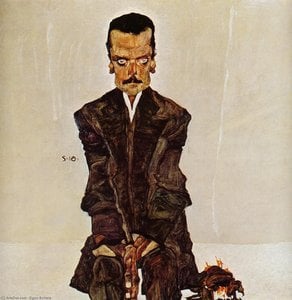
A Study in Vulnerability: Egon Schiele’s “Woman Wrapped in a Blanket”
Egon Schiele's "Woman Wrapped in a Blanket" is not merely a depiction of a nude figure; it’s a raw, intensely personal exploration of the human condition, rendered with the unsettling beauty characteristic of Expressionism. Created using watercolor on paper, this work, often found within the collections of the Prague National Gallery, immediately draws the viewer into a world of shadowed emotion and quiet desperation. The painting's power lies not in idealized form or romantic gesture, but in its unflinching portrayal of vulnerability – a theme deeply rooted in Schiele’s own turbulent life.
The subject herself is presented with an almost unsettling directness. Her body, partially obscured by the enveloping blanket, suggests both concealment and exposure. The long, flowing hair cascading down her back adds to this sense of languid surrender, yet there's a palpable tension in her posture, a subtle rigidity that hints at an inner struggle. Schiele’s masterful use of watercolor allows for delicate washes and layered textures, creating a luminous quality that contrasts sharply with the darker tones employed in the background. The yellow hue of the backdrop feels almost sickly, contributing to the overall atmosphere of unease and hinting at themes of illness and decay – echoes of his father's suffering and the pervasive anxieties of his era.
Decoding the Expressionist Palette
Schiele’s stylistic choices are crucial to understanding the painting’s emotional resonance. He employs bold, decisive lines—a hallmark of Expressionism—to define the figure’s form, emphasizing her contours and creating a sense of immediacy. The deliberate use of red in the lower portion of the composition is particularly striking; it acts as a visual anchor, drawing the eye downwards and intensifying the feeling of confinement or perhaps even impending doom. This isn't simply decorative color; it’s a carefully considered element that amplifies the painting’s psychological depth.
The influence of Gustav Klimt, another prominent figure in Viennese Expressionism, is undeniable. While Klimt often employed opulent ornamentation and shimmering gold, Schiele strips away such embellishments, focusing instead on capturing raw emotion through simplified forms and a restrained palette. However, the underlying currents of symbolism—particularly those relating to mortality and the body—are clearly present, reflecting a shared interest in exploring the darker aspects of human experience.
A Portrait of an Era
"Woman Wrapped in a Blanket" was created during a period of profound social and artistic upheaval in Vienna. The late 19th and early 20th centuries witnessed rapid industrialization, urbanization, and increasing anxieties about modernity. Expressionism emerged as a direct response to these changes, seeking to capture the subjective experience of the world—the feelings of alienation, anxiety, and spiritual emptiness that characterized the era. Schiele’s work is inextricably linked to this broader cultural context, offering a poignant reflection on the psychological landscape of his time.
The painting's themes – isolation, vulnerability, and the confrontation with mortality – continue to resonate powerfully today. It serves as a potent reminder of the fragility of human existence and the enduring power of art to explore the most profound aspects of our shared experience. WahooArt offers meticulously crafted reproductions that faithfully capture the nuances of Schiele’s technique and emotional intensity, allowing you to bring this captivating work into your own space.
Bringing “Woman Wrapped in a Blanket” Home
Whether you are an art enthusiast, a collector seeking to expand your collection, or simply someone drawn to the evocative power of Expressionism, a reproduction of "Woman Wrapped in a Blanket" is a compelling addition to any interior. The delicate watercolor medium and Schiele’s signature style translate beautifully into high-quality reproductions, ensuring that you can appreciate every detail of this emotionally charged masterpiece. Explore our selection of Egon Schiele prints and discover the perfect way to bring this iconic image into your home – a testament to the enduring legacy of one of art's most poignant voices.



 Peržiūrėti realybėje
 Pirkti rankomis tapytą paveikslą
 Pasidalinti
 Dalintis
 Išsamiau

 Atsisiųsti
 Panašūs eksponatai
 Rentgeno nuotrauka
 Automatinė diorama
 Statistika
 Skaityti daugiau






































 Stiklo variantas prieinamas tik pasirinkus dydį iki 110 cm