A Portrait of Shared Vulnerability
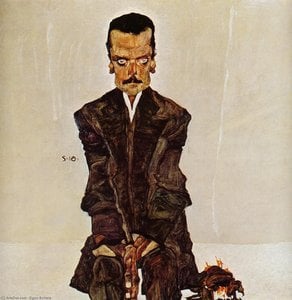
Egon Schiele's "Untitled (7973)," a stark black and white rendering of two figures embraced, immediately commands attention with its raw emotional intensity. The photograph captures a moment of profound intimacy – a man’s face partially obscured by the woman’s, their bodies intertwined in a close, almost desperate embrace. The composition is strikingly direct; there's no attempt at romantic idealization here, but rather an unflinching portrayal of human connection, vulnerability, and perhaps even a touch of melancholy. The figures are positioned centrally, creating a sense of claustrophobia and drawing the viewer into their shared space. It’s a scene that feels both intensely private and universally resonant.
Schiele's signature style is powerfully evident in this work. The elongated limbs, the subtly distorted features, and the almost frantic energy of the lines all contribute to an atmosphere of psychological depth. The lack of color amplifies the emotional weight; it forces us to focus entirely on the forms, textures, and the unspoken narrative conveyed through gesture and expression. This deliberate reduction to monochrome is characteristic of Schiele’s approach – he believed that black and white could capture a greater sense of truth than color ever could.
The Shadow of Loss and Expressionism
To fully appreciate “Untitled (7973),” it's crucial to understand the context of Egon Schiele’s life and artistic development. Born in Vienna in 1890, Schiele’s early years were marked by profound loss – his father succumbed to syphilis when he was just fourteen, a tragedy that deeply impacted him and became a recurring theme in his work. This personal trauma fueled an obsession with mortality, the fragility of existence, and the darker aspects of human experience. His art became a vehicle for exploring these themes, often depicting figures consumed by anxiety, despair, or a sense of impending doom.
Schiele’s style is firmly rooted in Expressionism, a movement that sought to convey subjective emotions rather than objective reality. He rejected the polished surfaces and idealized forms of earlier artistic traditions, opting instead for bold lines, distorted perspectives, and emotionally charged imagery. His work was often considered controversial during his lifetime, with critics accusing him of being morbid and unsettling. However, Schiele remained committed to his unique vision, producing a prolific body of work that continues to fascinate and challenge viewers today.
Symbolism of Touch and the Human Condition
The act of embracing itself is laden with symbolic meaning within this painting. The closeness of the figures suggests a profound connection – perhaps one born out of shared vulnerability or mutual understanding. The partially obscured face of the man hints at a hidden emotion, a secret longing, or even a sense of exposure. It’s a powerful image that speaks to the complexities of human relationships and the ways in which we seek solace and intimacy in times of uncertainty.
Schiele frequently explored themes of sexuality and death in his work, often intertwining them in unsettling yet compelling ways. In “Untitled (7973),” the proximity of the figures evokes a sense of both physical attraction and existential dread. The image can be interpreted as a meditation on the transient nature of life, the inevitability of mortality, and the bittersweet beauty of human connection. It’s a poignant reminder that even in moments of intense intimacy, the shadow of death always lingers nearby.
Reproductions for Art & Interior Design
WahooArt offers meticulously crafted hand-painted reproductions of Egon Schiele's "Untitled (7973)," allowing you to bring this emotionally resonant artwork into your home or office. Our skilled artists faithfully recreate Schiele’s distinctive style, capturing the nuances of his line work and the intensity of his emotional expression. Whether you are an art collector, a design enthusiast, or simply someone seeking a piece that evokes a powerful response, our reproductions provide a beautiful and authentic way to experience this iconic work of art.
问答 (or more naturally for a website heading): Klausimai ir atsakymai
Kas sukūrė „untitled (7973)“?
„untitled (7973)“ priskiriamas Egon Šylė.
Kokio tipo kūrinys yra „untitled (7973)“, autorius – Egon Šylė?
Kataloge „untitled (7973)“, autorius – Egon Šylė yra priskirtas kategorijai WallArt. Ši kategorija padeda rasti panašius kūrinius.
Kas sukūrė „untitled (7973)“ ir kokiu stiliumi tai atlikta?
Egon Šylė sukūrė „untitled (7973)“, priklausantį Expressionism stiliui.



 Peržiūrėti realaus dydžio版
 Pirkti rankomis tapytą reprodukciją
 Siųsti
 Dalintis
 Išsamiau
 Vadovas

 Atsisiųsti
 Panašūs eksponatai
 Rentgeno spindulių nuotrauka
 Diaporama
 Statistika

 Rodyti daugiau






































 Stiklo variantas prieinamas tik pasirinkus dydį iki 110 cm