A Portrait of Quiet Intensity: Unpacking Egon Schiele's "Untitled (7210)"
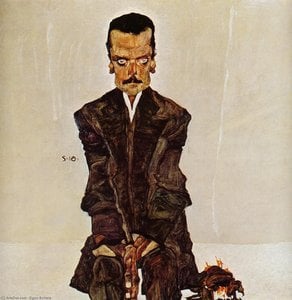
Egon Schiele’s “Untitled (7210),” a haunting depiction of a reclining woman, is more than just a portrait; it’s a visceral exploration of vulnerability, mortality, and the delicate balance between life and death. Painted in 1916, during a period of immense personal turmoil for the artist – marked by the loss of his sister Elvira and the looming shadow of World War I – this work embodies Schiele's signature style: raw emotion rendered with unsettling honesty and an almost brutal directness. The painting immediately draws the viewer in with its subdued palette—a wash of muted browns, greys, and ochres that create a profoundly melancholic atmosphere. The room itself feels claustrophobic, lit by an unseen source that casts long shadows and emphasizes the woman’s isolation.
The central figure lies supine on what appears to be a simple bed or platform, her limbs relaxed yet imbued with a subtle tension. Her head is tilted upwards, as if seeking solace in the heavens, while one hand rests gently on the floor beside her – a gesture of quiet surrender and perhaps a yearning for connection. The lack of overt adornment—she’s entirely nude—heightens the painting's emotional impact, stripping away any pretense and exposing a profound sense of vulnerability. The artist masterfully uses line to define form; Schiele’s characteristic elongated figures and sinuous curves are particularly evident in the woman’s body, contributing to the work’s overall feeling of unease and dynamism.
Expressionist Roots: Exploring Schiele's Psychological Landscape
Schiele was a pivotal figure within the Expressionist movement, rejecting academic conventions in favor of intensely personal and emotionally charged imagery. His art wasn’t about capturing objective reality; it was about conveying inner experience—the anxieties, fears, and desires that simmered beneath the surface of consciousness. This is powerfully evident in “Untitled (7210).” The painting isn't simply a representation of a woman lying down; it’s a visual manifestation of Schiele’s own preoccupation with death, loss, and the fragility of human existence – themes deeply rooted in his biography.
Born into a family marked by illness and tragedy—his father succumbed to syphilis when Egon was just fourteen—Schiele's work is often interpreted as an exploration of these traumatic experiences. The recurring motif of death, frequently depicted with a disturbing frankness, reflects a profound awareness of mortality that permeated his life and art. The painting’s somber mood and the woman’s solitary pose speak to this underlying sense of grief and isolation. It's important to note Schiele’s mentor, Gustav Klimt, who was a figurative painter of the early 20th century, influenced Schiele’s style.
Symbolism and Technique: A Study in Line and Shadow
Schiele’s technique is characterized by bold, expressive lines that seem to vibrate with energy. He employed a method of drawing directly onto the canvas, often using charcoal or crayon, which resulted in a textured surface and a sense of immediacy. The use of shadow is particularly effective in creating depth and atmosphere, further emphasizing the painting's mood of melancholy and introspection. The background figures, though less detailed, contribute to the overall sense of confinement and isolation, suggesting that the woman’s experience is not entirely solitary.
Notice the deliberate distortion of form—the elongated limbs, the slightly skewed perspective—which adds to the painting's unsettling quality. This stylistic choice wasn’t merely decorative; it served to heighten emotional impact and convey a sense of psychological tension. The woman’s posture, with her head tilted upwards, can be interpreted as a gesture of supplication or perhaps a desperate plea for transcendence. The placement of her hand on the floor suggests both vulnerability and a grounding in the physical world.
A Timeless Exploration of Human Condition
“Untitled (7210)” remains a powerfully evocative work, offering a glimpse into the tormented soul of one of art history’s most compelling figures. It's a testament to Schiele’s ability to translate profound emotional experiences onto canvas with remarkable honesty and intensity. Today, reproductions of this painting continue to resonate with viewers, prompting reflection on themes of mortality, vulnerability, and the enduring search for meaning in a world often marked by suffering. WahooArt offers high-quality hand-painted reproductions that capture the essence of Schiele’s masterpiece, allowing you to bring this iconic work into your own space.



 Peržiūrėti realaus dydžio版
 Perjungti į spausdinimą
 Siųsti
 Dalintis
 Išsamiau
 Gidas
Gidas

 Atsisiųsti
 Panašūs eksponatai
 Rentgeno spindulių nuotrauka
 Diaporama
 Statistika

 Rodyti daugiau






































 Stiklo variantas prieinamas tik pasirinkus dydį iki 110 cm