The Raw Pulse of Expressionism
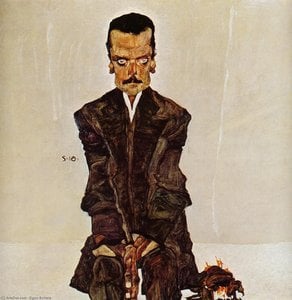
In the hauntingly beautiful Self Portrait with Raised Arms, Back View, Egon Schiele invites us into a private sanctuary of psychological intensity. Painted in 1912, this work serves as a profound window into the artist’s soul, capturing a moment that transcends mere self-observation to become an exploration of human vulnerability. The painting does not seek to flatter the subject through idealized proportions; instead, it embraces a deliberate distortion that characterizes the early twentieth-century Expressionist movement. As we gaze upon the twisted torso and the dynamic, upward reach of the arms, we are met with a sense of profound introspection and an unsettling physicality that vibrates with life and anxiety.
Schiele’s mastery lies in his ability to use the human form as a vessel for internal turmoil. The composition is anchored by a striking visual rhythm, where lines radiate from the central focus of the raised elbow, creating a sense of movement that feels both energetic and restless. For collectors and lovers of fine art, this piece offers more than just a visual spectacle; it provides an emotional resonance that speaks to the universal experience of navigating one's own existence amidst uncertainty.
Technical Mastery and the Language of Line
The technical execution of this masterpiece is a testament to Schiele’s exceptional skill with oil on canvas. He utilizes a textured surface to allow for rich color saturation, where subtle nuances of light and shadow dance across the skin, highlighting the tension between anatomical precision and expressive deformation. The artist’s use of line is particularly noteworthy; his strokes are often jagged and nervous, mirroring the very tremors of the psyche he sought to depict. This meticulous attention to detail—the way light catches a ridge of bone or the subtle shift in flesh tone—juxtaposes beautifully against the broader, more abstract elements of the composition.
For interior designers and curators, this painting offers a sophisticated focal point that commands attention through its complexity. The interplay of light and shadow creates a depth that makes the artwork feel alive within a room, providing a sense of dramatic weight and intellectual depth. It is a piece that rewards prolonged study, revealing new layers of meaning with every glance at its textured surface.
A Legacy of Mortality and Emotion
To understand this work, one must consider the historical context of Schiele’s life and the era of Vienna in which he lived. His early years were marked by significant personal loss, including the death of his father, which deeply instilled in him an obsession with mortality and the fragility of life. This preoccupation is palpable in every stroke of Self Portrait with Raised Arms, Back View. The painting exists in that delicate space between eros andThanatos—between the vitality of movement and the heavy presence of death.
This profound emotional impact makes the work an enduring icon of modernism. It does not merely depict a man; it depicts the very ache of existence. Owning a high-quality reproduction of such a seminal work allows one to bring this powerful dialogue between vulnerability and strength into a contemporary space, serving as a constant reminder of the beauty found within our most raw and unshielded moments.



 Peržiūrėti realaus dydžio版
 Pirkti rankomis tapytą reprodukciją
 Siųsti
 Dalintis
 Išsamiau
 Gidas
Gidas

 Atsisiųsti
 Panašūs eksponatai
 Rentgeno spindulių nuotrauka
 Diaporama
 Statistika

 Rodyti daugiau






































 Stiklo variantas prieinamas tik pasirinkus dydį iki 110 cm