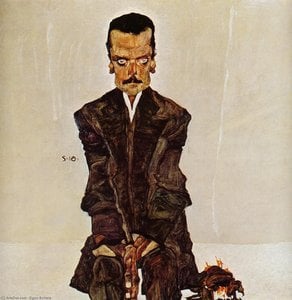
A Portrait of Inner Turmoil: Egon Schiele’s ‘Self Portrait with Hand to Cheek’
Egon Schiele's 'Self Portrait with Hand to Cheek,' painted in 1910, isn’t merely a depiction of an artist gazing at himself; it’s a raw and unsettling exploration of the human psyche. Created during a period of intense personal struggle and artistic experimentation, this watercolour captures the essence of Expressionism – not through idealized beauty or serene landscapes, but through a deliberate distortion of form and a potent infusion of emotion. The painting immediately commands attention with its arresting intensity; Schiele’s gaze is direct, almost confrontational, while his hand, delicately placed on his cheek, suggests both vulnerability and a desperate attempt to shield himself from an unseen torment.
The Language of Distortion: Style and Technique
Schiele's technique in ‘Self Portrait’ is characterized by bold, almost frantic brushstrokes. He eschews smooth surfaces and precise lines, favoring instead a dynamic layering of color that conveys movement and unease. The vibrant red of his shirt – a startling contrast against the muted purple background – pulsates with an energy that feels both passionate and agitated. Notice how he uses short, broken strokes to define the contours of his face, creating a sense of fragmented observation rather than a solid representation. This deliberate distortion isn’t about inaccuracy; it's a crucial element in communicating the artist’s internal state—a feeling of being simultaneously exposed and concealed.
- Watercolour Medium: Schiele favored watercolour for its ability to capture fleeting emotions and create atmospheric effects, lending itself perfectly to his expressive style.
- Dynamic Brushwork: The visible brushstrokes are not merely a stylistic choice but an integral part of the painting’s emotional impact, suggesting a restless spirit.
- Color Palette: The juxtaposition of red and purple is particularly significant, hinting at conflicting passions and spiritual yearnings.
Symbolism Within the Frame: Interpretation and Meaning
Beyond its immediate visual impact, ‘Self Portrait with Hand to Cheek’ is rich in symbolic meaning. The hand on the cheek is a recurring motif in Schiele's work, often interpreted as a gesture of introspection, self-examination, or even a futile attempt to suppress overwhelming emotions. Some scholars suggest it represents a desire for comfort and protection, while others see it as a symbol of confronting one’s own mortality – a theme deeply ingrained in Schiele’s life and art following the early death of his father. The red shirt itself can be read as representing vitality, passion, or even danger, adding another layer to the painting's complex emotional landscape.
A Window into an Era: Historical Context and Legacy
Schiele’s work emerged during a pivotal moment in art history – the dawn of the 20th century and the rise of Expressionism. Artists like Schiele were rejecting the academic traditions of realism and naturalism, seeking instead to express subjective experience and emotional truth. ‘Self Portrait with Hand to Cheek’ stands as a testament to this movement's radical departure from established norms. It reflects the anxieties and uncertainties of a rapidly changing world, mirroring the broader cultural shifts occurring in Europe at the time. The painting’s influence can be seen in subsequent avant-garde movements, paving the way for artists who dared to explore the darker corners of the human psyche. Its resonance continues today, inspiring contemporary artists grappling with themes of identity, vulnerability, and the complexities of modern existence.
WahooArt offers meticulously crafted hand-painted reproductions of ‘Self Portrait with Hand to Cheek,’ allowing you to experience the raw emotion and artistic brilliance of this iconic work in stunning detail. Each reproduction is created by skilled artists using traditional techniques, ensuring an authentic representation of Schiele’s vision. Consider adding this powerful piece to your collection or incorporating its evocative imagery into your interior design – a testament to the enduring legacy of Egon Schiele.



 Peržiūrėti realaus dydžio版
 Pirkti rankomis tapytą reprodukciją
 Siųsti
 Dalintis
 Išsamiau
 Gidas
Gidas

 Atsisiųsti
 Panašūs eksponatai
 Rentgeno spindulių nuotrauka
 Diaporama
 Statistika

 Rodyti daugiau






































 Stiklo variantas prieinamas tik pasirinkus dydį iki 110 cm